BIEK's New Grading System: What Ungraded Below 40% Means for Students

The Board of Intermediate Education Karachi (BIEK) has introduced a grading change that every Intermediate student needs to understand: under the new grading system, a candidate who secures less than 40 percent marks in any paper is declared ungraded in that paper and must reappear in it, subject to eligibility requirements. The change came with the Intermediate Part-I Science Pre-Engineering Group result announced on 2 October 2026, in which 15,044 candidates registered, 14,683 appeared, and 6,310 passed all six papers. This article explains what ungraded means, how it differs from a simple fail, who must reappear, and what students should do if any of their papers is marked ungraded.
What BIEK Announced on 2 October 2026
BIEK announced the Intermediate Part-I Science Pre-Engineering Group result on 2 October 2026. In that result, 15,044 candidates registered, 14,683 appeared, and 6,310 passed all six papers. Those figures describe the Pre-Engineering Group result that carried the new grading system into public view. They do not describe any other group or year, and students in other groups should check their own board announcements rather than applying these figures to themselves. The key point for every Intermediate student is the rule itself, because it now governs how a low paper mark is recorded and what happens next.
The new grading system was introduced under decisions of the Inter Board Coordination Commission (IBCC) and the Sindh Universities and Boards Department. That matters because it tells students that the change is part of a wider grading reform, not a one-off decision by a single board. When a rule comes from the coordination and department level, it is applied across boards that follow it, and students should expect it to appear in future results as well. Always confirm the rule as it applies to your own group and year through your board's official announcement, because the detail of eligibility and reappearance is set by the board.
- BIEK announced the Inter Part-I Science Pre-Engineering result on 2 October 2026
- Registered: 15,044 candidates; appeared: 14,683; passed all six papers: 6,310
- New rule: below 40 percent in any paper means ungraded in that paper
- System introduced per IBCC and Sindh Universities and Boards Department decisions
What Ungraded Means in Plain Words
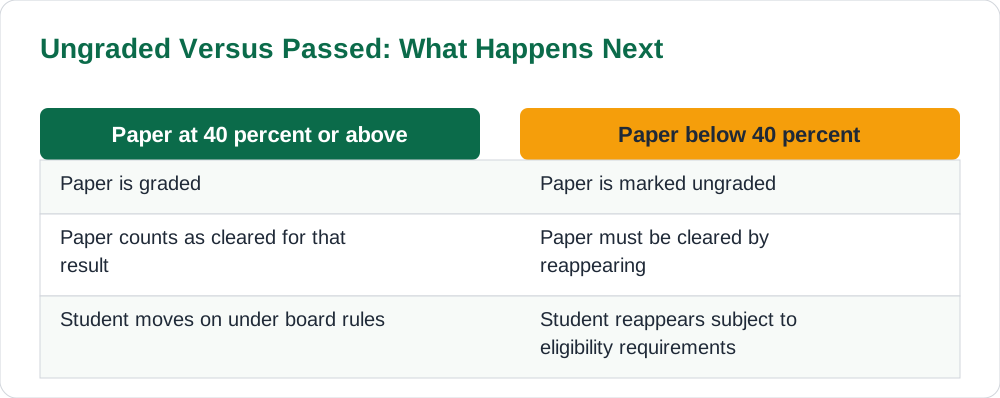
Ungraded means that the paper does not receive a grade at all. In the old way of thinking, a student who scored low in a paper might still receive a low grade for it. Under the new system, a paper below 40 percent is not given a grade, and the student must reappear in that paper, subject to eligibility requirements. The word ungraded is therefore not a softer way of saying failed. It is a specific status with a specific consequence: the paper is incomplete until the student reappears and reaches the required standard.
This matters for how you read your result. If your result shows ungraded against a paper, do not treat it as a minor remark to ignore. It means that paper is still open and must be cleared by reappearing. If your result shows that you passed all six papers, as 6,310 candidates did in the Pre-Engineering Part-I result, then the ungraded rule did not block you in that result. Either way, read your result paper by paper, and ask your college or a teacher to explain any status word you do not understand before you make a decision about reappearance or promotion.
- Ungraded means the paper receives no grade at all
- Below 40 percent in any paper triggers ungraded status for that paper
- An ungraded paper must be cleared by reappearing, subject to eligibility
- Read your result paper by paper, not only as a total
How Ungraded Differs From a Simple Fail
Students often ask whether ungraded is just another word for failed. The honest answer is that the two ideas overlap but are not identical. A fail says you did not pass the paper. Ungraded says the paper is not graded at all because the mark fell below the threshold for a grade, and the paper must be taken again. In practice, the consequence is similar: you cannot treat the paper as cleared. But the language matters, because it tells you how the board records the paper and what the next step is. You reappear in the ungraded paper under the board's eligibility rules, rather than carrying a low grade forward.
The practical lesson is to stop thinking of 35 or 38 percent as nearly passing. Under the new system, a mark below 40 percent in a paper does not earn a low grade that you can carry forward. It earns an ungraded status that must be cleared. That raises the stakes for every paper, including the ones students consider minor. A student who focuses only on strong subjects and neglects one weak subject can find that the weak subject blocks progress, even if the strong subjects went well. Balanced preparation across all papers is now more important than ever.
- Fail: you did not pass the paper
- Ungraded: the paper receives no grade and must be retaken
- Below 40 percent does not earn a low grade to carry forward
- Balanced preparation across all papers matters more than ever
What to Do If One of Your Papers Is Ungraded
If your result shows an ungraded paper, stay calm and act in order. First, confirm the status with your college or a teacher, and make sure you are reading the result correctly. Second, find out the board's eligibility requirements and the process for reappearing in that paper, including the form, the fee, and the deadline that apply to you. Deadlines matter, because a missed deadline can delay your clearance by a full examination cycle. Do not rely on a friend's memory of the process. Read the board's official announcement or ask your college office for the current procedure.
Third, build a focused revision plan for that paper alone. An ungraded mark usually points to specific gaps: a chapter never properly understood, a paper attempted without time management, or a subject neglected in favour of stronger ones. Identify the chapters that cost you the most marks, and revise them using your STBB textbooks and Solved Notes. Solve past-paper questions for that subject under timed conditions, and ask a teacher to mark one practice paper so you learn exactly where marks were lost. A single ungraded paper is a setback, not a verdict, and students clear it every year with focused preparation.
- Confirm the ungraded status with your college or a teacher
- Find the eligibility rules, form, fee, and deadline for reappearing
- Do not rely on a friend's memory; read the official procedure
- Build a focused revision plan for the ungraded paper alone
Planning Ahead Under the New Grading System
The new grading system rewards students who prepare evenly across all subjects. If you are in Intermediate now, audit your own preparation honestly. List every paper you will sit, and mark each one as strong, average, or weak. Then give your weak papers more time, not less. A common trap is to spend all revision time on favourite subjects because they feel rewarding, while the weakest subject quietly falls below the 40 percent line. Reverse that habit. Put your weakest paper first in the day, when your mind is freshest, and use active recall and past-paper practice to close the gap.
Parents and teachers can help by watching for the same pattern. If a student is strong in five papers and weak in one, the weak paper deserves the most attention, not the least. A short daily slot on the weak subject, plus one timed practice paper each week, will usually lift it above the threshold. For more on steady habits, see our study tips collection and our guide on what to do after the Matric Science result, which explains how to plan a stream and subject combination that plays to your strengths without hiding your weaknesses.
- Audit every paper as strong, average, or weak
- Give weak papers more revision time, not less
- Study the weakest paper first in the day, when you are freshest
- One timed practice paper per week exposes gaps early
AI Help: Muse AI
Muse AI is Meta's personal AI assistant, and it can help you understand the new grading system by explaining what ungraded means in simple words, or by quizzing you on the chapters of a paper you need to reappear in.
Join Muse with invite code LTGSWD — in the Muse app, go to Settings > Redeem token and enter the code.
Disclosure: LTGSWD is the author's Muse invite code.
Muse AI does not give official STBB answers — always verify against your Sindh Textbook Board book and your teacher.
5 key points you must know
- BIEK announced the Inter Part-I Science Pre-Engineering result on 2 October 2026: 15,044 registered, 14,683 appeared, 6,310 passed all six papers.
- Under the new grading system, below 40 percent in any paper means ungraded in that paper.
- An ungraded paper receives no grade and must be cleared by reappearing, subject to eligibility.
- The system was introduced per IBCC and Sindh Universities and Boards Department decisions.
- Balanced preparation across all papers matters more than ever under the new rule.
Frequently asked questions
What does ungraded mean in BIEK's new grading system?
It means the paper receives no grade at all because the mark fell below 40 percent. The student must reappear in that paper, subject to eligibility requirements.
Is ungraded the same as failed?
The consequence is similar, because the paper is not cleared, but the status is specific: the paper is not graded and must be retaken under the board's eligibility rules, rather than carrying a low grade forward.
What were the Pre-Engineering Part-I result figures?
BIEK announced on 2 October 2026 that 15,044 candidates registered, 14,683 appeared, and 6,310 passed all six papers in the Inter Part-I Science Pre-Engineering Group.
Who introduced the new grading system?
The system was introduced under decisions of the Inter Board Coordination Commission (IBCC) and the Sindh Universities and Boards Department.
What should I do if one of my papers is ungraded?
Confirm the status with your college, find the eligibility rules, form, fee, and deadline for reappearing, and build a focused revision plan for that paper using your STBB textbooks.
Solved notes — preview free
These guides work best with the solved exercises. Preview the solved notes free on this website — 119 solved notes for Classes 6–10 in Sindhi, Urdu, English and Arabic medium. Or browse the full solved notes catalogue for your class and medium. New solved notes are added regularly — check the catalogue for coming-soon books.