BIEK Pre-Engineering Result Lessons: What the 40% Ungraded Rule Means for You

The Board of Intermediate Education Karachi announced the HSC Part-I Science Pre-Engineering Group Annual Examination 2026 result on 2 October 2026, and with it came a grading change every Karachi inter student needs to understand. Under the new system, decided by the Inter Board Coordination Commission together with the Sindh Universities and Boards Department, scoring under 40 percent in any paper means that paper is recorded as ungraded, not passed. The result figures show why this matters: 15,044 students registered, 14,683 appeared, and 6,310 passed all six papers, while 8,373 did not clear all six. This article explains the numbers honestly, unpacks the ungraded rule in plain language, and sets out exactly what students with ungraded papers should do next, without rumours and without invented dates.
The 2 October 2026 Result in Numbers
Controller of Examinations Zarina Rashid announced the result with a gazette published the same day, college-wise across 129 pages, which gives students and colleges a detailed record to check. Of the 15,044 registered candidates, 14,683 appeared for the examination, and 6,310 passed all six papers. The remaining picture is broken down paper by paper: 79 students passed five papers, 747 passed four, 1,827 passed three, 1,864 passed two and 1,783 passed one. Adding those groups together gives 8,373 students who did not clear all six papers, which is more than half of those who appeared. These are not abstract statistics; they represent thousands of Karachi students who now need a clear plan for the papers they still owe.
Reading the breakdown helps you place yourself accurately instead of guessing. If you passed five papers, you have one paper to clear, and your preparation can be narrow and intense. If you passed three or fewer, you need a broader plan that rebuilds several subjects over a longer period, and you should discuss your timetable honestly with your teachers. Either way, the first step is the same: obtain your detailed result, identify each paper's status, and separate papers you narrowly missed from papers where your understanding was weak. Colleges receive the gazette, so your college office can help you verify any detail that looks wrong. For general revision structure, the solved notes and the blog guides offer study plans you can adapt to your own paper count.
What Ungraded Actually Means Under the New Rule
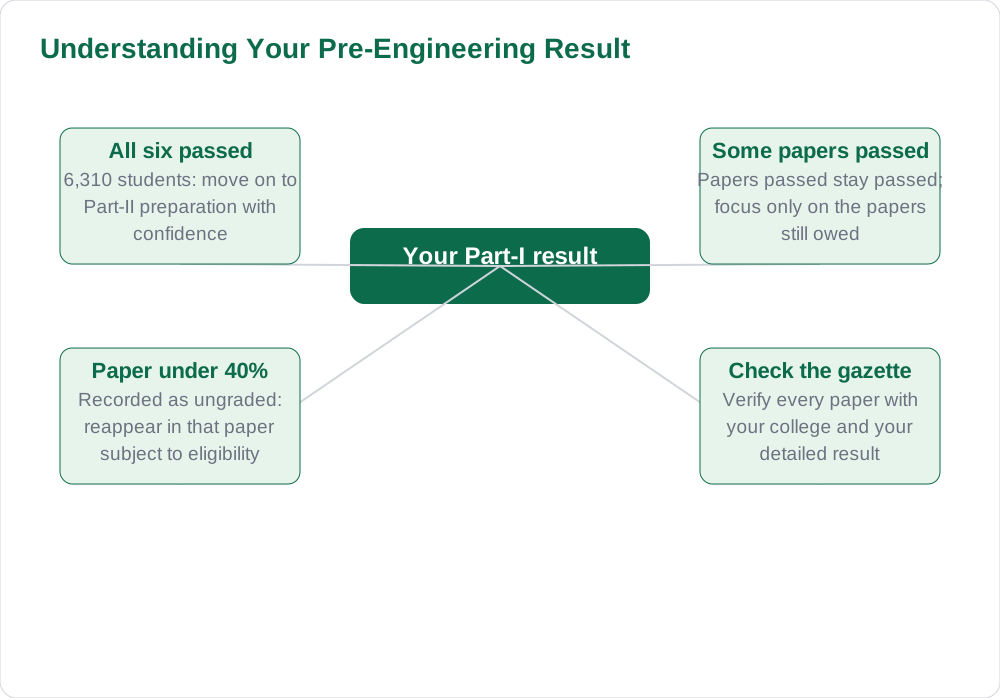
Under the new grading system, a paper in which a student scores under 40 percent is recorded as ungraded rather than passed, and the candidate reappears in that paper subject to eligibility. The word ungraded can sound alarming, but its practical meaning is straightforward: that paper does not count toward completion until you clear it, and you must reappear in it under the board's rules. It does not mean your other passed papers disappear, and it does not mean you have failed your whole year in the way students sometimes fear. Your passed papers remain passed, and your task is to focus on the ungraded papers one by one. Think of ungraded as an instruction, not a label: this paper needs to be done again, properly.
The rule also changes how students should think about borderline preparation. In the past, a student might have aimed simply to scrape through a weak subject; under a 40 percent threshold, scraping through means genuinely reaching that standard in every paper, not just on average across subjects. A strong performance in physics cannot rescue an ungraded chemistry paper, because each paper stands on its own. That is why balanced preparation matters more than ever, and why neglecting your weakest subject is now riskier than before. When you revise, test yourself honestly against the 40 percent line: can you answer enough of a past paper, under time, to clear it comfortably? If not, that subject needs more hours, not more hope.
What Ungraded Students Do Next, Step by Step
Start by confirming your exact position: list every paper, its status, and the marks or grade recorded, and keep a copy of your result for your records. Next, speak to your college teachers about the reappearance process, including eligibility conditions, the examination session in which you can reappear, and any form or fee your college or the board requires. The snapshot for this article does not state a reappearance date, so do not trust a date passed on by friends or social media; confirm the session and procedure from your college or from the board's official information. While you wait for procedural details, begin studying immediately, because the subject matter does not change and early preparation is always rewarded.
Plan your study around the number of ungraded papers you carry. One paper deserves deep, daily work until you can solve its past papers comfortably. Two or three papers need a weekly timetable that rotates subjects so none is neglected for a week at a time. More than three papers may need a longer horizon and a conversation with your teachers about priorities, since trying to fix everything at once often fixes nothing. In every case, use your textbook as the base, solve past papers under time, and keep an error notebook where you record every mistake and the correct method. Students who track their errors improve faster than students who simply reread chapters, because errors show exactly where marks are lost.
- List every paper and its status from your detailed result before planning anything
- Confirm reappearance eligibility, session and procedure from your college or the board
- Do not trust reappearance dates from social media; verify them officially
- Keep an error notebook and re-solve every mistake until it is fixed
- Test yourself against the 40 percent line with timed past papers
Study Tactics That Lift a Paper Above 40 Percent
For mathematics, the path above 40 percent is practice, not reading. Solve every type of question in each chapter, learn the standard methods, and practise until you can complete a past paper within the time limit. Keep a formula sheet and test yourself on it daily, because forgotten formulas lose easy marks. For physics, combine numerical practice with clear theory answers and labelled diagrams, and always include units and steps, since working earns marks even when a final number is wrong. For chemistry, write reactions and definitions by hand, practise numericals separately from theory, and revise the chapters that carry the most marks first without ignoring the rest.
English and other compulsory subjects deserve the same seriousness, because an ungraded compulsory paper blocks completion just as surely as a science paper. Practise essay structure, comprehension technique and grammar rules, and write full answers regularly so your speed and presentation improve. In every subject, attempt past papers from recent years, mark them strictly, and spend as much time on corrections as on solving. If a chapter repeatedly defeats you, ask a teacher or a stronger classmate to explain it, rather than skipping it again. Skipped chapters are how students stay below 40 percent; confronted chapters are how they climb above it. The books page can help you return to the right textbook for each subject.
Looking Ahead to Part-II Without Losing Ground
Clearing ungraded papers and preparing for Part-II must happen together, not one after the other, because Part-II preparation waits for no one. Keep attending your Part-II classes, keep up with new topics, and treat your ungraded papers as an additional study block in your week rather than a reason to pause everything else. Many Part-II topics build directly on Part-I foundations, so repairing a Part-I weakness often improves your Part-II understanding at the same time, especially in mathematics and physics. Students who see reappearance as revision, rather than punishment, often find their Part-II work becomes easier once the old gaps close.
Protect your confidence as carefully as your timetable. An ungraded paper is a common outcome in this result, shared by thousands of Karachi students, and it says nothing about your intelligence or your future. What matters is the response: a steady plan, honest practice, and papers cleared one by one. Stay in close contact with your teachers, keep your family informed about your plan so they can support it, and avoid comparing your progress daily with classmates, since everyone carries a different paper load. Clear your papers, keep your Part-II studies moving, and you will reach the end of inter with a complete result earned through work you can be proud of.
AI Help: Muse AI
Muse AI is Meta's personal AI assistant, and it can help you understand the ungraded rule by explaining the 40 percent threshold in simple words, or by turning a weak chapter into short practice questions you can test yourself on.
Join Muse with invite code LTGSWD — in the Muse app, go to Settings > Redeem token and enter the code.
Disclosure: LTGSWD is the author's Muse invite code.
Muse AI does not give official STBB answers — always verify against your Sindh Textbook Board book and your teacher.
4 key points you must know
- BIEK announced the Pre-Engineering Part-I result on 2 October 2026: 15,044 registered, 14,683 appeared, 6,310 passed all six papers
- Under the new rule, under 40 percent in any paper means that paper is ungraded, not passed
- Passed papers stay passed; ungraded students reappear only in the papers they owe, subject to eligibility
- Balanced preparation matters now: a strong subject cannot rescue an ungraded paper in another subject
Frequently asked questions
What does ungraded mean in the BIEK Pre-Engineering result?
Under the new grading system, scoring under 40 percent in a paper means that paper is recorded as ungraded, not passed. The candidate reappears in that paper subject to eligibility, while papers already passed remain passed.
How many students passed all six Pre-Engineering papers?
Of 14,683 students who appeared, 6,310 passed all six papers. A further 8,373 did not clear all six, including students who passed five, four, three, two or one paper.
What should I do first if I have an ungraded paper?
List every paper and its status from your detailed result, then speak to your college teachers about the reappearance process, eligibility and session. Begin studying the ungraded subject immediately and do not rely on dates shared on social media.
Can a high score in one subject compensate for an ungraded paper?
No. Each paper stands on its own under the 40 percent rule, so a strong physics result cannot rescue an ungraded chemistry paper. Every paper must individually reach the threshold.
Solved notes — preview free
These guides work best with the solved exercises. Preview the solved notes free on this website — 119 solved notes for Classes 6–10 in Sindhi, Urdu, English and Arabic medium. Or browse the full solved notes catalogue for your class and medium. New solved notes are added regularly — check the catalogue for coming-soon books.