Photosynthesis: Process and Steps for Pupils
This guide covers photosynthesis process steps pupils learn in biology and explains how green plants make their own food using sunlight, water, and carbon dioxide. The word photosynthesis means putting together with light. In this process, a plant takes in light energy, water from its roots, and carbon dioxide from the air, and it produces glucose, a type of sugar that stores energy, plus oxygen, which is released into the air. This single process feeds almost all life on Earth, because animals and people depend directly or indirectly on plants for food and oxygen. This guide traces each step in order, shows you how to label a diagram, and gives you simple ways to remember the word equation.
What Photosynthesis Needs
Photosynthesis needs four things: sunlight, chlorophyll, water, and carbon dioxide. Sunlight provides the energy. Chlorophyll is the green pigment inside chloroplasts that traps that energy. Water comes from the soil through the roots and travels up to the leaves. Carbon dioxide enters the leaf from the air through tiny openings called stomata. If any one of these is missing, photosynthesis slows down or stops. That is why plants grow best with enough light, water, and fresh air.
Leaves are the main site of photosynthesis because they are broad, thin, and full of chloroplasts. The broad surface catches sunlight, and the thin shape lets gases move in and out quickly. Veins carry water to the leaf and carry glucose away to other parts of the plant. When you draw a leaf for this topic, label the chloroplasts, stomata, veins, and the direction of water and gases. A clear labelled diagram often earns extra marks. You can compare this with cell ideas in Cell Structure and Functions Explained Simply.
The Word Equation and Chemical Idea
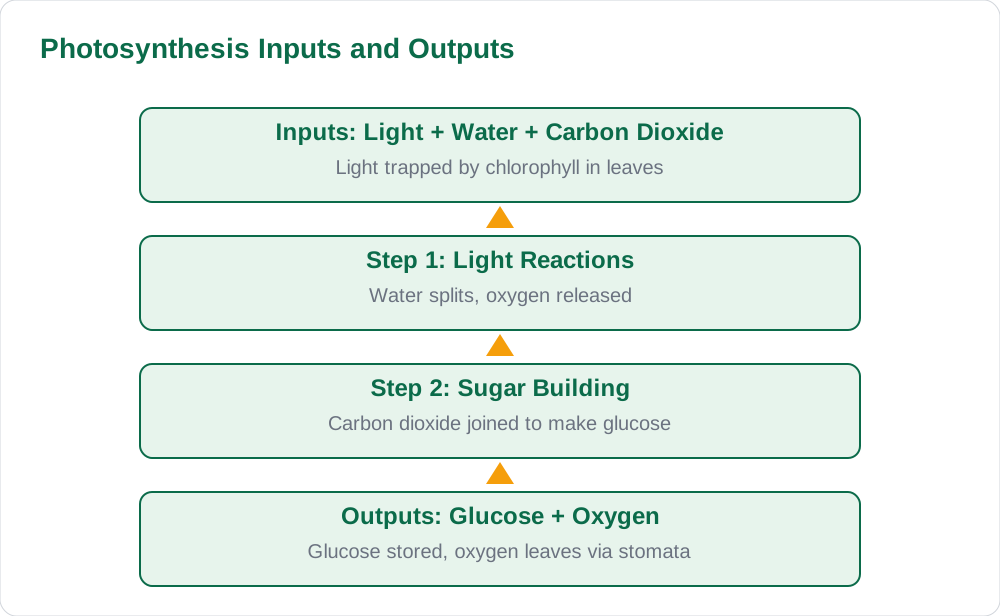
The word equation for photosynthesis is: carbon dioxide plus water, using light energy and chlorophyll, produces glucose plus oxygen. Pupils in Classes 6 to 8 usually learn the word equation first. In higher classes you also meet the balanced chemical equation with symbols. Do not worry if the symbols feel hard at first. Focus on understanding that carbon dioxide and water are the raw materials, and glucose and oxygen are the products. Glucose is the food that stores energy, and oxygen is the useful gas released.
A helpful way to check your understanding is to cover the equation and rebuild it from memory. Ask yourself: what are the two inputs from the environment? What is the energy source? What does the plant make? What does it release? If you can answer all four, you understand the core idea. Many exam questions ask you to write the word equation, label the inputs and outputs, or explain why a plant kept in darkness stops making starch. Each of those questions tests the same equation.
Step by Step Through the Process
Step one is light capture. Chlorophyll in the chloroplasts absorbs sunlight, mainly in the blue and red parts of light. This trapped energy starts the chemical work. Step two is water splitting. Water molecules are split using light energy, releasing oxygen, hydrogen, and energy. The oxygen leaves the leaf through the stomata, which is why plants add oxygen to the air. The hydrogen and energy are kept for the next step. You can think of this as the plant collecting building energy from light and water.
Step three is sugar building. The plant uses the hydrogen and energy from step two to join carbon dioxide molecules together into glucose. This step does not need light directly, but it depends on the energy captured earlier. The glucose may be used at once for energy, turned into starch for storage, or used to build new plant parts such as cellulose in cell walls. When pupils test a leaf for starch, they are checking whether photosynthesis has happened. A leaf kept in light turns blue-black with iodine, while a leaf kept in darkness does not.
Factors That Affect Photosynthesis
Three main factors change the rate of photosynthesis: light intensity, carbon dioxide concentration, and temperature. When light is dim, the rate is low because there is not enough energy. As light increases, the rate rises until another factor becomes limiting. Similarly, more carbon dioxide usually increases the rate up to a point, because there is more raw material to build glucose. Temperature matters because the enzymes that control photosynthesis work best at a moderate temperature. Too cold and they work slowly; too hot and they can be damaged.
In a school experiment you might change one factor at a time. For example, you could place one plant in bright light and another in shade, keeping water and temperature the same, and compare starch after a day. Always change only one variable so your result is fair. Record your observations in a table and write a short conclusion that links the result to the word equation. This habit of fair testing is useful across all biology practicals, including Food Tests and Nutrients: A Pupil Guide.
Why Photosynthesis Matters and How to Revise
Photosynthesis matters for three big reasons. First, it produces almost all the food in ecosystems: plants make glucose, animals eat plants or eat animals that ate plants, and people depend on crops. Second, it keeps oxygen in the air. Third, it reduces carbon dioxide, which helps balance the atmosphere. When you study ecosystems, remember that producers are organisms that make their own food by photosynthesis. That link connects this topic to Energy Flow in Ecosystems for Biology Pupils.
To revise, practise three tasks: write the word equation from memory, draw and label a chloroplast and a leaf, and explain each step in two sentences. Then answer questions such as why a plant in a dark cupboard does not grow well, or why deforestation affects oxygen and carbon dioxide. Use the solved notes on Solved Notes to check model answers and the book list on Books to find your class book.
AI Help: Muse AI
Muse AI is Meta's personal AI assistant, and it can help with photosynthesis revision by quizzing you on the word equation and each step in order until you can write it from memory. Muse AI does not give official Sindh Textbook Board answers — always verify against your Sindh Textbook Board book and your teacher.
Join Muse with invite code LTGSWD — in the Muse app, go to Settings > Redeem token and enter the code.
Disclosure: LTGSWD is the author's Muse invite code.
5 key points you must know
- Photosynthesis uses sunlight, chlorophyll, water, and carbon dioxide to make glucose and oxygen.
- The word equation is carbon dioxide plus water produces glucose plus oxygen.
- Chlorophyll in chloroplasts traps light energy in leaves.
- Oxygen is released when water is split using light energy.
- Light, carbon dioxide, and temperature affect the rate of photosynthesis.
Frequently asked questions
What is the word equation for photosynthesis?
Carbon dioxide plus water, using light energy and chlorophyll, produces glucose plus oxygen.
Where does photosynthesis take place?
Mainly in the leaves, inside chloroplasts that contain chlorophyll.
Why does a leaf kept in darkness not make starch?
Without light, the plant cannot trap energy to split water and build glucose, so no new starch is stored.
What enters and leaves through stomata?
Carbon dioxide enters the leaf and oxygen leaves through the stomata, and water vapour can also leave.
Solved notes — preview free
These guides work best with the solved exercises. Preview the solved notes free on this website — 119 solved notes for Classes 6–10 in Sindhi, Urdu, English and Arabic medium. Or browse the full solved notes catalogue for your class and medium. New solved notes are added regularly — check the catalogue for coming-soon books.