BISE Lahore On-Screen Marking: What Changes for Inter Students
BISE Lahore has begun moving to on-screen marking, under letter No. 512-RCO/BISE LHR dated 7 October 2026, and the change matters for every intermediate student in the Lahore board's jurisdiction, even though most students will never attend a workshop or see the new system directly. On-screen marking means answer sheets are scanned and examiners mark them on a computer screen instead of on paper, and Lahore is starting with four intermediate subjects only: Chemistry, Biology, Computer Science and Statistics. Matric papers are not included in this first step, and the board has not yet named the first examination to be marked on screen. This guide explains what the change actually means, who is involved, what stays the same, and what students in the four subjects should and should not worry about.
What On-Screen Marking Actually Means
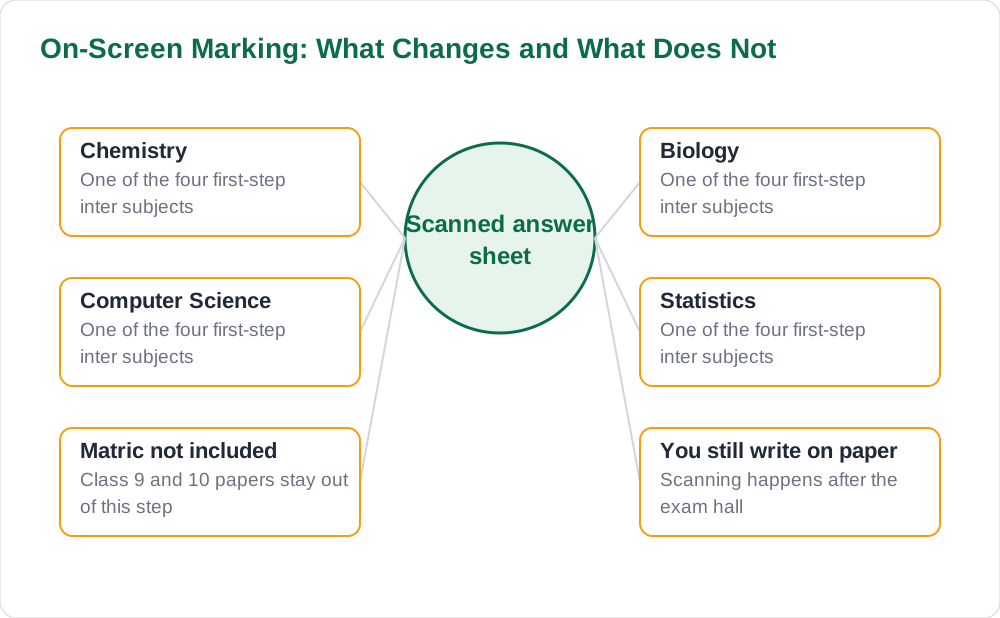
On-screen marking changes how examiners handle your answer sheet, not how you write it. You will still sit in an examination hall, receive a paper answer booklet, and write your answers by hand exactly as before, because the change happens after your booklet leaves the hall. Your booklet is scanned into a digital image, and examiners then view that image on a computer screen, award marks on screen, and record totals digitally. For students, the examination itself feels the same; the difference lies in the marking room, where the board gains tighter control over how marks are recorded, checked and totalled.
That distinction is worth holding on to, because it answers the most common student worry, which is whether they need to learn a new way of answering. You do not. Your job remains what it has always been: write clearly, show your working, label your diagrams, and answer every part of every question, because a scanned page rewards legible, well-organised writing just as a paper page does. If anything, on-screen marking raises the value of clear handwriting and clean layout, since an examiner reading a scanned image benefits even more from answers that are easy to follow. Prepare exactly as you would for any board paper, and let the board handle the change in how marking is done. For general board news and study guides, see the blog.
The Four Subjects in the First Step
Lahore's first step covers four intermediate subjects only: Chemistry, Biology, Computer Science and Statistics. These are the subjects named in the board's 7 October 2026 letter, and no other intermediate subject is included at this stage. If your subject is not one of these four, this change does not affect your papers yet, and you should continue preparing under the existing marking arrangements without worrying about a system that does not apply to you. The board has chosen a limited first step deliberately, so that the new process can be tested and refined on a manageable set of subjects before any wider rollout is considered.
Equally important is what the letter does not include: matric papers are not part of this first step, so Class 9 and 10 students under BISE Lahore are unaffected for now. Students sometimes hear that marking is going digital and assume every paper changes at once, but the letter is specific and limited, and that specificity is good news for everyone else. A limited rollout means the board can train examiners, fix scanning and software problems, and learn from the first subjects before expanding, rather than risking disruption across all papers at once. If you study one of the four subjects, read the rest of this guide carefully; if you do not, you can set the topic aside until the board announces a further step.
Who Goes to the Workshops — and Who Does Not
The letter arranges workshops to prepare colleges for the new system, and the invitation list is narrow by design. Each college sends one student per subject, chosen by the college, together with the principal and heads of department, which means a college offering all four subjects sends four students in total, one for each subject. Those students attend as their college's representatives, learn how the on-screen process works, and carry that understanding back to their classmates. The workshops are preparation for the system, not a new examination, and attending one does not change a student's own marks or standing.
Every other student does not attend, and that is not a disadvantage or an oversight. The workshops exist to prepare colleges and their representatives, not to teach the whole student body a new skill, because students do not need a new skill: they still write on paper in the hall. If you are not chosen, nothing is expected of you beyond your normal preparation, and you should not worry that classmates who attend have gained an advantage in marking. If you are chosen, treat it as a responsibility to your college: attend carefully, ask questions about anything unclear, and share what you learn accurately with your class, without exaggerating the change into something it is not.
Which Exam Comes First? What We Know and Do Not Know
One question the letter leaves open is which examination will be the first to be marked on screen, and honest reporting requires saying that the board has not named it. The next intermediate examination on the calendar is the second annual examination beginning on 3 November 2026, which makes it the natural candidate in students' minds, but natural does not mean confirmed, and no student should treat the second annual as the first on-screen examination until the board says so. The gap between a reasonable guess and a board announcement is exactly where rumours grow, and this guide will not fill it with a claim the board has not made.
What students can do is watch for the board's own announcement through their college, which will receive official word before any website or chat group. If the board names the second annual examination, students in the four subjects will know in time to prepare with confidence, and if it names a later examination, nothing is lost by having prepared normally. Either way, the correct preparation is identical: study the syllabus, practise past papers, write clearly and answer completely. A marking system changes how marks are recorded, not what knowledge earns them, so the student who prepares well is ready for either system on any date the board chooses.
Rechecking Rules Stay Put Until the Board Says Otherwise
The final point students should hold on to is that existing HSSC rechecking rules still apply until the board says otherwise. On-screen marking does not silently abolish rechecking, change its window, or alter its fee, and students who need rechecking for the 22 October 2026 result should follow the current procedure for their board without waiting for the new marking system to clarify itself. The rechecking window, counted as 15 days from 22 October, runs to about 6 November 2026, and if your board prints a different date, follow your board's date. A change in marking technology and a change in rechecking rules are two separate decisions, and only an explicit board notice can change the second.
That stability is reassuring, and it points to a general habit worth building: treat every board change as limited to what the board's letter actually says. The 7 October letter says four subjects, workshops for college representatives, and a move to on-screen marking; it does not say new syllabuses, new paper patterns, new rechecking rules or new examination dates, and none of those should be assumed. Students who read board letters this way, narrowly and literally, protect themselves from the exaggerated versions that circulate online, and they focus their energy on the one thing that has not changed at all: learning the subject well enough to earn the marks. For the current rechecking process, see rechecking versus retotalling, and for subject revision, see the books section.
AI Help: Muse AI
Muse AI is Meta's personal AI assistant, and it can explain new board procedures in plain language without the jargon of official letters.
For this article's topic, you can ask Muse AI to summarise what on-screen marking means for your own subject, or to help you list questions to ask your teacher about the change.
Join Muse with invite code LTGSWD — in the Muse app, go to Settings > Redeem token and enter the code.
Disclosure: LTGSWD is the author's Muse invite code.
Muse AI does not give official STBB answers — always verify against your Sindh Textbook Board book and your teacher.
5 key points you must know
- BISE Lahore letter No. 512-RCO/BISE LHR dated 7 October 2026 starts on-screen marking.
- The first step covers four inter subjects only: Chemistry, Biology, Computer Science, Statistics.
- Matric papers are not included in this first step.
- Each college sends one student per subject, chosen by the college, plus principal and heads of department.
- The board has not named the first exam to be marked on screen; existing rechecking rules still apply.
Frequently asked questions
What is on-screen marking?
Answer sheets are scanned after the examination and examiners mark the scanned image on a computer screen, instead of marking the paper booklet directly.
Which subjects are included in BISE Lahore's first step?
Four intermediate subjects only: Chemistry, Biology, Computer Science and Statistics. No other subject is included at this stage.
Are matric papers marked on screen too?
No. Matric papers are not included in this first step, so Class 9 and 10 students are unaffected for now.
Do all students attend the on-screen marking workshops?
No. Each college sends one student per subject, chosen by the college, plus the principal and heads of department. Other students do not attend.
Has the board named the first exam to be marked on screen?
No. The board has not named the first exam. The next intermediate exam is the second annual from 3 November 2026, but that does not mean it is confirmed as the first on-screen exam.
Solved notes — preview free
These guides work best with the solved exercises. Preview the solved notes free on this website — 119 solved notes for Classes 6–10 in Sindhi, Urdu, English and Arabic medium. Or browse the full solved notes catalogue for your class and medium. New solved notes are added regularly — check the catalogue for coming-soon books.