Filling a Board Answer Sheet Correctly
The answer sheet is the only record of a pupil's work that reaches the examiner, so filling it in correctly matters as much as knowing the answers. Every year, markers and board offices deal with sheets where the roll number is wrong, the subject is missing, or the question numbers do not match the answers, and each of these errors costs time and can cost marks. This guide walks through the fields a board answer sheet usually asks for, the order to fill them in, and the small checks that prevent the most common mistakes. Layouts differ between boards, so always follow the instructions printed on your own sheet and given by your invigilator, and confirm anything unusual with your school rather than guessing.
Before You Write a Single Answer
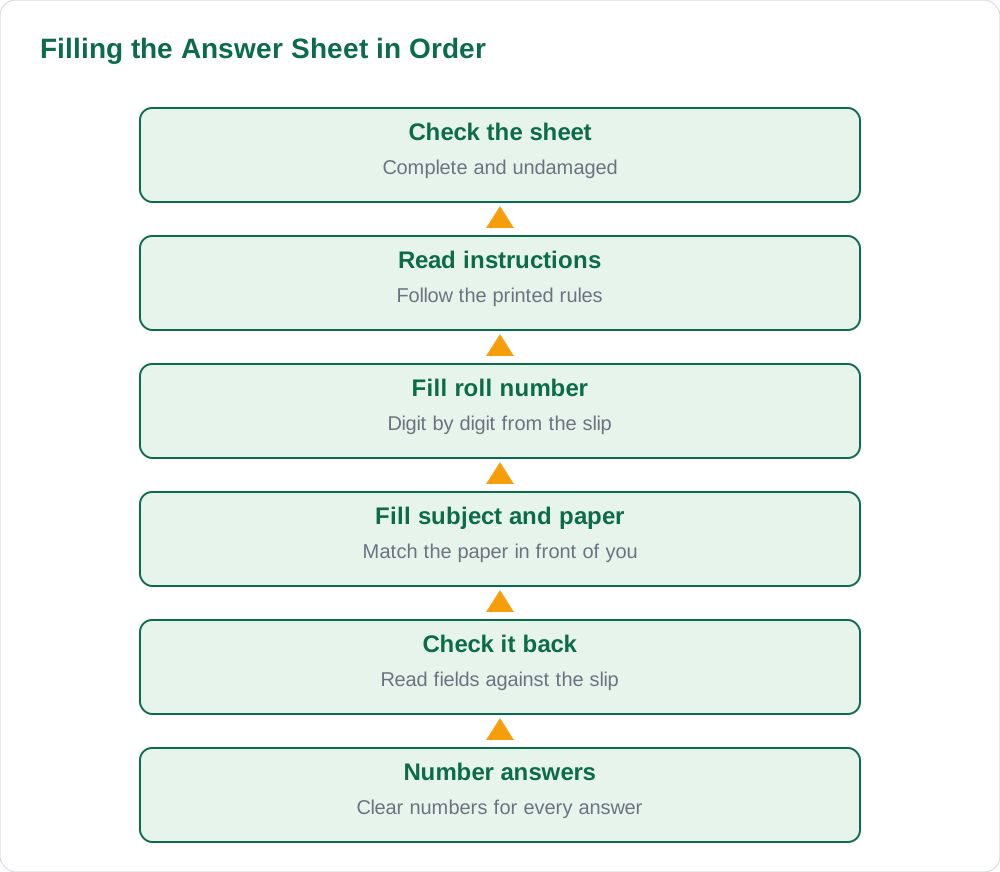
When the answer sheet is handed out, do not rush into the first question. First, check that the sheet is complete and undamaged: no torn pages, no missing sheets, no printing so faint you cannot read it. If anything is wrong, raise your hand and ask for a replacement before writing. Second, read the printed instructions on the sheet itself, because they tell you where to write the roll number, whether to use a pen or a pencil for particular fields, and how to mark the question numbers. These instructions override general advice, including this guide.
Then fill in the identification fields slowly, one at a time. The usual fields are the roll number, the subject name and code, the paper, the class, and the date, plus a signature space in some boards. Write the roll number digit by digit, reading it from your roll number slip rather than from memory, because a number remembered wrong is the single most damaging error on a sheet. After filling the fields, read them back once against the slip before turning to the questions. This thirty-second check is the cheapest insurance in the whole examination. While you prepare for the subject itself, the solved notes library, the books catalogue and the blog index all carry material that can help.
Roll Number, Subject and Paper Details
The roll number field deserves special care because it is how your sheet is identified during marking. Some sheets provide small boxes, one digit per box; others provide a blank line. In boxes, write one digit per box, starting from the first box, and do not add extra digits or dashes unless the sheet asks for them. If you make a mistake, follow the invigilator's instruction for correcting it, which usually means a single neat crossing-out and rewriting, never scribbling, white fluid or overwriting that makes the digit unreadable.
The subject field should match the paper you are sitting, exactly as it appears on your roll number slip, including any paper number where the subject has more than one paper. Pupils sometimes write the subject they revised most recently instead of the subject of the paper in front of them, especially when two papers fall on the same day. The same care applies to the class and paper fields. If your sheet asks for a question paper code, copy it from the question paper itself, not from memory, and if there is no such field on your sheet, leave it out rather than inventing one.
Numbering Your Answers Clearly
Clear question numbering is what lets the examiner find and credit each answer. Write the question number at the start of each answer, in the margin or position your sheet provides, and make it large enough to read at a glance. If a question has parts, label them as the question paper labels them, for example (a), (b) and (c), so the examiner can match each part to its marks. Answer the questions in the order given unless the paper allows choice, and if you skip a question to return to it later, leave a clear gap and the number ready for it, so you do not accidentally merge two answers.
When a question offers a choice, such as attempting any five of eight questions, attempt only the number asked for, because extra answers are usually not marked and can waste time better spent on the required ones. If you change your mind about an answer, cross out the unwanted version neatly with a single line and write the new version in a fresh space, rather than squeezing it between lines where it may be missed. Never write answers in the margin reserved for the examiner's marks, and never write two different answers to the same question hoping one will be chosen, because that usually earns no credit for either.
Using Extra Sheets and Rough Work
If you run out of space, raise your hand and ask for a supplementary sheet rather than writing in tiny script in the margins or on the question paper. A supplementary sheet must be tied or attached as the invigilator directs, and it should carry your roll number and the question number it continues, so it cannot be separated from your main sheet by accident. Number the continuation clearly, for example by writing the question number again at the top, and mention nothing on the main sheet except a short note such as continued on attached sheet, if the invigilator allows it.
Rough work should go where the paper permits it, usually in a marked rough-work space or at the end of the answer sheet, and it should be crossed out lightly when finished so the examiner knows it is not part of the answer. Do not do rough work on the desk, your hand, the question paper margin where it is not allowed, or the roll number slip. Calculations done in the wrong place are not marked and can look like unfair practice. Keep your working tidy: a short line of working that the examiner can follow is worth more than a bare answer, especially in mathematics and science papers.
Final Checks Before Handing In
Use the last few minutes for a sheet check, not for new writing. First, confirm the roll number and subject fields once more. Second, count your answers against the questions you attempted, and make sure every answer has its number. Third, check that any supplementary sheets are attached and labelled. Fourth, make sure you have not left any answer half-written across a page turn that could be missed. Finally, sign the sheet if a signature space is provided, and hand it in only to the invigilator, not to another pupil.
Do not take the answer sheet, or any part of it, out of the hall, and do not photograph it. After handing in, leave quietly and do not compare answers in a way that disturbs pupils still writing. If you realise after the paper that you wrote a wrong roll number, tell your school the same day: the school can inform the board, and an early report gives the board the best chance of tracing the sheet before marking is complete. The longer such an error is left, the harder it is to fix, which is why the check before handing in matters so much. For the rules that govern the hall itself, the instructions on your own slip and from your invigilator are the authority.
AI Help: Muse AI
Muse AI is Meta's personal AI assistant, and it can help you practise answer-sheet habits, for example by quizzing you on the filling order — check the sheet, read the instructions, fill the roll number, verify it — until it becomes automatic.
Join Muse with invite code LTGSWD — in the Muse app, go to Settings > Redeem token and enter the code.
Disclosure: LTGSWD is the author's Muse invite code.
Muse AI does not give official STBB answers — always verify against your Sindh Textbook Board book and your teacher.
5 key points you must know
- Check the sheet for damage and read its printed instructions before writing anything.
- Copy the roll number digit by digit from your slip, never from memory.
- Match the subject and paper fields to the paper actually in front of you.
- Number every answer clearly, including parts, exactly as the question paper labels them.
- Use the last minutes to re-check roll number, answer count and attached sheets.
Frequently asked questions
What is the most common answer sheet mistake?
A wrong roll number, usually copied from memory instead of from the slip. Always read it digit by digit from the slip and check it back before starting the answers.
What should I do if I write a wrong digit in the roll number?
Follow your invigilator's instruction at once — usually a single neat correction, not scribbling or white fluid. If you only notice after the paper, tell your school the same day so the board can be informed early.
Can I use a pencil for the whole answer sheet?
Follow the instructions printed on your own sheet. Most boards require a pen for answers, with pencil allowed for diagrams or rough work where stated. Do not guess — read the sheet.
What if I run out of space in the answer sheet?
Raise your hand and ask for a supplementary sheet. Label it with your roll number and the question number it continues, and attach it exactly as the invigilator directs.
Should I attempt extra questions if there is a choice?
No — attempt only the number the paper asks for. Extra answers are usually not marked and the time is better spent improving the required answers.
Solved notes — preview free
These guides work best with the solved exercises. Preview the solved notes free on this website — 119 solved notes for Classes 6–10 in Sindhi, Urdu, English and Arabic medium. Or browse the full solved notes catalogue for your class and medium. New solved notes are added regularly — check the catalogue for coming-soon books.