Board Result Scrutiny and Rechecking in Sindh: How to Apply and What It Checks
If your board result looks wrong — a mark total that does not add up, or a subject you expected to pass — scrutiny and rechecking are the official ways to have it reviewed. This guide explains what scrutiny and rechecking actually check, how to apply, and what happens afterwards, using the verified rules from an official BIEK result notice plus general board process guidance for Sindh.
What Scrutiny and Rechecking Mean
Scrutiny and rechecking are often used as if they mean the same thing, and in practice they describe the same official review: the board re-examines your answer book to check that the marking was recorded correctly. The key point is what this review is — and what it is not. Rechecking verifies marks totals and checks for unmarked answers. It is not a full re-evaluation, which means the examiner does not re-mark your answers from scratch or change marks because a different examiner might have judged an answer differently.
That distinction matters for expectations. Rechecking can catch real errors: a question that was left unmarked, marks that were added up wrong, or a total that was copied incorrectly onto your result. It cannot turn a weak answer into a strong one, because the original marking judgement stands. If you apply, apply with that understanding — you are asking the board to check for errors, not to re-judge your work.
- Scrutiny / rechecking is an official review of your answer book.
- It verifies marks totals and checks for unmarked answers.
- It is not a full re-evaluation or fresh marking.
- It can catch totalling, copying, and unmarked-answer errors.
The Verified Rules: Time Limit and Fee
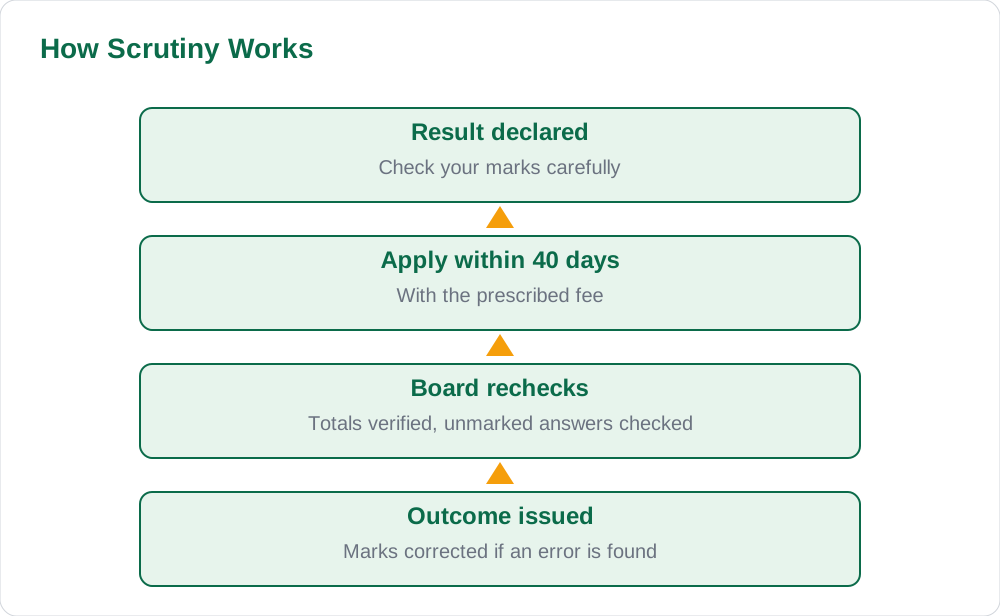
An official BIEK result notice, dated 14 September 2026 and signed by the Controller of Examinations (Acting), states the core rule: scrutiny of answer books can be done on payment of the prescribed fee and on application within 40 days of the declaration of the result. That gives you two conditions: you must apply within 40 days of the result being declared, and you must pay the prescribed fee.
The 40-day window is strict in the sense that it is the official deadline — do not leave your application to the last week. The fee is described as the prescribed fee, which means the amount is set by the board; this article does not state a fee amount, because fees can differ by board and by year, and you must confirm the current fee from your own board's official notice. Always check your board's own scrutiny notice for the exact fee, form, and submission route before you apply.
- Apply within 40 days of the declaration of the result.
- Pay the prescribed fee set by the board.
- Confirm the current fee, form, and route from your own board's notice.
- Do not leave the application to the last week.
How to Apply: General Steps
The exact application route varies by board, so treat these as general steps and confirm the details with your board. First, get the official scrutiny notice or form from your board's official website or your school, and read it fully. Second, decide which subject or subjects you want scrutinised — applying for a subject where your marks look clearly wrong is more sensible than applying for every subject at random.
Third, submit your application through the route the board specifies — usually through your school or institution — with the prescribed fee, within the 40-day window. Keep a copy of your application and any receipt. Fourth, wait for the board's outcome. Scrutiny takes time, and the board will inform you or your institution of the result. Do not pay any agent or middleman: scrutiny applications go through the board's own process, and anyone offering a guaranteed increase in marks is scamming you.
- Get the official scrutiny notice or form from your board or school.
- Choose the subject or subjects where the marks look clearly wrong.
- Apply through the board's specified route, with the prescribed fee, within 40 days.
- Keep a copy of your application and receipt; never pay a middleman.
Marks Statements and Grace Marks
The same official BIEK notice sets out two more rules students should know. First, marks statements are issued after two weeks from respective institutions, and no marks statement is issued from the board's premises. In practice, that means you collect your marks statement from your school or college, not by going to the board's office. If your institution does not have it after two weeks, ask your institution, not the board counter.
Second, grace marks, if any, are not added in the grand total. Grace marks are small concessions a board may allow in certain cases, but they do not form part of your grand total. Understanding this helps you read your marks statement correctly: your grand total is the total of your subject marks, and any grace marks are treated separately. If anything on your marks statement looks unclear, ask your school to explain it before you decide whether to apply for scrutiny.
- Marks statements are issued after two weeks from respective institutions.
- No marks statement is issued from the board's premises.
- Collect your marks statement from your school or college.
- Grace marks, if any, are not added in the grand total.
If You Failed: The Supplementary Option
Scrutiny is not the only option after a disappointing result. General board guidance — for example from BISE Sukkur — says that a student who fails subjects can appear in the 2nd Annual, or supplementary, exam for only the failed subject or subjects, not the full year. That is an important relief: you do not have to repeat subjects you already passed.
The sensible order is: first, check whether your marks look like they contain an error, and if so, apply for scrutiny within the 40-day window. Second, whether or not you apply for scrutiny, start preparing for the supplementary exam in the failed subject or subjects, so that you are ready either way. Third, talk to your teachers about a realistic study plan — how to finish your syllabus in 30 days and how to revise the night before an exam can help you organise that preparation. For more on results generally, see how to check the Sindh board result online.
- A student who fails subjects can appear in the 2nd Annual exam for only the failed subjects.
- You do not repeat subjects you already passed.
- Apply for scrutiny if the marks look wrong, and prepare for supplementary exams in parallel.
- Ask your teachers for a realistic study plan for the failed subjects.
AI Help: Muse AI
Muse AI is Meta's personal AI assistant. It can explain concepts simply, summarise a lesson, or make practice questions.
Muse AI can help you decide your next step after a result by explaining scrutiny, rechecking, and supplementary exams in simple words and building a revision plan for a failed subject.
Join Muse with invite code LTGSWD — in the Muse app, go to Settings > Redeem token and enter the code.
Disclosure: LTGSWD is the author's Muse invite code.
Muse AI does not give official Sindh Textbook Board answers — always verify against your Sindh Textbook Board book and your teacher.
5 key points you must know
- Rechecking verifies marks totals and checks for unmarked answers — it is not a full re-evaluation.
- Scrutiny requires application within 40 days of the result declaration, with the prescribed fee.
- Marks statements are issued after two weeks from respective institutions, not from the board's premises.
- Grace marks, if any, are not added in the grand total.
- A student who fails subjects can appear in the 2nd Annual exam for only the failed subjects.
Frequently asked questions
What does rechecking actually check?
Rechecking verifies marks totals and checks for unmarked answers. It is not a full re-evaluation, so the original marking judgement stands.
How long do I have to apply for scrutiny?
Under the official BIEK notice, scrutiny can be done on application within 40 days of the declaration of the result, on payment of the prescribed fee.
How much is the scrutiny fee?
The notice refers to the prescribed fee, which is set by the board and can differ by board and year. Confirm the current fee from your own board's official scrutiny notice.
Where do I collect my marks statement?
Marks statements are issued after two weeks from respective institutions, and no marks statement is issued from the board's premises. Collect yours from your school or college.
If I fail one subject, must I repeat the whole year?
No. General board guidance says a student who fails subjects can appear in the 2nd Annual (supplementary) exam for only the failed subject or subjects, not the full year.
Solved notes — preview free
These guides work best with the solved exercises. Preview the solved notes free on this website — 119 solved notes for Classes 6–10 in Sindhi, Urdu, English and Arabic medium. Or browse the full solved notes catalogue for your class and medium. New solved notes are added regularly — check the catalogue for coming-soon books.