Reading the Periodic Table: Groups, Periods and Trends
The periodic table looks complicated at first glance, but it is really a map — and like any map, it becomes easy once you know what the rows and columns mean. Reading the periodic table is about groups, periods, and trends: the vertical columns are groups, the horizontal rows are periods, and an element's position tells you how it is likely to behave. In this guide you will learn to read the table step by step, without memorising every element. We start with the layout: why elements sit where they do, what the group numbers mean, and how periods connect to electron shells. Then we look at the big regions of the table — metals on the left, non-metals on the right, and the metalloids in between — and the trends that run across and down the table. By the end you will be able to look at an element's position and predict useful facts about it, such as how many outer electrons it has and whether it is likely to lose or gain electrons. This skill pays off in every later chemistry topic, from bonding to reactions, so take the time to build it properly with a colour-coded table of your own.
Groups: The Vertical Columns
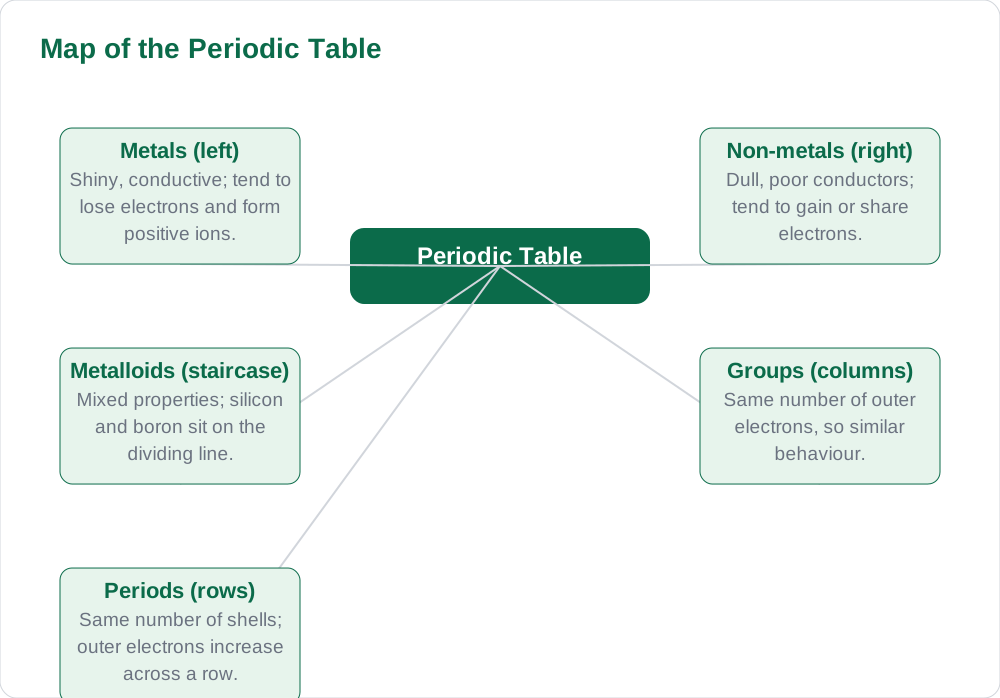
A group is a vertical column of the periodic table. Elements in the same group have the same number of electrons in their outer shell, which is why they behave alike. Group 1 elements each have one outer electron, Group 2 elements have two, and Group 7 elements have seven. This single fact explains most of the similarities within a group: members react in similar ways, form similar compounds, and show a steady change in properties as you move down the column.
Some groups have special names worth knowing. Group 1 is the alkali metals (lithium, sodium, potassium and friends), soft reactive metals that form compounds with chlorine and oxygen. Group 7 is the halogens, reactive non-metals that include chlorine and bromine. Group 0 or 18 is the noble gases — helium, neon, argon — with full outer shells, which makes them very unreactive. When a question asks why two elements behave similarly, the answer is very often that they are in the same group.
Periods: The Horizontal Rows
A period is a horizontal row of the periodic table. The period number tells you how many electron shells the atom has: elements in Period 2 have two shells, elements in Period 3 have three shells, and so on. As you move across a period from left to right, the number of outer-shell electrons increases by one at each step, while the number of shells stays the same. This is why properties change gradually across a period — metals on the left give way to non-metals on the right.
Across a period, atoms gain protons, so the pull of the nucleus on the outer electrons grows stronger. This affects size and reactivity in ways you will study in more detail later. For now, remember the core pattern: down a group, shells increase; across a period, outer electrons increase. If you can say both of those sentences from memory, you already understand the skeleton of the table.
Metals, Non-Metals and Metalloids
The periodic table divides roughly into two regions. Metals sit on the left and in the centre: they are shiny, good conductors of heat and electricity, and they tend to lose electrons in reactions. Non-metals sit on the right: they are dull in appearance, poor conductors, and they tend to gain or share electrons. A zig-zag staircase line near the right side separates the two regions, and the elements along that line are called metalloids — elements like silicon and boron that show a mix of metal and non-metal properties.
Knowing which region an element belongs to gives you a quick prediction about its behaviour. A metal on the left of the table, such as sodium, will usually form a positive ion by losing electrons. A non-metal on the right, such as chlorine, will usually form a negative ion by gaining an electron, or share electrons in a covalent bond. This left-right pattern is one of the most useful shortcuts in school chemistry, and it is worth colouring on your own copy of the table: one colour for metals, one for non-metals, and one for metalloids.
Colour-coding is a study technique, not decoration. When you shade each group in its own colour, the patterns jump out: the alkali metals marching down Group 1, the halogens down Group 7, the noble gases sitting quietly at the far right. For more on study methods that use visual organisation, see How to Get A+ in Sindh Board Exams and Science Vocabulary Roots.
Trends Across and Down the Table
A trend is a pattern that repeats as you move in one direction across the table. Moving down a group, atoms get larger because each step adds a new electron shell, and the outer electrons sit further from the nucleus. Reactivity also changes down a group: Group 1 metals become more reactive as you go down, because the single outer electron is further from the nucleus and easier to lose. Group 7 halogens show the opposite pattern — they become less reactive down the group, because gaining an electron becomes harder as the atom grows.
Moving across a period from left to right, atoms get slightly smaller because the growing nuclear charge pulls the same number of shells inward. Metals become less reactive and non-metals become more reactive as you approach the right side. You do not need to memorise long lists of trend facts; if you can explain each trend with shells and nuclear pull, you can work out the answer in the exam. Practise by picking any group and predicting which member is largest, and any period and predicting which member is most metallic.
Using the Table in Exam Questions
Most school questions about the periodic table follow a few familiar patterns. You may be asked to find an element's group and period from its electron arrangement: the number of outer electrons gives the group, and the number of shells gives the period. You may be asked to predict properties: an element in Group 2 will form a 2+ ion, while an element in Group 7 will form a 1- ion. Or you may be asked to compare two elements: explain why potassium is more reactive than lithium (same group, more shells, outer electron further out and easier to lose).
The safest exam method is to write the electron arrangement first, then read the group and period from it, then answer. This turns a memory question into a reasoning question. Keep a blank periodic table outline beside you while you revise, and fill it in from memory: group numbers across the top, period numbers down the side, and the names of the special groups. If you can rebuild the skeleton of the table without looking, the detail questions become much easier.
AI Help: Muse AI
Muse AI is Meta's personal AI assistant, and it can help with this topic by testing you on the table: ask it to name an element's group and period, work out your own answer from the electron arrangement, then compare. Muse AI does not give official Sindh Textbook Board answers — always verify against your Sindh Textbook Board book and your teacher.
Join Muse with invite code LTGSWD — in the Muse app, go to Settings > Redeem token and enter the code.
Disclosure: LTGSWD is the author's Muse invite code.
5 key points you must know
- Groups are vertical columns: same number of outer electrons, similar behaviour.
- Periods are horizontal rows: the period number equals the number of shells.
- Metals sit left, non-metals right, metalloids along the staircase line.
- Down a group atoms get larger; across a period they get slightly smaller.
- Read group and period from the electron arrangement, then predict behaviour.
Frequently asked questions
How do I find an element's group from its electron arrangement?
Count the electrons in the outer shell — that number is the group number (for the main groups). For example, an arrangement of 2,8,1 has one outer electron, so the element is in Group 1.
How do I find an element's period?
Count the number of shells in the electron arrangement. Two shells means Period 2, three shells means Period 3, and so on.
Why do elements in the same group behave alike?
They have the same number of outer electrons, and outer electrons control bonding and reactions. Group members therefore react in similar ways and form similar compounds.
Why are Group 1 metals more reactive going down the group?
Each step down adds a shell, so the single outer electron sits further from the nucleus and is held less tightly, making it easier to lose.
What are noble gases, and why are they unreactive?
Noble gases in Group 0/18 have full outer shells, so they have no need to gain, lose, or share electrons. That stability makes them very unreactive.
Solved notes — preview free
These guides work best with the solved exercises. Preview the solved notes free on this website — 119 solved notes for Classes 6–10 in Sindhi, Urdu, English and Arabic medium. Or browse the full solved notes catalogue for your class and medium. New solved notes are added regularly — check the catalogue for coming-soon books.