Building Arguments for English Debates
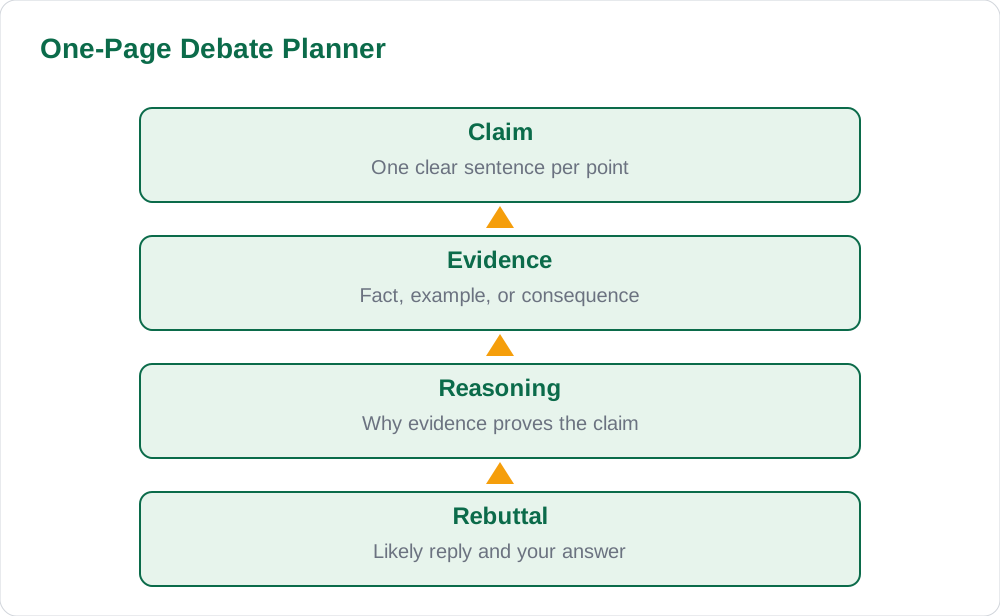
Debates are not shouting matches. The building arguments English debates pupils need is a calm, structured skill: make a clear claim, support it with evidence, explain why the evidence matters, and answer the other side fairly. This guide teaches that structure through a simple four-part model — claim, evidence, reasoning, and rebuttal — and a one-page planner you can reuse for any motion. You will learn how to choose strong points, how to organise them, how to listen and rebut, and how to speak clearly under time pressure. Whether you are debating in class or in a competition, this method helps you sound confident, logical, and respectful.
Claim, Evidence, Reasoning: The Core of Every Argument
A claim is a clear statement of your position on one part of the motion. School uniforms should be required is a claim. School uniforms are good is too vague to be useful. A good claim is specific enough to argue about. Each of your main points should be one claim, stated in one sentence at the start of your argument.
Evidence is the support for your claim: a fact, an example, a comparison, or a logical consequence. Reasoning is the explanation that connects the evidence to the claim. Many pupils give evidence but skip reasoning, leaving the audience to guess the link. Always add a because sentence. For example: Claim: Homework should be limited. Evidence: Pupils who sleep less do worse in class. Reasoning: Because heavy homework cuts sleep, limiting it protects learning. The reasoning sentence is what makes the argument complete.
Choosing Strong Points and Organising Them
Choose two or three strong points rather than six weak ones. A strong point is specific, relevant to the motion, and hard to dismiss quickly. For the motion This house believes mobile phones should be banned in schools, strong points might be distraction in class, cheating in tests, and cyberbullying during breaks. Weak points might be phones are expensive or phones break easily, which are true but do not prove a ban is needed.
Organise your points from strongest to second-strongest, and put your strongest point first so the audience hears it while attention is high. Give each point its own short paragraph in notes and its own clear signpost in speech: My first point is, My second point is, My final point is. Signposts help judges follow your case even if they miss a detail. For more structured writing, see story writing.
Listening and Rebuttal: Answering the Other Side
Rebuttal is the art of answering the other side's arguments. It requires listening. During the opposition's speech, write down their claims in short notes. Do not try to write every word; capture the claim and one key piece of evidence. Then choose the one or two claims you can answer best. You do not need to rebut everything. Answering the strongest opposing point well beats answering five weak points badly.
A good rebuttal has three moves: name the argument, explain why it is incomplete or wrong, and restate your own position. For example: The opposition says phones help research. That is true in a library, but in class they mostly distract, which is why a ban during lessons still makes sense. Notice the tone: respectful, specific, and focused on the argument, not on the person. Never attack the speaker. Attack the idea.
Language, Delivery, and Time Control
Use clear, formal language. Avoid slang and avoid reading your speech word for word. Speak from short notes so you sound natural and can look at the audience. Vary your pace: slow down for your main claim, pause after an important sentence, and keep examples brief. A pause of two seconds after a strong point gives the audience time to absorb it.
Manage your time by practising with a clock. If you have three minutes, plan for two minutes and thirty seconds of content and leave thirty seconds for a closing summary. If you run out of time, finish with your strongest point restated in one sentence rather than trailing off. Judges remember a clear closing. End with a summary: For these reasons, we believe the motion should stand, followed by your one-line strongest reason.
- Speak from short notes, not a full script.
- Signpost each point: first, second, final.
- Pause after strong claims so the audience can absorb them.
- Close with a one-sentence restatement of your strongest point.
Practising Debates in Class
Practise with short, low-pressure debates. Take a simple motion, such as School should start later, and give each side five minutes to plan with the planner above. Debate for two minutes per speaker, then discuss which arguments were strongest and why. This reflection matters as much as the debate itself because it teaches you to evaluate arguments, not just to produce them.
Keep a debate notebook. After each debate, write one thing that worked, one rebuttal you missed, and one phrase you want to reuse. Over a term, this notebook becomes a personal toolkit of arguments and phrases. For related skills, see writing a formal email and writing natural dialogue, or browse the books page.
AI Help: Muse AI
Muse AI is Meta's personal AI assistant, and it can help with preparing for a debate by helping you test a claim, evidence, and rebuttal for your motion. Muse AI does not give official Sindh Textbook Board answers — always verify against your Sindh Textbook Board book and your teacher.
Join Muse with invite code LTGSWD — in the Muse app, go to Settings > Redeem token and enter the code.
Disclosure: LTGSWD is the author's Muse invite code.
5 key points you must know
- Every argument needs claim, evidence, and reasoning.
- Choose two or three strong points, not many weak ones.
- Rebuttal names the argument, answers it, and restates your case.
- Speak from notes, signpost points, and pause after strong claims.
- Attack ideas, never the speaker.
Frequently asked questions
How many points should I make in a debate?
Two or three strong points are enough. Each point needs a claim, evidence, and reasoning. More points usually mean less depth and weaker rebuttal time.
What is the difference between evidence and reasoning?
Evidence is the fact or example. Reasoning explains why that evidence proves your claim. Both are needed; evidence without reasoning leaves the link unclear.
How do I rebut well?
Listen, note the strongest opposing claim, name it, explain why it is incomplete or wrong, and restate your position. Stay respectful and focus on the idea, not the person.
Should I read my debate speech?
No. Speak from short notes so you sound natural, can look at the audience, and can adapt to what the other side actually said.
Solved notes — preview free
These guides work best with the solved exercises. Preview the solved notes free on this website — 119 solved notes for Classes 6–10 in Sindhi, Urdu, English and Arabic medium. Or browse the full solved notes catalogue for your class and medium. New solved notes are added regularly — check the catalogue for coming-soon books.