English-Medium Essays: Academic Vocabulary That Works
Many pupils can think clearly but struggle to sound clear in an English essay. They know what they want to say, yet their sentences feel plain, repetitive, or informal. Academic vocabulary is the bridge between thinking and writing. It does not mean using long words to impress the reader. It means choosing precise words, linking ideas with formal connectors, and using sentence frames that keep the essay organised. This guide shows how English-medium pupils in Sindh Textbook Board classes can build a working academic vocabulary, use connectors correctly, and write essays that are clear, formal, and easy to follow.
What Academic Vocabulary Really Means
Academic vocabulary is the set of words and phrases used in school writing to explain, compare, argue, and conclude. It includes topic words, such as environment, education, or health, and general academic words, such as however, therefore, in addition, and for example. Topic words change with each essay. General academic words stay useful in almost every essay. Pupils who learn the general words first gain a toolkit they can reuse in any subject. They stop repeating and and then in every sentence and begin to show how ideas connect.
Academic writing also avoids slang, very informal words, and vague words such as thing, stuff, and a lot. Instead of saying a lot of people, a pupil can write many people or a large number of people. Instead of saying the thing is good, a pupil can write the idea is useful or the plan is effective. These small changes make writing sound more serious without making it harder to understand. Teachers can help by giving pupils a short list of vague words to avoid and a precise replacement for each one. Pupils can keep that list inside their notebook and check it before handing in an essay. More writing help appears in the blog and in the solved notes.
- Topic words change with each essay; general academic words work in every essay.
- Replace vague words such as thing and a lot with precise words.
- Academic writing is clear and formal, not long and complicated.
Connectors That Link Ideas Clearly
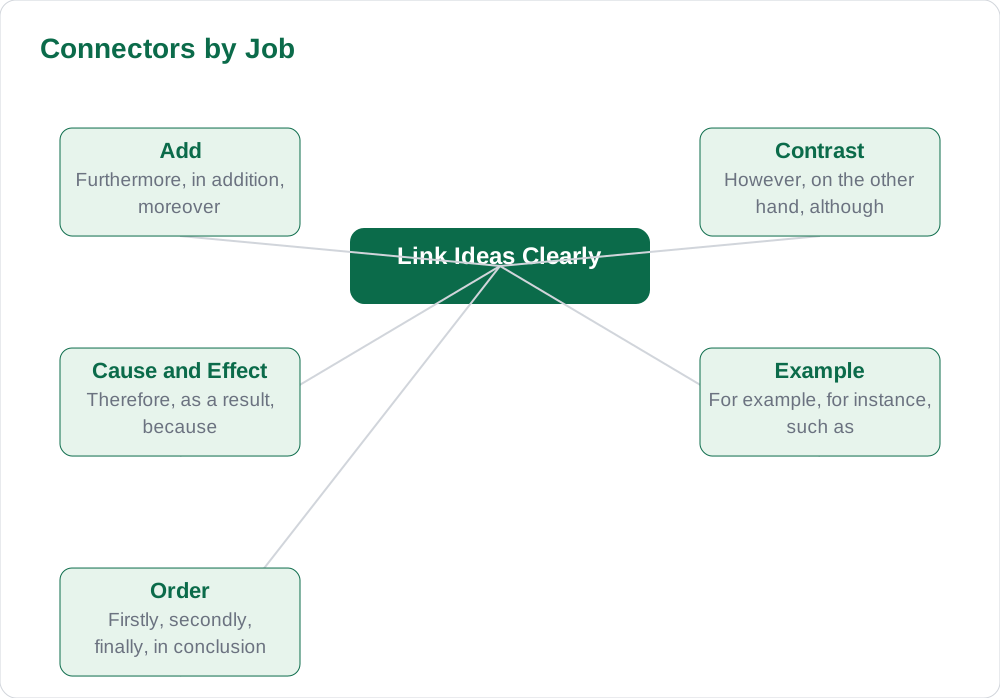
Connectors are words and phrases that show how one sentence relates to the next. Adding connectors include furthermore, in addition, and moreover. Contrasting connectors include however, on the other hand, and although. Cause and effect connectors include therefore, as a result, and because. Giving an example uses for example, for instance, and such as. Sequencing uses firstly, secondly, finally, and in conclusion. Pupils who learn one connector from each group can already link ideas far better than pupils who use and and but for everything.
Connectors must be used with correct punctuation. However at the start of a sentence is followed by a comma. Although joins two ideas in one sentence and does not need a full stop in the middle. For example is followed by a comma when it starts a sentence. Teachers should show one correct example and one incorrect example for each connector, because pupils learn the pattern faster from contrast. Pupils should also avoid using three connectors in one sentence, which makes writing sound crowded. One connector per sentence is usually enough. A clean essay uses connectors like road signs: enough to guide the reader, never so many that they block the view.
- Adding: furthermore, in addition, moreover.
- Contrasting: however, on the other hand, although.
- Cause and effect: therefore, as a result, because.
- Example: for example, for instance, such as.
Sentence Frames You Can Reuse
Sentence frames are half-finished sentences that pupils can complete with their own ideas. They reduce the fear of a blank page and keep grammar correct. Useful frames include One advantage of this idea is that, Another reason for this is that, and In contrast, the second idea is. For conclusions, frames include In conclusion, the evidence shows that and Overall, the most important point is that. Pupils should practise these frames with different topics so that the frames become automatic. When the frame is automatic, the pupil can focus on the idea rather than on how to start the sentence.
Frames work best when pupils change the content, not when they copy whole paragraphs. A pupil who uses the same frame for every paragraph will sound repetitive. A pupil who uses two or three different frames across an essay will sound varied and natural. Teachers can give pupils a frame bank with ten frames and ask them to use at least four in each essay. Pupils can also collect good frames from their textbook and from model essays. Over time, they will build their own set of favourite frames that fit their style. Model essays and writing tips are available in the blog and the books for each class.
- One advantage of this idea is that ...
- Another reason for this is that ...
- In contrast, the second idea is ...
- In conclusion, the evidence shows that ...
Building Topic Vocabulary Before Writing
Good essays begin before writing, with five minutes of vocabulary preparation. The pupil writes the essay topic in the centre of a page and lists ten words connected to it. For a topic on clean water, the list might include pollution, filtration, hygiene, supply, and conservation. Then the pupil writes a short meaning for each word and one example sentence. This preparation prevents the common problem of repeating the same three words in every paragraph. It also helps the pupil plan the essay, because the word list often suggests the paragraphs.
Pupils should also learn collocations, which are words that naturally go together. In English, we say make a decision, not do a decision. We say take an exam, not give an exam, when we mean sitting for it. We say strong evidence, not powerful evidence, in most academic writing. Teachers can point out two or three collocations in each lesson and ask pupils to use them in sentences. Pupils can keep a collocation notebook with the pair, the meaning, and one example. This small habit improves writing far more than memorising long lists of single words.
From Draft to Polished Essay
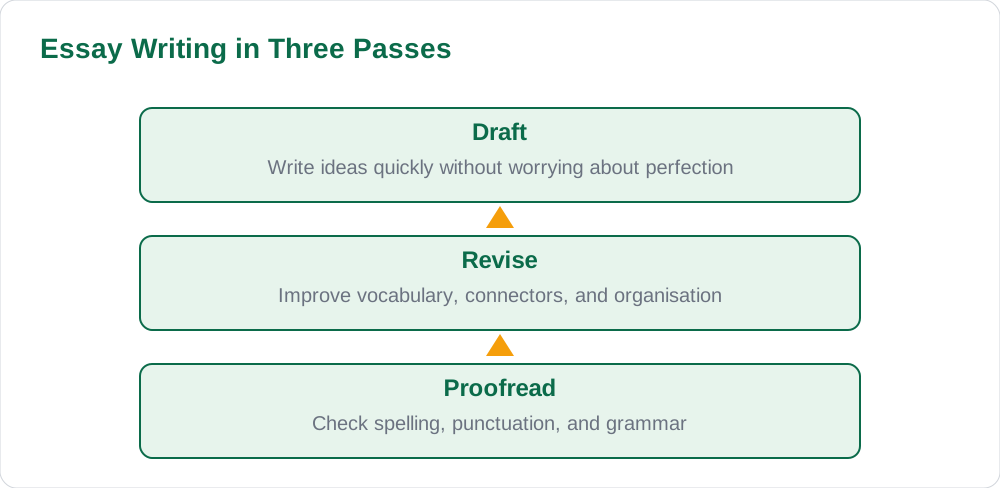
A strong essay is rarely finished in one draft. Pupils should write a first draft for ideas, then revise for vocabulary and connectors, then proofread for spelling and punctuation. During revision, pupils can ask three questions. Did I repeat any word too often? Can I replace a vague word with a precise word? Did I use a connector to show how each paragraph connects to the next? Answering these questions takes ten minutes and lifts the essay noticeably. Pupils should also read the essay aloud, because awkward sentences are easier to hear than to see.
Proofreading should be separate from revision. In proofreading, pupils check spelling, capital letters, full stops, commas, and verb tenses. They should not try to change ideas during proofreading. A simple checklist helps: every sentence starts with a capital letter, every sentence ends with a full stop or question mark, and every paragraph has a clear topic sentence. Teachers can give pupils five minutes at the end of class for proofreading only. Pupils who follow this routine produce essays that are clearer, more formal, and easier to mark. For more practice, pupils can use the solved notes and the about page to learn about the site.
- Draft for ideas, revise for vocabulary, proofread for accuracy.
- Replace repeated and vague words with precise words.
- Read the essay aloud to catch awkward sentences.
AI Help: Muse AI
Muse AI is Meta's personal AI assistant that can help pupils suggest formal alternatives for plain words and check whether connectors fit the sentence.
Join Muse with invite code LTGSWD — in the Muse app, go to Settings > Redeem token and enter the code.
Disclosure: LTGSWD is the author's Muse invite code.
Muse AI does not give official STBB answers — always verify against your Sindh Textbook Board book and your teacher.
5 key points you must know
- Academic vocabulary means precise words and clear connectors, not long words.
- Learn one connector from each group: adding, contrasting, cause, example, order.
- Reusable sentence frames reduce blank-page fear and keep grammar correct.
- Prepare ten topic words before writing to avoid repetition.
- Draft, revise, and proofread in separate passes for a polished essay.
Frequently asked questions
How can a pupil avoid repeating the same words in an essay?
Prepare a topic word list before writing, use synonyms carefully, and check the draft for words used more than twice. Replace a repeated word with a precise alternative that keeps the same meaning.
Is it wrong to use I in an academic essay?
It depends on the task. Some essays ask for personal opinion and allow I think. Others ask for formal discussion and prefer phrases such as In my opinion or The evidence suggests. Pupils should follow the teacher's instruction for each task.
How many connectors should an essay include?
Use one connector per paragraph link, not one in every sentence. Enough connectors to guide the reader, but not so many that the essay sounds crowded or artificial.
What is the best way to learn collocations?
Learn them as pairs with one example sentence, such as make a decision or strong evidence. Record two or three new collocations each week and use each one in a sentence of your own.
Solved notes — preview free
These guides work best with the solved exercises. Preview the solved notes free on this website — 119 solved notes for Classes 6–10 in Sindhi, Urdu, English and Arabic medium. Or browse the full solved notes catalogue for your class and medium. New solved notes are added regularly — check the catalogue for coming-soon books.