English Tenses on One Timeline: Past, Present, Future at a Glance
English tenses confuse many pupils because textbooks list them as twelve separate forms with long names. Past perfect continuous sounds like a different language from present simple, yet both are points on one timeline. When pupils see all the tenses on a single line, the relationships become visible: past is before now, present is around now, and future is after now. This guide places the main English tenses on one timeline, explains each tense with a simple example, and shows how to choose the right tense in writing and in exams. It is written for English-medium pupils in Sindh Textbook Board classes.
One Timeline, Three Time Zones
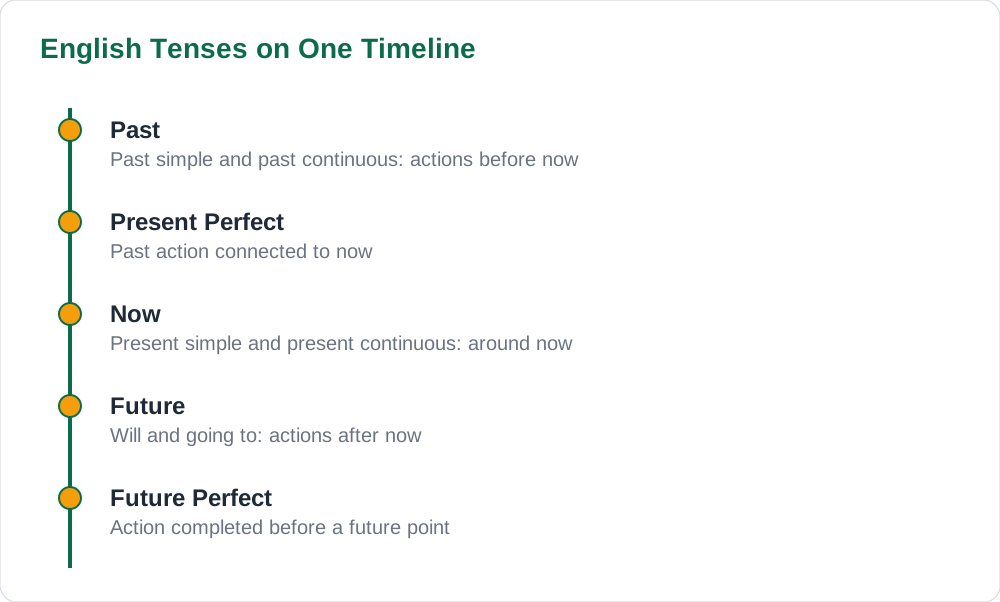
Imagine a horizontal line. The left side is the past, the middle point is now, and the right side is the future. Every English tense lives somewhere on this line. Present simple and present continuous live around now. Past simple and past continuous live to the left of now. Future forms live to the right of now. Perfect tenses connect two points: past perfect connects an earlier past moment to a later past moment, and present perfect connects a past action to the present moment. When pupils draw this line once, they can place any tense on it without memorising a table.
The timeline also shows why some tenses are used together. In a story, past simple moves the story forward, while past continuous sets the scene. For example, While I was walking to school, I saw an old friend. Walking is past continuous because it was in progress, and saw is past simple because it is the main event. In a plan, present continuous can describe a fixed arrangement, while will describes a decision. Pupils who see these pairs on the timeline choose tenses more naturally. A timeline poster in class and a small timeline in each notebook help pupils keep the picture in mind. More grammar help is in the blog and the solved notes.
- Past is left of now, present is around now, future is right of now.
- Perfect tenses connect two points in time.
- Draw the timeline once and place each tense on it.
Present Tenses: Simple and Continuous
Present simple describes habits, facts, and routines. Examples include She walks to school every day and Water boils at a high temperature. The verb stays in its base form, with s or es for he, she, and it. Present continuous describes an action in progress around now. Examples include She is walking to school now and They are studying for their exams this week. The form is am, is, or are plus verb plus ing. Pupils often confuse the two, especially when they translate from Urdu or Sindhi, where one form can cover both meanings.
A simple test helps. If the action is a habit or a fact, use present simple. If the action is happening now or around now, use present continuous. For example, I read books is a habit, so it uses present simple. I am reading a book now is an action in progress, so it uses present continuous. Teachers can give pupils pairs of sentences and ask them to label each one. Pupils should also practise with time words: every day, usually, and always often go with present simple, while now, at the moment, and this week often go with present continuous. The books show textbook examples for each tense.
- Present simple: habits, facts, routines. She walks to school every day.
- Present continuous: action in progress. She is walking to school now.
- Time words give clues: every day versus now and at the moment.
Past Tenses: Simple, Continuous, and Perfect
Past simple describes a finished action in the past. Examples include I visited my grandmother yesterday and They played cricket last week. The verb is in its past form, often with ed for regular verbs. Past continuous describes an action in progress at a past moment. Examples include I was visiting my grandmother when the phone rang and They were playing cricket at five oclock. The form is was or were plus verb plus ing. Pupils use past continuous to set the scene and past simple for the main event.
Past perfect describes an action that happened before another past action. For example, I had finished my homework before dinner started. Finishing homework happened first, and dinner started second. The form is had plus past participle. Pupils do not need past perfect in every story, but it is useful when the order of past events matters. A timeline helps here: place the earlier event further left and the later event closer to now. Teachers can ask pupils to draw two dots on the timeline for past perfect sentences. This visual step makes the tense far easier to remember. More examples are in the solved notes and the blog.
- Past simple: finished action. I visited my grandmother yesterday.
- Past continuous: action in progress. I was visiting when the phone rang.
- Past perfect: earlier of two past actions. I had finished before dinner started.
Future Tenses: Will, Going To, and Present Continuous
English has several ways to talk about the future. Will describes a decision made at the moment of speaking or a promise. Examples include I will help you with your homework and I will call you tomorrow. Going to describes a plan already made or a prediction based on evidence. Examples include We are going to visit Lahore next month and Look at those clouds, it is going to rain. Present continuous can describe a fixed arrangement, such as We are meeting our teacher at four oclock. Pupils should learn the difference in meaning, not only the form.
A useful guide is to ask when the decision was made. If the decision is made now, use will. If the plan was made before, use going to or present continuous. For example, if a pupil decides in class to help a friend, the pupil says I will help you. If the pupil already planned to visit a cousin next week, the pupil says I am going to visit my cousin or I am visiting my cousin next week. Teachers can give pupils situations and ask them to choose the best future form. Pupils who practise with situations learn faster than pupils who only memorise rules. The books give textbook dialogues for each future form.
- Will: decision now, promise, or offer. I will help you.
- Going to: plan already made or prediction from evidence.
- Present continuous: fixed arrangement. We are meeting at four.
Choosing the Right Tense in Exams
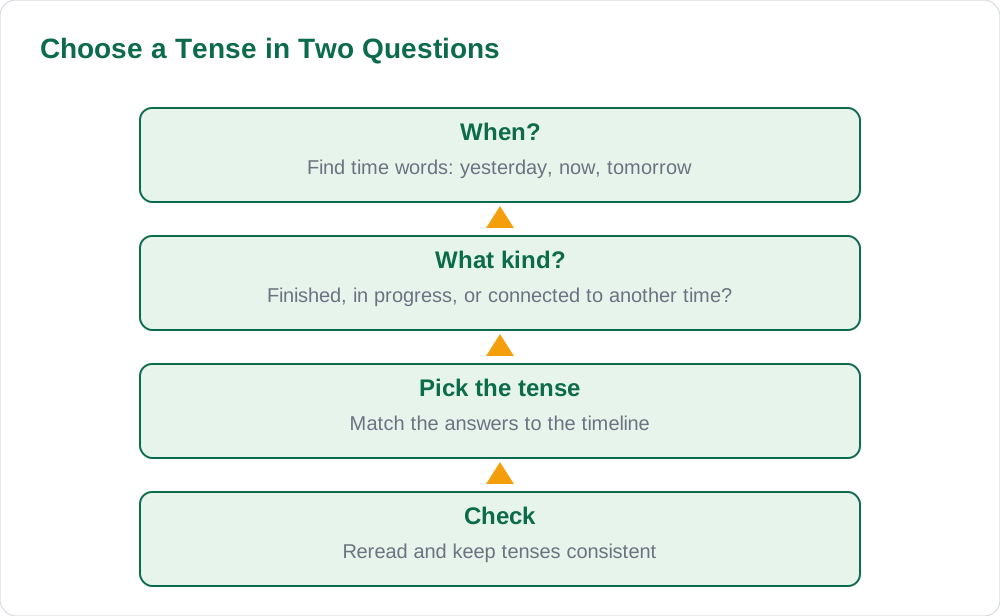
In exams, pupils should first find the time words in the question. Yesterday, last week, and ago point to past tenses. Now, every day, and usually point to present tenses. Tomorrow, next week, and soon point to future forms. Time words are the fastest clue. Second, pupils should ask whether the action is finished, in progress, or connected to another time. Finished points to simple tenses. In progress points to continuous tenses. Connected points to perfect tenses. These two questions, when and what kind, solve most tense questions.
Pupils should also check tense consistency in longer answers. A story that starts in the past should stay in the past unless there is a reason to change. A description of a daily routine should stay in present simple. Changing tenses without a reason confuses the reader and loses marks. Before handing in the paper, pupils should reread each paragraph and check that the verbs match the time. A quick timeline sketch in the margin can help during the exam. Pupils who practise this routine make fewer tense errors, even under pressure. More exam strategies are in the solved notes and the blog.
- Find time words first: yesterday, now, tomorrow.
- Ask whether the action is finished, in progress, or connected.
- Keep tenses consistent within a paragraph unless there is a reason to change.
AI Help: Muse AI
Muse AI is Meta's personal AI assistant that can help pupils place a sentence on the tense timeline and explain why one tense fits better than another.
Join Muse with invite code LTGSWD — in the Muse app, go to Settings > Redeem token and enter the code.
Disclosure: LTGSWD is the author's Muse invite code.
Muse AI does not give official STBB answers — always verify against your Sindh Textbook Board book and your teacher.
5 key points you must know
- All tenses live on one timeline: past left, present around now, future right.
- Present simple is for habits and facts; present continuous is for actions in progress.
- Past continuous sets the scene; past simple gives the main event.
- Will is for decisions now; going to is for plans already made.
- Find time words first, then ask whether the action is finished, in progress, or connected.
Frequently asked questions
What is the difference between present simple and present continuous?
Present simple describes habits, facts, and routines, such as She walks to school every day. Present continuous describes an action in progress around now, such as She is walking to school now.
When should pupils use past perfect?
Use past perfect for the earlier of two past actions, such as I had finished my homework before dinner started. It shows that one past action happened before another past action.
What is the difference between will and going to?
Will describes a decision made at the moment of speaking or a promise. Going to describes a plan already made or a prediction based on evidence, such as dark clouds before rain.
How can pupils avoid mixing tenses in a story?
Keep the story in one main tense, usually past simple, and use other tenses only for a clear reason, such as past continuous for background. Reread each paragraph to check consistency before handing in the paper.
Solved notes — preview free
These guides work best with the solved exercises. Preview the solved notes free on this website — 119 solved notes for Classes 6–10 in Sindhi, Urdu, English and Arabic medium. Or browse the full solved notes catalogue for your class and medium. New solved notes are added regularly — check the catalogue for coming-soon books.