After the Paper: Turn Your Mistakes into Marks

Most pupils do one of two things when a marked paper comes back: they glance at the score and file it away, or they dwell on the score and feel bad. Neither turns the paper into progress. The paper itself is one of the best study tools you will ever get — it shows exactly where your marks went, which errors you repeat, and what to fix before the next paper. Reviewing an exam paper afterward is how mistakes become marks. This guide shows you a calm, structured way to review a returned paper: reading the examiner's marks without taking them personally, sorting your lost marks by cause, building a mistake log, and turning that log into a short, focused plan for the next paper. It works for class tests, mock exams, and board papers alike.
First: Read the Score, Then Read the Marks
When the paper comes back, give yourself a minute to react to the score — that is natural — and then move past it. The score is the summary; the marks on the page are the lesson. Go through the paper slowly, question by question, and read every tick, cross, and comment. Where did you gain marks? Where did you lose them? Were there marks you expected and did not get, and can you see why?
If your teacher has written comments, read them twice. Teacher comments are the closest thing to an examiner's view of your work, and they usually point at the exact habits to fix. If a comment is unclear, ask your teacher to explain it — teachers would far rather explain a comment than watch you repeat the error. This conversation is part of the review, not a punishment.
Sort Your Lost Marks by Cause
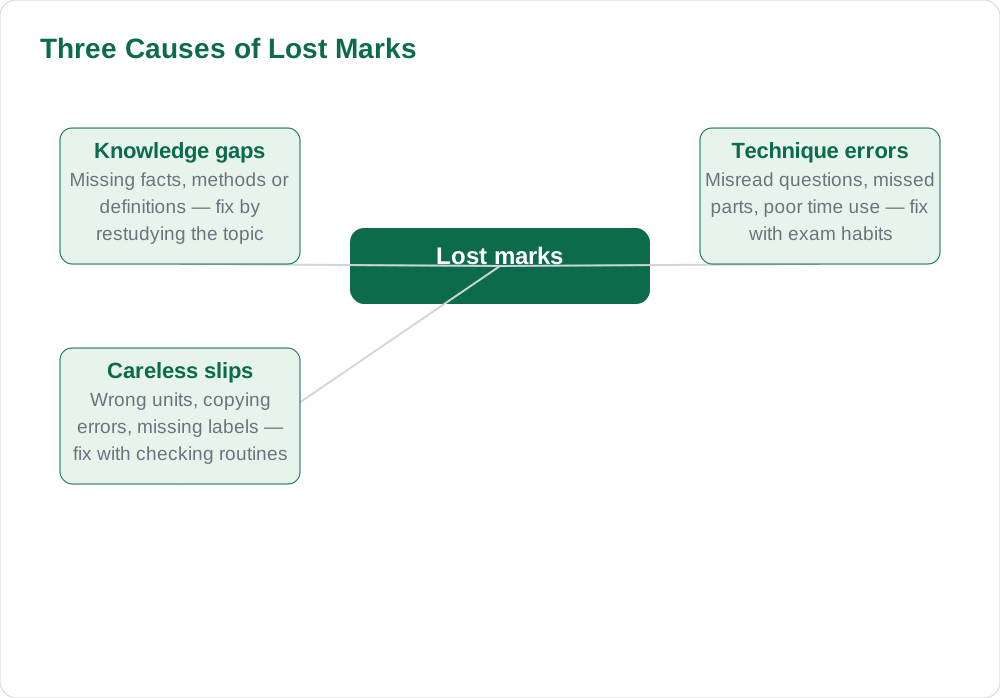
Lost marks fall into three groups, and the fix is different for each. Knowledge gaps mean you did not know the material: the fact, the method, or the definition was missing. Technique errors mean you knew the material but lost marks on execution: misreading the question, missing a part, running out of time, or writing off topic. Careless slips mean small errors in something you knew: a wrong unit, a copying error, an unlabelled diagram, a spelling slip.
Most pupils are surprised by the split. Technique errors and careless slips often cost as many marks as knowledge gaps — and they are usually faster to fix, because they need a habit change, not weeks of new study. Sorting your losses honestly is what turns a disappointing paper into a useful one.
Build a Mistake Log That Actually Helps
A mistake log is a short notebook — or a single page per subject — where you record each error, its cause, and one fix. Keep entries short and specific: not I must do better, but Q3(b) missed: did not read second part — fix: underline each part and tick it off. Specific entries are fixable; vague entries are not. Date each entry so you can see patterns over time.
Review the log before your next test or mock, not just after. Read your last few entries and say the fix to yourself before you start: Underline keywords. Check units. Leave ten minutes to check. This turns the log from a record of the past into a plan for the next paper. Pupils who keep a log find that the same errors stop appearing — which is exactly the point.
- Record each error with its cause and one specific fix — never a vague promise.
- Date each entry so you can spot errors that keep repeating.
- Read the log before the next paper, and check whether old errors reappear.
Rewrite the Answers You Got Wrong
For the questions where you lost the most marks, rewrite the answer correctly — from the textbook, from your teacher's feedback, or from your own corrected understanding. Rewriting is not punishment; it is the fastest way to replace a wrong memory with a right one. A question you rewrite correctly is a question you are unlikely to get wrong again, because you have now produced the right answer yourself.
Focus on the questions with the biggest losses and the clearest fixes. Rewriting every answer on the paper takes too long and dilutes the effort. Pick the top three to five questions, rewrite them well, and file them with your mistake log. If the same topic appears in the next paper, you will have a correct, practised answer ready.
Turn the Log Into a Plan for the Next Paper
A review ends with a plan, not a feeling. Take your mistake log and turn the top three errors into three actions for the next paper: for example, underline keywords on every question, reserve ten minutes for checking, and label every diagram. Write these three actions on a small card or at the front of your notes, and read them before the next paper starts.
Also plan your restudy: which topics need a fresh look, and which need only a quick refresh? Knowledge gaps get a study session; technique errors get a habit; careless slips get a checking routine. This split keeps your revision focused — you study what actually lost you marks, instead of rereading everything equally.
Keep It Calm and Forward-Looking
A paper review should leave you clearer, not smaller. A low score is information, not a verdict on your ability — it tells you what to fix, and fixing it is entirely within your control. Avoid comparing your score with classmates in a way that turns the review into a competition; the only comparison that matters is your next paper against this one.
If a paper went badly, talk to someone: your teacher, a parent, or a friend. A short conversation often turns a vague worry into a concrete plan, and that is the whole purpose of the review. For the habits that prevent repeat errors, see how to avoid common exam mistakes, how to manage time during exams, and how to revise the night before.
AI Help: Muse AI
Muse AI is Meta's personal AI assistant, and it can help you build your mistake log: describe the errors you made in a paper, and ask it to help you sort them into knowledge gaps, technique errors and careless slips with one fix each. Muse AI does not give official Sindh Textbook Board answers — always verify against your Sindh Textbook Board book and your teacher.
Join Muse with invite code LTGSWD — in the Muse app, go to Settings > Redeem token and enter the code.
Disclosure: LTGSWD is the author's Muse invite code.
5 key points you must know
- Read the examiner's marks and comments, not just the score.
- Sort lost marks into knowledge gaps, technique errors, and careless slips.
- Keep a dated mistake log with one specific fix per error.
- Rewrite the top three to five lost answers correctly from the textbook or feedback.
- Turn the top three errors into three actions for the next paper.
Frequently asked questions
What if my teacher did not write comments on my paper?
Do your own review: compare your answers with the textbook and sort the lost marks by cause. Then ask your teacher about the one or two questions you cannot explain yourself.
How long should a paper review take?
About thirty to forty-five minutes for a full paper is enough. The goal is a short mistake log and three actions, not a second full study session.
Should I review papers I did well on?
Yes, briefly. Even a good paper usually has a few lost marks, and fixing those small leaks is how good scores become better ones.
What if the same error keeps appearing in my log?
That is the log working — it has found a habit. Give that error a pre-paper reminder: read its fix aloud before the next paper starts, and check for it in your final ten-minute check.
Is it normal to feel upset about a low score?
Yes, completely. Let yourself feel it briefly, then move to the review. A plan turns the feeling into progress, and progress is what the next paper rewards.
Solved notes — preview free
These guides work best with the solved exercises. Preview the solved notes free on this website — 119 solved notes for Classes 6–10 in Sindhi, Urdu, English and Arabic medium. Or browse the full solved notes catalogue for your class and medium. New solved notes are added regularly — check the catalogue for coming-soon books.