Using Quotations Sparingly in Long Answers
Using quotations sparingly long answers is a matter of judgement: a well-chosen quotation can give an answer authority and colour, but a page stuffed with quotations suggests the writer has no argument of their own. Examiners reward answers in which the student's own reasoning leads and quotations support, not answers in which quotations do all the talking. This guide explains when a short quotation genuinely strengthens an answer, when paraphrase is the better choice, how to weave a quotation into your own sentence, and how to avoid the common errors — misquotation, over-quotation, and the dropped quotation that sits in the paragraph without any comment.
What a quotation is for in an exam answer
A quotation earns its place when it does something your own words cannot do as well: capture an idea in its original, memorable form, show that a point comes from a recognised source, or provide a precise phrase that the question itself turns on. In those cases, a short quotation acts as evidence and as emphasis at once. It tells the examiner that you know the source material and that you chose this particular wording deliberately, not that you are filling space.
A quotation fails when it merely repeats what you just said, when it is so long that it swallows the paragraph, or when it is included because you could not think of anything else to write. In all three cases the quotation weakens the answer, because it replaces your thinking instead of supporting it. Before including any quotation, ask a hard question: would the paragraph be weaker without it? If the answer is no, paraphrase or cut it.
When to quote and when to paraphrase
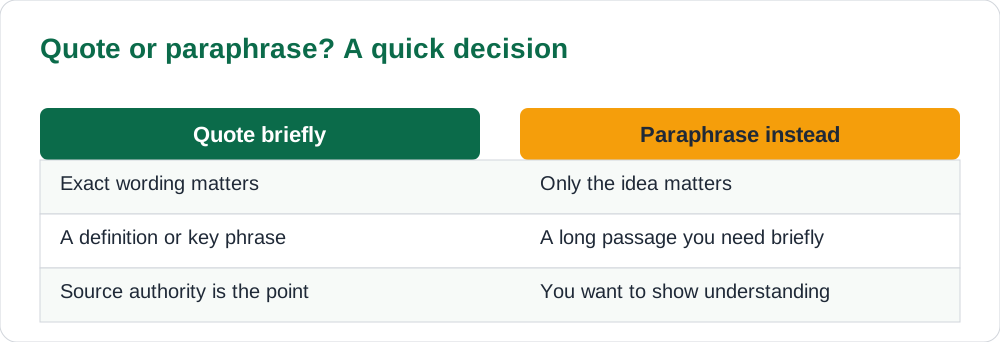
Quote when the exact wording matters: a definition, a famous formulation, or a phrase whose precision would be lost in paraphrase. Quote also when the source's authority is itself part of the point — for example, when showing that a teaching comes from a particular source studied in class. In both cases, keep the quotation short: a line or two, rarely more. A short quotation is easy to integrate, easy to check for accuracy, and easy for the examiner to read.
Paraphrase when the idea matters but the exact wording does not. Most of the time, this is the better choice: paraphrase shows that you understood the material well enough to restate it, it keeps the answer in your own voice, and it avoids the risk of misquoting. Paraphrase also lets you compress a long passage into the one sentence your argument actually needs. As a rule of thumb, if you are quoting more than paraphrasing in an answer, the balance has tipped the wrong way.
Weaving a quotation into your own sentence
A quotation should sit inside your own sentence, not beside it. Introduce it with a short clause that sets up its meaning — for example, noting what the source emphasises — then give the quotation, then comment on it in your own words. The comment is essential: it shows why the quotation is there and what it proves for your argument. A quotation without a comment is a dropped quotation, and examiners treat it as decoration rather than evidence.
Keep the grammar smooth: the quotation should fit the sentence around it, and you should not need to twist your sentence to accommodate it. If the fit is awkward, shorten the quotation or paraphrase part of it and quote only the key phrase. Accuracy matters throughout: quote only wording you know exactly, and never alter a quotation silently to suit your argument. If you are unsure of the exact words, paraphrase instead — an honest paraphrase always beats a guessed quotation.
- Introduce the quotation with a clause that sets up its meaning.
- Follow every quotation with a comment in your own words.
- Quote a line or two, not a whole passage.
- Quote only wording you know exactly; otherwise paraphrase.
- Never alter a quotation silently to fit your argument.
How many quotations is too many?
For a typical long answer, one or two short quotations are plenty, and many excellent answers contain none at all. There is no rule that an answer must contain a quotation, and inventing one to meet an imagined quota is a serious mistake. What matters is the argument: quotations are seasoning, and an answer that is mostly seasoning has no substance. If you find yourself reaching for a third or fourth quotation, stop and ask whether your own explanation could carry the paragraph instead.
The same restraint applies to length. A quotation of several lines interrupts the flow of your answer and shifts attention from your reasoning to someone else's words. It also increases the risk of an error, since a long quotation is harder to reproduce exactly. Short, well-placed quotations signal confidence and control; long, frequent ones signal dependence. Let your own voice dominate the answer, and let quotations appear only where they add something your voice cannot.
Checking quotations in revision
In revision, build a small, reliable collection of quotations you know exactly — from your own book and class teaching — rather than a long list you half-remember. For each one, write a sentence of context and a sentence of comment, so you practise using it, not just recalling it. Test yourself by writing the quotation from memory and checking it against the book; any quotation you cannot reproduce exactly should move to your paraphrase list instead.
Also practise the decision itself: take a draft paragraph and try it twice, once with a quotation and once paraphrased, and judge which version is stronger. This exercise trains the judgement that matters in the exam — not how many quotations you know, but when one helps. For the general answer frame, see Introduction, Body, Conclusion: A Frame for Long Questions, and for evidence method in a subject where sources matter greatly, see Supporting Islamiat Long Answers with Evidence and References. You can also browse books for topic organisation.
AI Help: Muse AI
Muse AI is Meta's personal AI assistant. You can ask it to explain a concept in simple words, summarise a lesson, or make practice questions for revision.
For this topic, ask Muse AI to help you paraphrase a passage in your own words, or to judge whether a draft paragraph needs a quotation at all.
Join Muse with invite code LTGSWD — in the Muse app, go to Settings > Redeem token and enter the code.
Disclosure: LTGSWD is the author's Muse invite code.
Muse AI does not give official STBB answers — always verify against your Sindh Textbook Board book and your teacher.
5 key points you must know
- A quotation must do something your own words cannot do as well.
- Quote briefly when exact wording or source authority matters; paraphrase otherwise.
- Weave quotations into your own sentence and always comment on them.
- One or two short quotations per long answer are plenty; none is also fine.
- Never guess a quotation — paraphrase honestly instead.
Frequently asked questions
Must a long answer contain a quotation to score well?
No. Many excellent long answers contain no quotations at all. Marks come from the argument, explanation, and evidence, and a quotation is only one kind of evidence. Never invent a quotation to meet an imagined quota.
How long should a quotation in an exam answer be?
A line or two is usually enough. Short quotations are easy to integrate, easy to reproduce accurately, and easy for the examiner to read. A quotation of several lines interrupts your argument and increases the risk of error.
What is a dropped quotation?
A quotation placed in a paragraph without any introduction or comment, so the reader cannot tell why it is there. Always introduce a quotation and follow it with your own comment explaining what it proves for your argument.
Is paraphrasing safer than quoting?
Usually, yes. Paraphrase shows understanding, keeps the answer in your voice, and avoids misquotation. Quote only when the exact wording or the source's authority is itself part of the point.
Solved notes — preview free
These guides work best with the solved exercises. Preview the solved notes free on this website — 119 solved notes for Classes 6–10 in Sindhi, Urdu, English and Arabic medium. Or browse the full solved notes catalogue for your class and medium. New solved notes are added regularly — check the catalogue for coming-soon books.