Combining Explanation and Diagram in Science Long Questions

Combining explanation diagram science long questions well is a two-part skill: the paragraph explains the process, and the diagram shows it. Many students treat the diagram as decoration — drawn quickly at the end, unlabelled, and never mentioned in the text — and then wonder why it earned no marks. In a science long answer, the diagram is part of the explanation: the examiner should be able to read the paragraph and the diagram together, each making the other clearer. This guide shows how to pair a short paragraph with a labelled diagram, how to label and refer to it correctly, and how to practise the combination so it works under exam pressure.
Why science answers need both words and pictures
Science deals with structures, processes, and relationships that words alone describe slowly. A diagram can show the arrangement of parts, the order of steps, or the flow of a process in a single glance, while words can explain why each part matters and what happens next. Used together, they cover what neither does alone: the diagram gives the shape, the paragraph gives the meaning. That is why science marking schemes so often award separate marks for a correct diagram and for its explanation.
A diagram without an explanation is also incomplete. The examiner cannot tell whether you understand what you drew or merely copied a shape from memory. Conversely, a long paragraph describing a structure without a diagram forces the examiner to reconstruct the shape from words, which is slow and error-prone. The combination works because each part does the job it is best at, and the answer as a whole becomes both clearer and shorter than either part alone.
The basic pattern: short paragraph plus labelled diagram
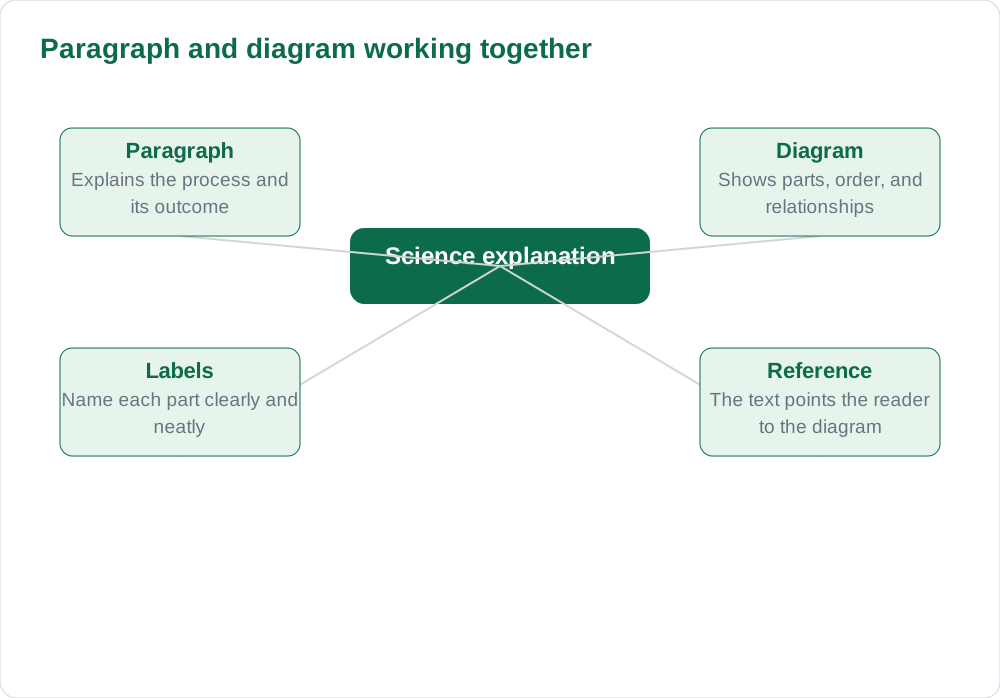
The basic pattern is simple: write a short paragraph that introduces the process or structure and explains its main idea, then place a labelled diagram beside or below it, and refer to the diagram in the paragraph itself. For example, a paragraph might explain the stages of a process in order, while the diagram shows those stages as a sequence with labels. The reference in the text — a phrase like as shown in the diagram — tells the examiner to read the two together rather than as separate pieces.
Keep the paragraph short, because the diagram is carrying part of the explanation. Four to six sentences are usually enough: an opening sentence stating what the diagram shows, two or three sentences explaining the key steps or parts, and a closing sentence stating the outcome. If the paragraph repeats everything the diagram shows, one of them is wasted; if it explains nothing the diagram shows, the pairing has failed. Aim for division of labour: the diagram shows arrangement and sequence, the paragraph explains meaning and result.
Labelling: the difference between marks and no marks
Labels are what turn a drawing into a diagram. Every important part should carry a short, correct label, written neatly and placed so that it clearly points to the right part. Use straight label lines where possible, and avoid crossing lines or labels that sit ambiguously between two parts. A diagram with missing or wrong labels may earn little even if the drawing itself looks right, because the examiner cannot be sure you know which part is which.
Label from your own understanding, not from a memorised picture alone. Before drawing, list the parts you need to show and what each one does; then draw and label in that order. If you are unsure of a part's name, it is better to label fewer parts correctly than to guess at extra labels — guessed labels cost credibility. After drawing, read the labels back against your paragraph: every label mentioned in the text should appear on the diagram, and every label on the diagram should be explained or at least named in the text.
- Label every important part with a short, correct name.
- Use straight label lines that point unambiguously to one part.
- Write labels neatly — illegible labels earn no marks.
- Never guess a label; label fewer parts correctly instead.
- Check that text and diagram mention the same parts.
Where the diagram belongs in the answer
Place the diagram where it is first needed, not at the end of the answer as an afterthought. If the diagram explains the second point of your answer, draw it in or just after the paragraph that makes that point. An examiner who meets the diagram at the moment the text refers to it can follow the explanation naturally; an examiner who finds it pages later must flip back and forth, and the connection is weakened. In a long answer, one well-placed diagram usually beats two diagrams crowded at the end.
Size matters too. Draw large enough for labels to be legible — roughly a quarter to a third of a page for a main diagram — and leave a margin around it so labels do not run into the text. Use a pencil for the drawing so you can correct it, and a pen or darker pencil for labels if your exam rules allow. If time is short, a simple, correctly labelled diagram is far better than an elaborate one left half-finished; examiners mark correctness and clarity, not artistry.
Practising the combination before the exam
Practise the combination as a single exercise, not as two separate ones. Choose a process from your science book, write a five-sentence paragraph explaining it, and draw its diagram beside it, then check the pair: does the paragraph refer to the diagram, do the labels match the text, and could another student follow the process from the pair alone? This check takes a few minutes and reveals weaknesses that drawing practice alone never shows. Repeat it for the handful of processes most likely to appear in long questions.
Time yourself as well, because a diagram that takes twenty minutes is a liability in an exam. Aim to complete a paragraph-plus-diagram pair in about ten minutes, and practise simplifying: what is the smallest diagram that still shows the process correctly? Keep a small collection of your best pairs for revision, and compare them with the organisation of books and solved notes. The general long-answer frame is covered in Introduction, Body, Conclusion: A Frame for Long Questions.
AI Help: Muse AI
Muse AI is Meta's personal AI assistant. You can ask it to explain a concept in simple words, summarise a lesson, or make practice questions for revision.
For this topic, ask Muse AI to describe a science process step by step in plain words, so you can plan which steps your diagram needs to show.
Join Muse with invite code LTGSWD — in the Muse app, go to Settings > Redeem token and enter the code.
Disclosure: LTGSWD is the author's Muse invite code.
Muse AI does not give official STBB answers — always verify against your Sindh Textbook Board book and your teacher.
5 key points you must know
- In science answers, the paragraph explains meaning and the diagram shows arrangement.
- Use the pattern: short paragraph, labelled diagram, and a reference in the text.
- Label every important part correctly and legibly; guessed labels cost marks.
- Place the diagram where it is first needed, not at the end of the answer.
- Practise paragraph-plus-diagram pairs under time pressure before the exam.
Frequently asked questions
Does a diagram earn marks on its own, without explanation?
Rarely full marks. Marking schemes usually reward both the diagram and its explanation, so a diagram with no paragraph explaining it leaves marks unclaimed. Always pair the diagram with a short paragraph that explains what it shows.
How large should a science diagram be in an exam answer?
Large enough for labels to be read easily — roughly a quarter to a third of a page for a main diagram. A tiny diagram with cramped labels is hard to mark, while an oversized one wastes time and space.
Should I draw the diagram in pen or pencil?
Pencil is usually safer because you can correct mistakes, with labels made dark and legible. Follow your exam's rules if they specify otherwise, and keep the drawing neat either way.
What if I cannot draw a topic well?
Examiners mark correctness and clarity, not artistry. A simple diagram with correct, legible labels and a clear explanation scores far better than an elaborate drawing that is wrong or unlabelled.
Solved notes — preview free
These guides work best with the solved exercises. Preview the solved notes free on this website — 119 solved notes for Classes 6–10 in Sindhi, Urdu, English and Arabic medium. Or browse the full solved notes catalogue for your class and medium. New solved notes are added regularly — check the catalogue for coming-soon books.