The Coordinate Plane: From Classroom Grids to Ordered Pairs
The coordinate plane is one of mathematics' most useful inventions: a way to describe exactly where something is using just two numbers. Long before pupils meet graphs in textbooks, they have used the same idea — finding a seat in a classroom, a square on a game board, a house on a street map. The coordinate plane simply gives that everyday skill a precise language. This article builds the plane from classroom grid games to ordered pairs, quadrants and simple lines, so pupils arrive at graphing with the feeling that they already know it. Every example is clearly illustrative, and the focus throughout is on understanding where points live and why the order of the two numbers matters.
Finding Places: Rows, Columns and Grid Games
Every pupil already knows how to find a square on a grid. In a game of battleships or a crossword, you name a row and a column, and the square is found. The classroom itself is a grid: rows of desks and columns of desks, and a pupil's seat can be described as row three, column four. The coordinate plane takes this familiar idea and makes it mathematical, replacing rows and columns with two number lines — one horizontal, one vertical — that cross at a point called the origin. The skill transfers directly: pupils who can find a seat can find a point.
A good first lesson is a grid game played on squared paper or on the classroom floor. The teacher calls out pairs of numbers, and pupils stand on or mark the matching square. Then the class reverses the game: a pupil stands on a square, and the class must name the pair. This two-way practice — pair to place, and place to pair — is the foundation of all coordinate work, and it should be thoroughly enjoyable before any formal vocabulary arrives. The solved notes on this site use the same game-first approach, and the books page lists the official texts to check against.
- A grid square is found by a row and a column — the coordinate plane works the same way.
- Practise both directions: pair to place, and place to pair.
- Play grid games before introducing formal vocabulary.
- The classroom itself is a grid: seats are coordinates pupils already use.
Ordered Pairs: Across First, Then Up
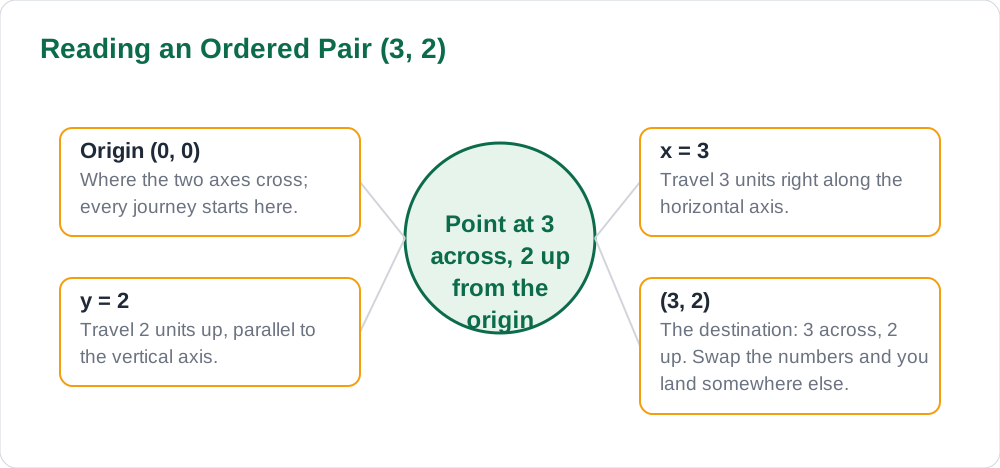
An ordered pair is written as (x, y): two numbers in brackets, separated by a comma. The first number, x, tells you how far to travel across — right for positive, left for negative. The second number, y, tells you how far to travel up or down — up for positive, down for negative. The word ordered is the warning: the order matters. The point (3, 2) is not the same as the point (2, 3). The first is three across and two up; the second is two across and three up. They are different places, and mixing them up is the most common coordinate error.
A memory aid that works well is the corridor-and-stairs image: walk along the corridor first (across, the x direction), then climb the stairs (up, the y direction). Pupils who picture the corridor and stairs rarely plot points in the wrong order, because the image matches the convention. Teachers should also give plenty of practice reading points: show a plotted point and ask for its ordered pair, because reading and plotting are two different skills and both need practice. A pupil who can do both has mastered the basics of the plane.
The Four Quadrants: Where Points Live
The two axes divide the plane into four regions called quadrants, numbered 1 to 4 in a counter-clockwise direction starting from the top right. In quadrant 1, both coordinates are positive. In quadrant 2, x is negative and y is positive. In quadrant 3, both are negative. In quadrant 4, x is positive and y is negative. Pupils do not need to memorise this as a table; they can work it out by asking: am I left or right of the origin, and above or below it? Left means negative x, below means negative y. Two questions, four answers, four quadrants.
Points on the axes themselves belong to no quadrant: a point like (0, 4) sits on the vertical axis, and (5, 0) sits on the horizontal axis. This is worth stating explicitly, because pupils often try to force axis points into a quadrant. A quick class game — the teacher names a point and pupils call out its quadrant or on an axis — builds fluency in minutes. Pupils should also practise plotting points in all four quadrants, not just the first, because exams test the full plane and the negative coordinates are where the errors hide.
- Quadrant 1: (+, +). Quadrant 2: (-, +). Quadrant 3: (-, -). Quadrant 4: (+, -).
- Work it out: left of origin means negative x, below origin means negative y.
- Points on an axis belong to no quadrant.
- Practise all four quadrants — negative coordinates are where errors hide.
Plotting Simple Lines: Points That Follow a Rule
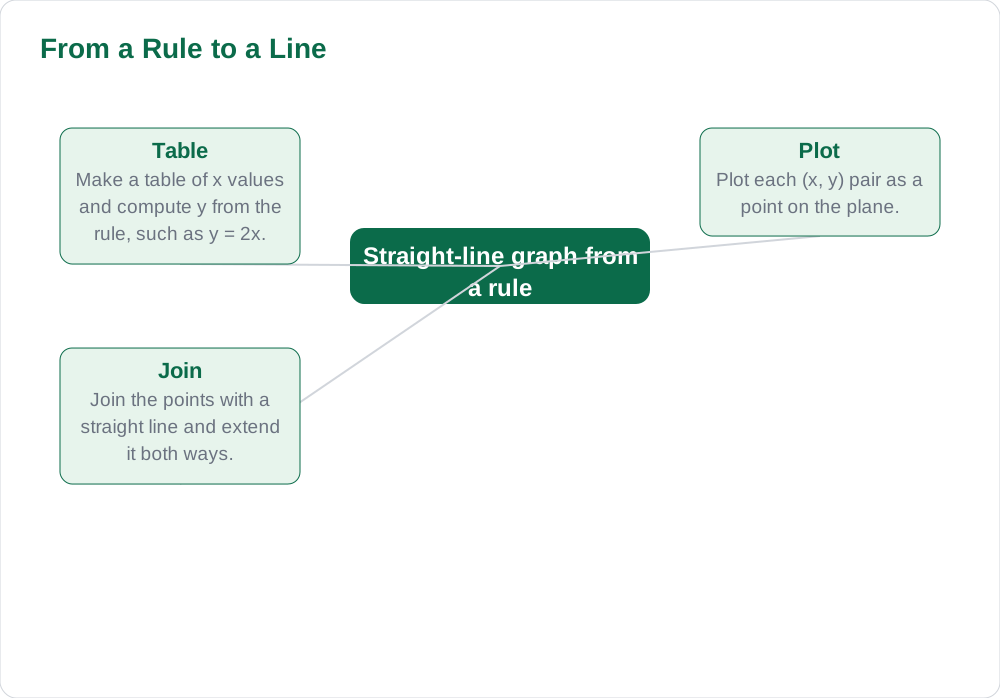
The coordinate plane becomes truly powerful when points follow a rule. Take the rule y equals x as an illustrative example: every point where the y value equals the x value. The points (0, 0), (1, 1), (2, 2) and (3, 3) all follow the rule, and plotting them shows a diagonal line climbing from the origin. Take the rule y equals 2x as an illustrative example: the points (0, 0), (1, 2), (2, 4) and (3, 6) form a steeper diagonal. Pupils who plot points from a table of values and then join them discover that a straight-line rule makes a straight-line graph, which is the beginning of all graph work.
Teachers should let pupils discover the patterns rather than announcing them. Give three tables of values from three rules, ask pupils to plot each set, and let the class compare the pictures: which line is steepest, which is flat, which passes through the origin? The discussion builds the intuition that later makes gradient and intercept meaningful. A pupil who has seen that y equals 2x is steeper than y equals x will understand slope as a real property of a line, not as a formula to memorise.
Coordinates in Real Life: Maps, Games and Data
Coordinates are everywhere once pupils start noticing them. Street maps use grid references, board games use rows and columns, and a cinema seat is described by a row letter and a seat number — a coordinate pair in disguise. In geography, latitude and longitude are coordinates for the whole planet. In science, the coordinate plane carries experimental data: temperature against time, height against age. Pupils who see coordinates as a general tool for locating things, rather than as a maths-only topic, remember them far longer.
A rich classroom project is to map the school: draw a grid over a sketch of the school grounds, and give each building a coordinate pair. Then ask pupils to write directions as coordinate journeys: from the gate at (0, 0) to the library at (4, 3). The project combines coordinates with real navigation, and it gives pupils a reason to be precise. For pupils ready to go further, the next step is reading values from a plotted line — for example, finding the y value when x equals 5 — which turns the plane from a place for points into a tool for prediction. For more step-by-step guides, see the blog and the guide to first steps in algebra.
AI Help: Muse AI
Muse AI is Meta's personal AI assistant, and it can help with this topic by describing where a point like (-3, 2) sits, naming its quadrant, or by making tables of values for a rule such as y = 2x so you can practise plotting.
Join Muse with invite code LTGSWD — in the Muse app, go to Settings > Redeem token and enter the code.
Disclosure: LTGSWD is the author's Muse invite code.
Muse AI does not give official STBB answers — always verify against your Sindh Textbook Board book and your teacher.
5 key points you must know
- An ordered pair (x, y) means x across, then y up — the order matters.
- Corridor first, then stairs: travel along the x-axis, then parallel to the y-axis.
- The axes divide the plane into four quadrants; axis points belong to no quadrant.
- Points that follow a rule form a pattern: straight-line rules make straight-line graphs.
- Coordinates are a general locating tool: maps, games, seats, latitude and longitude.
Frequently asked questions
What is the difference between (3, 2) and (2, 3)?
They are different points. (3, 2) means 3 across and 2 up; (2, 3) means 2 across and 3 up. That is why pairs are called ordered — the order of the two numbers matters. Swapping them lands you in a different place on the plane.
How do I remember which number comes first?
Use the corridor-and-stairs image: walk along the corridor first (across, the x direction), then climb the stairs (up, the y direction). The x-coordinate is always written first in the pair (x, y), and it always describes the across movement.
Which quadrant is the point (-4, -2) in?
Quadrant 3, because both coordinates are negative: left of the origin and below it. A quick check: left means negative x, below means negative y, and (-, -) is quadrant 3. Points with one zero, such as (0, 4), sit on an axis and belong to no quadrant.
What is the origin?
The origin is the point (0, 0), where the horizontal and vertical axes cross. Every plotting journey starts there: travel x units across from the origin, then y units up or down. It is the reference point for the whole plane.
How do I plot a line like y = 2x?
Make a table of x values, compute y for each using the rule, plot the resulting (x, y) points, and join them with a straight line. For y = 2x, the points (0, 0), (1, 2) and (2, 4) lie on a straight line through the origin. Always plot at least three points so an error in one stands out.
Solved notes — preview free
These guides work best with the solved exercises. Preview the solved notes free on this website — 119 solved notes for Classes 6–10 in Sindhi, Urdu, English and Arabic medium. Or browse the full solved notes catalogue for your class and medium. New solved notes are added regularly — check the catalogue for coming-soon books.