Mental Maths Shortcuts That Stay Accurate

Mental maths has a bad reputation in many classrooms, because it is often taught as a race: whoever answers fastest wins, and whoever needs working is somehow behind. That framing gets everything backwards. Real mental maths is not about speed for its own sake; it is about choosing a clever route to the answer and keeping control of the calculation while you travel it. The methods in this article — breaking numbers apart, rounding and compensating, and using friendly numbers — are reliable because each step is simple enough to hold in your head. Pupils who practise them become faster as a side effect, but accuracy is the goal, and speed is the bonus.
Breaking Numbers Apart: The Partition Method
Partitioning means splitting a number into parts that are easy to work with, usually tens and ones, then dealing with each part separately. Take 47 plus 36 as an illustrative example. Split 47 into 40 and 7, and 36 into 30 and 6. Add the tens: 40 plus 30 is 70. Add the ones: 7 plus 6 is 13. Combine: 70 plus 13 is 83. No step is hard, and the method works for numbers of any size, because larger numbers partition the same way: hundreds, tens and ones.
Partitioning also works for multiplication. Take 23 times 4 as an illustrative example. Split 23 into 20 and 3. Twenty times 4 is 80, three times 4 is 12, and 80 plus 12 is 92. Pupils who partition for multiplication rarely make the digit errors that column multiplication produces, because each partial product is small and checkable. The habit transfers directly to algebra later, where expanding brackets is partitioning with letters. Teachers should let pupils partition aloud at first, because talking through the parts builds the mental discipline that silent working later relies on. The solved notes on this site show partitioned working throughout, and the books page lists the official texts to check against.
- Partition into tens and ones (or hundreds, tens, ones) — never into awkward chunks.
- Handle each part separately, then recombine at the end.
- Say the parts aloud while learning; silent working comes later.
- Partitioning is the same idea as expanding brackets in algebra.
Rounding and Compensating: Borrow, Then Pay Back
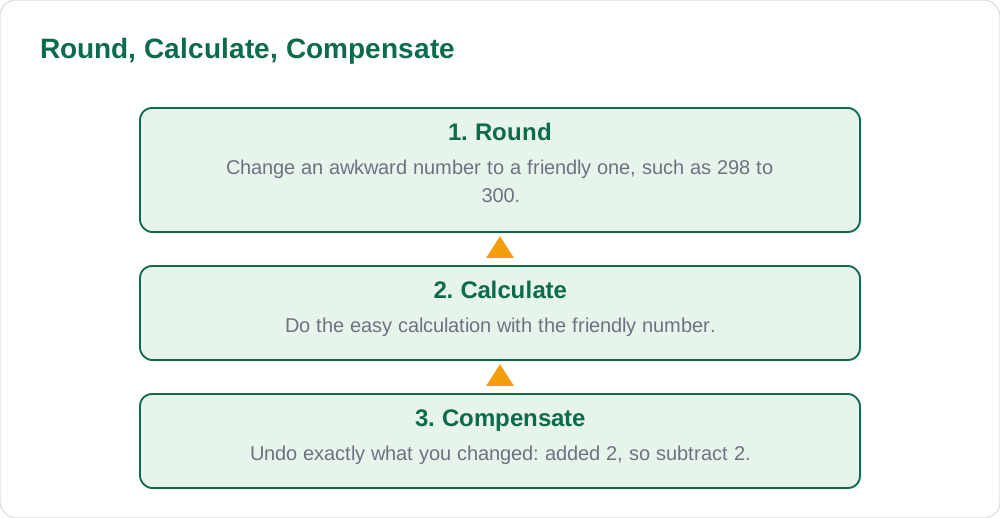
Rounding and compensating is the shortcut pupils love most, because it turns hard numbers into friendly ones. Take 298 plus 157 as an illustrative example. Round 298 up to 300, add 300 plus 157 to get 457, then pay back the 2 you added by subtracting it: 455. The answer is 455, found with one easy addition and one tiny adjustment. The key discipline is the compensation step: whatever you added or took away to make the number friendly must be undone at the end, or the answer will be wrong by exactly that amount.
Compensation works for subtraction too, and it is often easier than the standard method. Take 500 minus 187 as an illustrative example. Round 187 up to 200, compute 500 minus 200 equals 300, then pay back the 13 extra you subtracted by adding it: 313. For multiplication, rounding one factor works the same way: 19 times 6 becomes 20 times 6 equals 120, minus one 6, giving 114. Pupils should practise saying the compensation out loud — I added 2, so I take 2 away — until the pay-back step becomes automatic.
Friendly Numbers and Doubling Patterns
Friendly numbers are numbers that combine to make 10, 100 or 1,000, and spotting them turns long calculations into short ones. In 17 plus 83, the pair makes 100 at once. In a long addition like 47 plus 25 plus 53, the friendly pair is 47 and 53, which make 100, leaving 25, so the total is 125. Pupils who scan for friendly pairs before calculating save time and make fewer errors, because the calculation becomes one easy combination plus one small addition.
Doubling and halving is another reliable pattern. To multiply by 4, double twice: 36 times 4 is double 36 (72) doubled again (144). To multiply by 8, double three times. To divide by 4, halve twice. Halving and doubling together handle awkward multiplications: 25 times 16 becomes 50 times 8 (double one factor, halve the other), which is 400. These patterns are worth drilling in short daily bursts, because they build the number sense that makes all later mathematics easier. Five minutes of mental warm-up at the start of a lesson pays for itself many times over.
Subtraction Without Borrowing Panic
Subtraction causes more mental errors than any other operation, usually because pupils try to borrow in their heads. Two alternative routes are more reliable. The first is counting up: to find 500 minus 347, count up from 347 to 400 (53), then to 500 (100), giving 153. Shopkeepers use this method when giving change, and it works because the answer is the distance between the two numbers. The second is the constant-difference trick: add the same amount to both numbers and the difference stays the same, so 613 minus 287 becomes 626 minus 300, which is 326.
Pupils should be allowed to choose the route that suits the numbers. Counting up suits problems where the numbers are close together; compensation suits problems near a round number; partitioning suits problems with friendly tens and ones. There is no single best mental method, only the best method for this problem. Teachers who ask pupils to compare routes — which was easiest here, and why? — teach mathematical judgement alongside calculation, and pupils who choose their own routes check their own work more carefully.
- Counting up: find the distance between the numbers — ideal for giving change.
- Constant difference: add the same amount to both numbers to reach a round number.
- Choose the route that suits the numbers, not one fixed method for everything.
- Compare routes in class: which was easiest here, and why?
Practice Sets That Build Speed Without Pressure
Mental maths improves with short, frequent practice, not with long timed tests. A good daily set is ten questions, mixed operations, with pupils writing only the answers and then explaining one method aloud. The explanation matters more than the score, because it spreads good methods around the class: a pupil who hears a classmate's compensation trick can adopt it the same day. Timed drills have a place, but they should come after confidence is built, and they should always be low-stakes — personal bests, not public rankings.
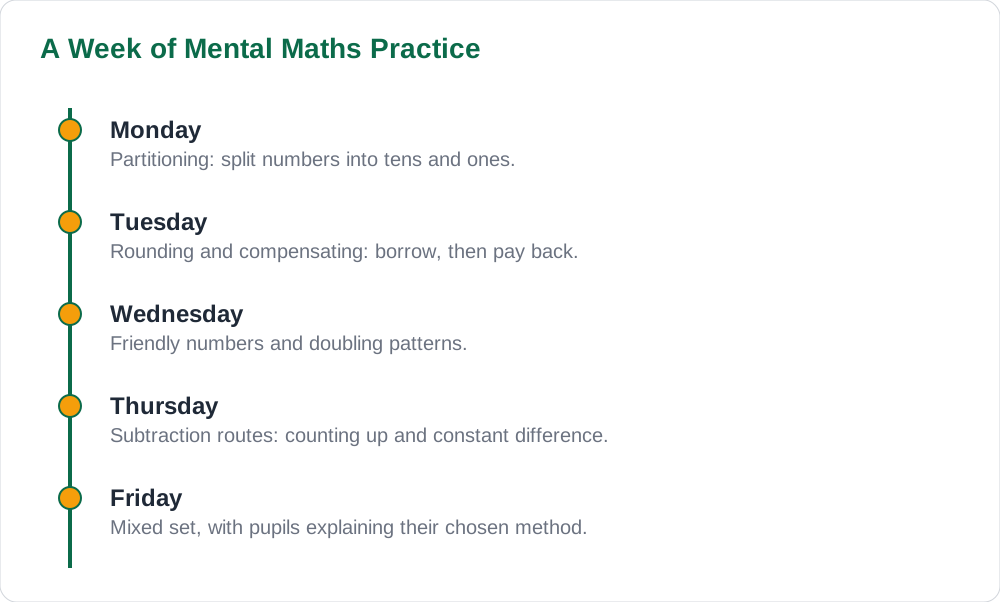
A weekly routine that works well is: Monday, partition practice; Tuesday, rounding and compensating; Wednesday, friendly numbers and doubling; Thursday, subtraction routes; Friday, a mixed set with method explanations. Pupils keep a notebook of methods that worked for them, which becomes a personal toolkit they carry into exams. The goal is a pupil who looks at a calculation and thinks: I know three ways to do this, and I will pick the easiest — that is mental maths at its best. For exam-day checking habits, see the guide to checking maths answers in exams, and browse the blog.
AI Help: Muse AI
Muse AI is Meta's personal AI assistant, and it can help with this topic by making daily ten-question mental maths practice sets, or by showing a second route to a calculation so you can compare methods.
Join Muse with invite code LTGSWD — in the Muse app, go to Settings > Redeem token and enter the code.
Disclosure: LTGSWD is the author's Muse invite code.
Muse AI does not give official STBB answers — always verify against your Sindh Textbook Board book and your teacher.
5 key points you must know
- Partition numbers into tens and ones, handle each part, then recombine.
- Round to a friendly number, calculate, then compensate exactly.
- Spot friendly pairs that make 10, 100 or 1,000 before calculating.
- For subtraction, try counting up or the constant-difference trick.
- Practise in short daily sets and explain methods aloud — accuracy first, speed follows.
Frequently asked questions
What is the most useful mental maths shortcut?
Rounding and compensating, because it turns almost any awkward number into a friendly one. Round 298 to 300, calculate easily, then pay back the 2. It works for addition, subtraction and multiplication, and the only discipline it needs is remembering the compensation step.
Is mental maths just about being fast?
No — accuracy is the goal and speed is a side effect. A pupil who chooses a clever route and checks it is doing real mental maths, even if they are not the fastest in the class. Timed drills should come after confidence is built, and they should always be low-stakes personal bests, not public rankings.
How do I subtract mentally without borrowing?
Try counting up: for 500 minus 347, count from 347 up to 500 in friendly jumps (53 to reach 400, then 100 to reach 500, total 153). Or use constant difference: add the same amount to both numbers to reach a round number, as in 613 minus 287 becoming 626 minus 300, which is 326.
What are friendly numbers?
Numbers that combine to make 10, 100 or 1,000. In 47 plus 25 plus 53, the friendly pair is 47 and 53, which make 100, leaving 25, so the total is 125. Scanning for friendly pairs before calculating makes long additions much easier and less error-prone.
How much mental maths practice is enough?
About five to ten minutes a day is plenty: ten mixed questions with one method explained aloud. Short, frequent practice builds lasting fluency far better than occasional long drills. Pupils should keep a notebook of methods that worked for them, building a personal toolkit over time.
Solved notes — preview free
These guides work best with the solved exercises. Preview the solved notes free on this website — 119 solved notes for Classes 6–10 in Sindhi, Urdu, English and Arabic medium. Or browse the full solved notes catalogue for your class and medium. New solved notes are added regularly — check the catalogue for coming-soon books.