Solving English Vocabulary MCQs with Context Clues
Solving English vocabulary MCQs with context clues is a skill every student can learn, even without memorising thousands of words. In Sindh board English papers, vocabulary questions often place an unfamiliar word inside a sentence, and the surrounding words quietly give away its meaning. Clues may come from a definition in the same sentence, an example that follows, a contrast word like but or however, or the overall tone of the passage. Learning to spot these clues turns a vocabulary question from a memory test into a reading puzzle you can solve. This guide explains the main types of context clues, shows how to use grammar and word parts alongside them, and gives you a method for choosing confidently even when the word itself is completely new to you.
Read the Whole Sentence, Not Just the Word
The biggest mistake in vocabulary MCQs is staring at the unknown word in isolation, hoping its meaning will appear. Instead, read the entire sentence twice, and then read the sentences before and after it, because context clues often sit nearby rather than beside the word itself. Ask yourself what kind of word the sentence needs: a positive or negative word, an action or a description, something strong or gentle? That rough sense of the meaning already eliminates options that clash with the sentence's tone, even before you work out the exact definition. Many students find that two options disappear at this stage, leaving a much easier choice.
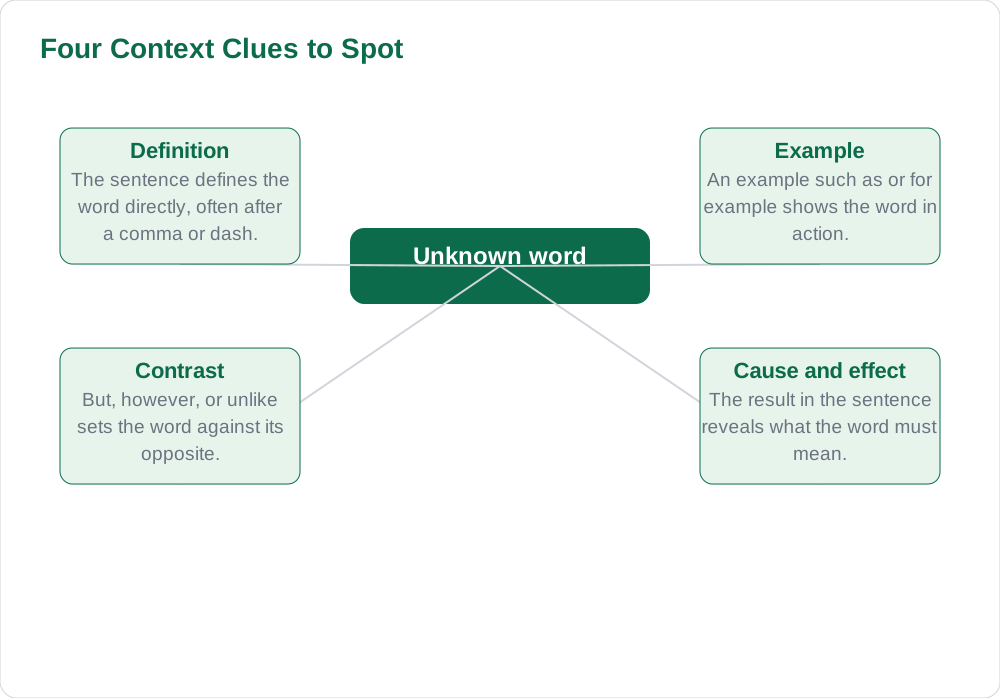
Pay attention to punctuation as well, since commas, dashes, and brackets often introduce a definition or restatement of the unknown word. A phrase set off by commas right after the word may explain it directly, and a clause beginning with words like that is or in other words signals a definition is coming. Similarly, examples introduced by such as or for example show the word in action, and the example's meaning usually matches the word closely. Training your eye to notice these signals is the heart of context-clue reading, and it improves your general reading comprehension at the same time. More English study tips are on the blog.
Definition, Example, and Contrast Clues
Definition clues are the easiest to use: the sentence defines the word directly, sometimes with an appositive phrase or a clause. Example clues work differently, giving one or more instances of the word's meaning, so you infer the general idea from the specific example. Contrast clues use words like but, however, unlike, or although to set the unknown word against its opposite, which tells you the word means roughly the reverse of the known word. For instance, in a practice sentence where a character is described as unlike his generous brother, the context suggests a word meaning the opposite of generous, and options can be judged against that sense.
Synonym clues place a known word with a similar meaning near the unknown word, often joined by and or or, which narrows the meaning quickly. Cause-and-effect clues work through logic: if the sentence says a word's action led to a particular result, the word's meaning must fit that result. Learning to name the clue type as you read, saying to yourself that this is a contrast clue or this is an example clue, makes the process deliberate instead of accidental. After a few weeks of practice, you will spot clue types automatically, and vocabulary questions will feel less like guessing and more like detective work. See also Reading MCQ Stems Carefully: Negatives and Traps.
Using Tone, Grammar, and Word Parts
Tone is a powerful clue that students often ignore. If a sentence praises someone, the unknown word is probably positive, and if it criticises, the word is probably negative. Check the adjectives and verbs around the word, since they usually share its emotional colour. Grammar helps too: the word's part of speech, shown by its position and ending, tells you whether the options must be nouns, verbs, or adjectives, and options of the wrong part of speech can be eliminated at once. A word following the or a is likely a noun, a word following very or extremely is likely an adjective, and these small grammar checks remove options that meaning alone might leave open.
Word parts offer a second line of evidence when context alone is not enough. Prefixes like un, dis, and re, suffixes like ful, less, and ness, and familiar roots can suggest a word's direction or category. Use word parts as supporting evidence, never as proof on their own, because English has many misleading lookalikes. Combine all three sources, context, grammar, and word parts, and choose the option that fits all of them; an option that fits the context but breaks the grammar, or fits the grammar but clashes with the tone, is probably a distractor. This combined check is what makes context-clue solving reliable rather than lucky. The books page lists the English textbooks these questions come from.
Testing Each Option in the Sentence
Once you have a rough predicted meaning, test each option by placing it into the sentence in place of the unknown word and reading the whole sentence aloud in your head. The correct option will make the sentence sound natural and sensible, while wrong options will sound odd, break the grammar, or clash with the tone. This substitution test is the most reliable final check, because it uses the sentence itself as the judge rather than your memory of definitions. Do it for every option, not just your favourite, since a distractor may sound plausible in isolation but fail when placed in the full sentence.
Be careful with options that are near-synonyms of the correct answer but carry a different shade of meaning. English has many words that overlap yet differ in strength or feeling, such as happy versus delighted, or tired versus exhausted, and the context usually demands one shade rather than another. Check the sentence's intensity: a mild situation needs a mild word, while a dramatic situation needs a strong one. If two options both fit grammatically, choose the one whose strength and tone match the sentence best. This attention to shade is what separates good vocabulary scores from excellent ones, and it develops naturally as you read more English. Visit the solved notes for English revision material.
Building Vocabulary Through Reading
Context clues help in exams, but the long-term way to improve vocabulary scores is reading regularly. Read English stories, newspaper articles, and your textbook lessons with a notebook nearby, and when you meet an unknown word, try to guess its meaning from context before checking a dictionary. Write down the word, your guessed meaning, and the sentence it came from, and review the notebook weekly. This habit teaches you both new words and the clue-spotting skill at the same time, and it is far more effective than memorising word lists without sentences, because exam questions always test words in context.
In the exam, stay calm when you meet an unknown word, since panic shuts down exactly the careful reading that context clues need. Work through the method steadily: read the sentence, spot the clue type, predict the meaning, eliminate misfits, and test the survivors in the sentence. If you still cannot decide, choose the option that best matches the sentence's tone and grammar, mark the question, and move on. A calm, methodical attempt at a vocabulary question beats a rushed guess, and the time you save by not panicking can be spent on questions you know well. For exam calm, read Guessing vs Skipping in MCQs: A Calm Strategy.
AI Help: Muse AI
Muse AI is Meta's personal AI assistant, and it can help you practise English vocabulary MCQs with context clues. For example, you can ask it to create sentences with an unknown word and explain which context clue reveals its meaning.
Join Muse with invite code LTGSWD — in the Muse app, go to Settings > Redeem token and enter the code.
Disclosure: LTGSWD is the author's Muse invite code.
Muse AI does not give official STBB answers — always verify against your Sindh Textbook Board book and your teacher.
5 key points you must know
- Read the whole sentence and its neighbours, not just the unknown word in isolation.
- Name the clue type: definition, example, contrast, synonym, or cause and effect.
- Use tone, grammar, and word parts as supporting evidence alongside context.
- Test each option by substituting it into the sentence and checking sense, grammar, and tone.
- Build vocabulary by guessing from context while reading, then checking a dictionary.
Frequently asked questions
What if the sentence gives no obvious clue?
Then use tone and grammar: decide whether the word must be positive or negative, and what part of speech it must be. Eliminate options that fail those tests, then choose the survivor that best fits the sentence's overall sense.
Should I memorise word lists for vocabulary MCQs?
Word lists help, but words learned in sentences stick better and match how exams test them. Combine short lists with regular reading, and always learn each new word inside an example sentence rather than alone.
How do I handle two options that both seem correct?
Compare their shades of meaning and strength against the sentence's tone and intensity. The context usually demands one shade: a mild situation needs a mild word, a dramatic one a strong word. Substitute each option and see which makes the sentence sound most natural.
Can word parts alone tell me the meaning?
Word parts give useful hints, but English has misleading lookalikes, so never rely on them alone. Use prefixes, suffixes, and roots as supporting evidence together with context clues and grammar checks.
Solved notes — preview free
These guides work best with the solved exercises. Preview the solved notes free on this website — 119 solved notes for Classes 6–10 in Sindhi, Urdu, English and Arabic medium. Or browse the full solved notes catalogue for your class and medium. New solved notes are added regularly — check the catalogue for coming-soon books.