How Parents Can Help a Child Read at Home

Parents often ask how they can help a child read better, and worry that they need special training or expensive books to make a difference. In truth, the most powerful help is simple and free: fifteen minutes of reading together every day, with patience, questions, and praise. This article shows parents how to build a read-together routine at home that grows a child's confidence, vocabulary, and love of reading. You do not need to be a perfect reader yourself, and you do not need to correct every mistake; you need a regular time, a book your child enjoys, and a calm attitude that makes reading feel like a pleasure rather than a test. Small daily steps, repeated with love, change a child's reading more than any occasional long session.
Start with Fifteen Minutes at the Same Time Daily
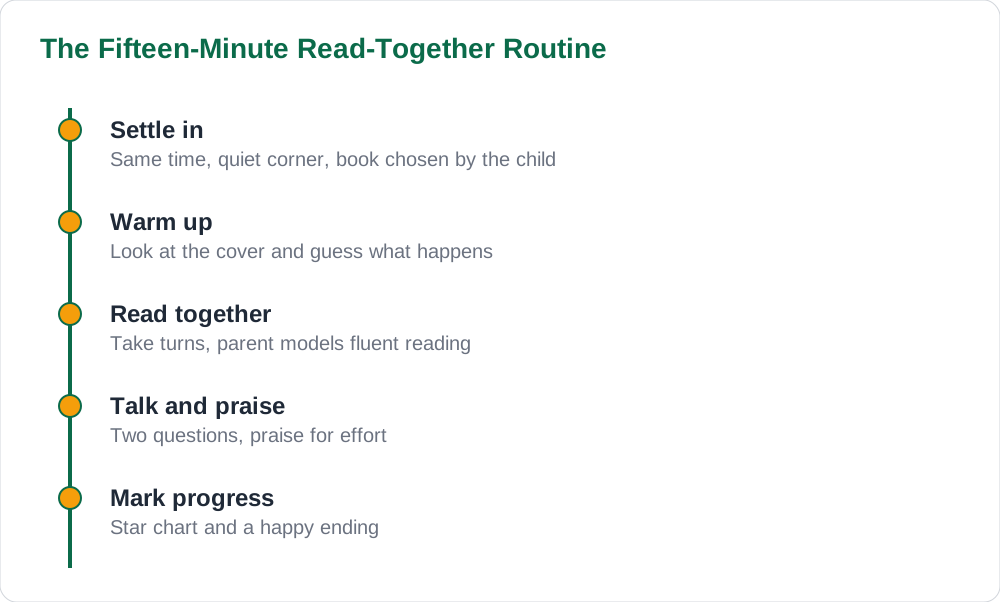
Reading improves through regular practice, so choose a fixed fifteen-minute slot each day and protect it like any other family routine. After dinner, before bed, or after homework are all good times, as long as the child is not too tired and the house is relatively calm. Sit together somewhere comfortable, away from the television, and let the child choose the book whenever possible, because a child who picks a story about animals, heroes, or funny characters will try much harder than one forced through a boring text. If school books are the only option, alternate a school book with a storybook so reading stays enjoyable.
Keep the session short and positive, especially at first, because fifteen happy minutes beat forty-five miserable ones. If the child is enjoying the book, you may continue a little longer, but never force extra pages once frustration appears, since ending on a good note makes the child eager for tomorrow. Mark progress visibly, such as a star chart for each day read, and celebrate milestones like finishing a book or reading for a whole week. Consistency matters more than speed: a family that reads together daily, even briefly, builds a habit that lasts for years. The solved notes can help parents see what their child is studying at school.
Read Together: Take Turns and Model Good Reading
Reading together does not mean listening silently while the child struggles alone; it means sharing the reading so the child feels supported. Take turns by paragraph or page, read the first sentence of a hard passage yourself, or read together in chorus for a tricky section, so the child hears fluent reading and can copy your pace and expression. Read with feeling, using different voices for characters and pausing at full stops, because children learn that reading is about meaning and enjoyment, not just sounding out words. When you model good reading, your child absorbs rhythm, punctuation, and story sense without a formal lesson.
Let the child read most of the time, but step in smoothly when they stall, by supplying a difficult word after a few seconds rather than letting them struggle in silence. A gentle prompt such as look at the picture, or what sound does this letter make, teaches the child strategies for tackling new words independently. Avoid turning every page into a test by asking the child to read the same passage repeatedly, since that kills enjoyment; instead, move on and return to tricky words another day. The goal of shared reading is confidence, and a child who feels supported will volunteer to read more. Browse the book collection to find suitable reading material by class and subject.
Ask Questions That Build Understanding
Reading is not only about pronouncing words correctly; it is about understanding the story, and questions are how parents check and deepen that understanding. Before reading, ask the child to guess from the cover or pictures what might happen, which activates their thinking and curiosity. During reading, pause occasionally to ask simple questions such as why did the character do that, or what do you think happens next, and accept any sensible answer rather than hunting for one correct response. After reading, ask the child to retell the story in their own words, naming the main character, the problem, and how it ended, which is one of the best checks of understanding.
Keep questions light and conversational, because an interrogation after every page will make a child dread reading time. Two or three good questions per session are plenty, and the best questions often start with why and how, since they invite thinking rather than yes-or-no answers. If the child cannot answer, help by rereading the relevant sentence together and talking about it, rather than simply giving the answer. Questions also build vocabulary naturally: when a new word appears, explain it briefly with an example from daily life, and use it again later in conversation. The blog offers more study tips for families supporting learning at home.
Handle Mistakes with Patience and Praise
How a parent reacts to mistakes decides whether a child loves reading or fears it, so treat errors as a normal part of learning. When a child misreads a word, wait a few seconds to let them self-correct, then supply the word calmly and ask them to reread the sentence so the story keeps flowing. Do not correct every single mistake, especially small ones that do not change the meaning, because constant interruption breaks concentration and confidence. Focus corrections on words that matter for understanding, and praise the child's effort, persistence, and good guesses, not only perfect accuracy.
Praise specifically so the child knows what to repeat: you read that long word all by yourself, or you remembered to pause at the full stop, works far better than a general good. If the child is tired, frustrated, or upset, stop the session kindly and try again tomorrow, because forcing a distressed child to continue teaches them to hate reading. Remember that progress is often slow and uneven, with plateaus followed by sudden jumps, so compare your child only with their own past reading, never with siblings or neighbours. A patient parent who celebrates small wins raises a confident reader. The [home page](/) is a good starting point for families exploring this site.
Build a Reading Home Beyond the Fifteen Minutes
The fifteen-minute routine works best inside a home where reading is visible and valued, so let children see adults reading too, whether books, newspapers, or messages. Keep books within reach, in a small box or shelf the child can browse freely, and visit a library, school shelf, or book stall when you can, letting the child choose. Talk about stories at other times of the day, such as retelling a funny part at dinner or wondering aloud what a character will do next, which keeps reading alive beyond the session. Even labels, shop signs, and recipes count as reading practice, so point them out naturally during daily life.
If your child struggles badly despite regular practice, or seems to avoid reading with real distress, speak to their teacher early rather than waiting for the problem to grow. Teachers can check whether the book level is right, whether eyesight or another issue needs attention, and can suggest suitable material. Share what you observe at home, such as which words confuse your child or which stories they love, since that information helps the teacher help your child. Reading is a partnership between home and school, and your daily fifteen minutes are one of the most valuable contributions you can make. For questions, use the contact page.
AI Help: Muse AI
Muse AI is Meta's personal AI assistant, and it can help parents find age-appropriate story ideas, suggest simple questions to ask after reading, or explain a difficult word in easy language. Try asking it for three discussion questions about a story your child is reading, then use them during your next read-together session.
Join Muse with invite code LTGSWD — in the Muse app, go to Settings > Redeem token and enter the code.
Disclosure: LTGSWD is the author's Muse invite code.
Muse AI does not give official STBB answers — always verify against your Sindh Textbook Board book and your teacher.
5 key points you must know
- Read together for fifteen minutes daily at a fixed, calm time.
- Let the child choose books and take turns so reading feels shared.
- Ask a few why and how questions to build understanding, not just pronunciation.
- Correct gently, praise specific effort, and stop before frustration grows.
- Make reading visible at home and talk to the teacher if struggles persist.
Frequently asked questions
What if I am not a confident reader myself?
You can still help greatly. Take turns, read easier books together, and use pictures and discussion. Your encouragement and regular time matter more than perfect reading.
Should I correct every mistake my child makes?
No. Wait for self-correction, supply difficult words calmly, and focus on mistakes that change meaning. Constant correction breaks confidence and enjoyment.
What kind of book should my child read?
A book the child enjoys and can read mostly independently, with only a few hard words per page. Let them choose, and alternate school books with storybooks they love.
How long before I see improvement?
Progress is gradual and uneven, but most children show growing confidence within a few weeks of daily reading. Celebrate small wins and compare your child only with their own past reading.
Solved notes — preview free
These guides work best with the solved exercises. Preview the solved notes free on this website — 119 solved notes for Classes 6–10 in Sindhi, Urdu, English and Arabic medium. Or browse the full solved notes catalogue for your class and medium. New solved notes are added regularly — check the catalogue for coming-soon books.