Magnetism, Compasses and Magnetic Fields

A magnet can pull a nail across a table without touching it, and a compass needle always swings back to point north, however you turn it. Both effects come from magnetism, an invisible influence that acts through space around a magnet. Every magnet has two poles, north and south, and the region around the magnet where its influence can be felt is called its magnetic field. You cannot see the field, but you can make it visible with iron filings, and you can feel it when two magnets push each other apart. This article explains magnetism from its simplest rules to its most useful instrument, the compass. You will learn the law of poles, how to draw magnetic field lines, why the Earth itself behaves like a giant magnet, and how a compass uses that to point north. You will also learn how to make a simple compass safely with a magnetised needle, and how magnets are used in everyday devices. By the end, the compass in your pocket will no longer be a mystery: it will be a small magnet turning in the Earth's own magnetic field.
Magnets and Their Poles
A magnet is an object that attracts materials made of iron, nickel, or cobalt, called magnetic materials. It does not attract wood, plastic, paper, or most other metals like aluminium or copper. A bar magnet has two poles: a north pole and a south pole. The poles are the places where the magnet is strongest, usually at its ends. If you hang a magnet freely, it swings until its north pole points roughly toward the Earth's north, which is how the poles got their names.
The law of poles is simple: like poles repel each other, and unlike poles attract each other. Two north poles push apart, two south poles push apart, and a north pole and a south pole pull together. You can feel both effects by holding two bar magnets in your hands: one way they snap together, the other way they push apart as if an invisible cushion sits between them. If you cut a magnet in half, you do not get a separate north pole and a separate south pole. Each half becomes a complete magnet with its own north and south pole. This is because magnetism comes from the arrangement of tiny regions inside the material, called domains, and cutting does not separate them.
Seeing the Invisible: Magnetic Field Lines
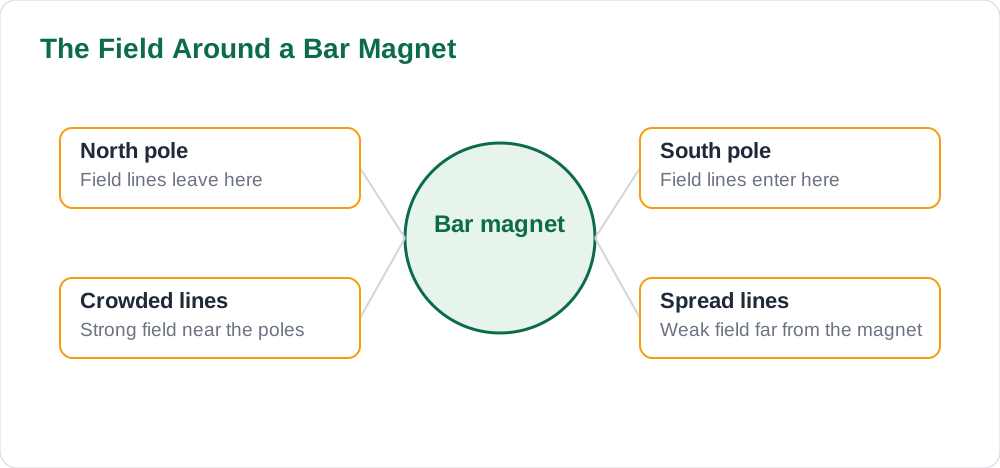
The magnetic field is the region around a magnet where its magnetic force can be felt. Field lines are a way of drawing that field. They are imaginary lines, but they show the shape of the field clearly. Three rules govern them. First, field lines come out of the north pole and go into the south pole outside the magnet. Second, they never cross each other. Third, where the lines are close together, the field is strong; where they are far apart, the field is weak. Around a bar magnet, the lines are closest at the poles, which is why the poles are the strongest parts.
You can see field lines with iron filings. Place a bar magnet under a sheet of paper or cardboard, sprinkle iron filings on top with a teacher's supervision, and tap the paper gently. The filings line up along the field lines, forming curved patterns from one pole to the other. A small compass needle placed near the magnet also points along the field lines, and walking the compass around the magnet traces the pattern one point at a time. A plotting compass is the neat classroom version of this: move it around the magnet, mark the direction of the needle at each step, and join the marks into smooth curves. The picture that emerges is the field. The same drawing skill is used for other science diagrams, as explained in diagrams and labelling.
Why a Compass Points North
A compass is a small magnet, usually a needle, balanced so it can turn freely. It points north because the Earth itself acts like a giant magnet. The Earth's magnetic field runs roughly from south to north, and the compass needle, which is a magnet, lines up with that field. The needle's north-seeking end points toward the Earth's geographic north, near the magnetic pole in the Arctic. Strictly speaking, the Earth's magnetic pole in the north is a magnetic south pole, because it attracts the north pole of the compass needle, but compass makers call the needle's end the north pole because it points north.
This is why a compass works anywhere on Earth, from a school playground to the middle of the sea: wherever you stand, the Earth's field is there, and the needle lines up with it. Early sailors used compasses centuries ago to navigate when the Sun and stars were hidden. The needle does not point to the geographic North Pole exactly; it points to the magnetic pole, which is hundreds of kilometres away, and the difference, called declination, varies by place. For school work and everyday navigation, the compass direction is close enough to true north to be useful.
Making and Using a Compass Safely
You can make a simple compass with adult supervision. Stroke a steel needle in one direction about thirty times with one pole of a bar magnet, always lifting the magnet away and returning to the same end before each stroke. This magnetises the needle. Then float the needle on a small piece of cork or a leaf in a bowl of water, or balance it on a pin through a cork. The needle will swing and settle pointing north-south. Test it by turning the bowl: the needle swings back to north every time. Keep magnets away from phones, bank cards, and computers, because a strong magnet can damage them, and never let small magnets near young children, who might swallow them.
To use a compass, hold it flat and level, away from metal objects and other magnets, which would pull the needle off course. Wait for the needle to settle, then read the direction it points. Turn your body until the needle points to the N mark, and you are facing north. Then east is on your right, west on your left, and south behind you. Pupils often hold a compass near a steel desk or a magnet and wonder why it points strangely: the compass is simply following the strongest nearby magnetic field, which is the desk or the magnet, not the Earth. Move away from metal, and the needle returns to north.
Magnets in Everyday Life
Magnets are inside many devices you use every day. A refrigerator door seals with a magnetic strip. Speakers and headphones use magnets to turn electrical signals into sound: a coil in a magnetic field vibrates and moves the air. Electric motors use magnets and coils to turn electricity into motion, powering fans, toys, and washing machines. Generators do the reverse, turning motion into electricity with magnets and coils, and they supply much of the world's power.
Magnetic strips and chips store information on bank cards and tickets, and magnetic resonance imaging, MRI, uses powerful magnets in hospitals to look inside the human body. A compass is only the oldest and simplest magnetic instrument. When you meet electromagnets in later lessons, you will see that a coil of wire carrying a current becomes a magnet that can be switched on and off, and that idea runs cranes in scrap yards, doorbells, and relays. Magnetism looks like a toy in a primary classroom, but it is one of the forces that runs the modern world. If you want to check how to set up a safe demonstration, the safe experiments guide gives the same careful habits. Class material is listed on the books page.
AI Help: Muse AI
Muse AI is Meta's personal AI assistant, and it can help with this topic by describing how to draw magnetic field lines for any magnet arrangement, or by explaining why a compass needle turns when you bring a magnet near it. You can ask it to quiz you on pole rules or on the difference between the Earth's geographic and magnetic poles. Muse AI does not give official Sindh Textbook Board answers — always verify against your Sindh Textbook Board book and your teacher.
Join Muse with invite code LTGSWD — in the Muse app, go to Settings > Redeem token and enter the code.
Disclosure: LTGSWD is the author's Muse invite code.
5 key points you must know
- Like poles repel; unlike poles attract; cutting a magnet gives two complete magnets.
- Magnetic field lines leave the north pole, enter the south pole, and never cross.
- Crowded field lines mean a strong field; spread lines mean a weak field.
- A compass needle is a small magnet that lines up with the Earth's magnetic field.
- Keep magnets away from phones, cards, computers, and young children.
Frequently asked questions
Why does a compass point north?
A compass needle is a small magnet, and the Earth acts like a giant magnet. The needle lines up with the Earth's magnetic field, so its north-seeking end points toward the magnetic pole in the Arctic, which is close to geographic north.
What happens if you cut a magnet in half?
Each half becomes a complete magnet with its own north and south pole. You never get a lone north or south pole, because magnetism comes from tiny regions inside the material that each carry both poles.
Why do iron filings show the field pattern?
Each tiny iron filing becomes a small magnet in the field and lines up along the field lines. Sprinkled on paper over a magnet, the filings trace the curved pattern of the field from one pole to the other.
Why does my compass point the wrong way near a desk?
The compass follows the strongest nearby magnetic field. Steel furniture, iron objects, and other magnets can pull the needle off course. Move away from metal and the needle returns to pointing north.
Do magnets attract all metals?
No. Magnets attract magnetic materials: iron, nickel, and cobalt. They do not attract wood, plastic, paper, aluminium, or copper. A coin made of a non-magnetic metal will not stick to a magnet.
Solved notes — preview free
These guides work best with the solved exercises. Preview the solved notes free on this website — 119 solved notes for Classes 6–10 in Sindhi, Urdu, English and Arabic medium. Or browse the full solved notes catalogue for your class and medium. New solved notes are added regularly — check the catalogue for coming-soon books.