Motion, Speed and Velocity: What Is the Difference?
When a rickshaw travels from your home to school, everyone says it is moving, but physics asks two sharper questions: how far did it travel, and in which direction did it end up? Motion means a change of position with time, and the words we use to describe motion are not interchangeable. Distance tells you the total length of the path, while displacement tells you the straight-line change from the starting point to the finishing point, together with its direction. Speed tells you how fast something moves, while velocity tells you how fast it moves and in which direction. Mixing these words up is one of the most common mistakes in physics, and this article clears it up with races, rickshaw journeys, and walks around the school ground. By the end of this article you will be able to look at any journey and say four things about it: the distance covered, the displacement, the average speed, and the average velocity. You will also know why a runner who completes one full lap of a track can have a large distance but zero displacement, and why a car driving steadily around a roundabout is changing its velocity even when its speedometer does not move. These ideas are the foundation of every later topic in mechanics, so it is worth getting them exactly right now. Keep your physics notebook open and sketch each example as you read, because drawing the path is the fastest way to see the difference.
What Motion Really Means
An object is in motion when its position changes relative to a fixed reference point as time passes. A book sitting on your desk is at rest relative to the desk, but the same book is moving relative to the Sun, because the Earth carries it along. That is why physics always asks: motion relative to what? In school problems, the reference point is usually the ground, a starting line, or your home, and you measure positions from there. If the position does not change, the object is at rest; if it changes, the object is in motion.
Motion can be described in three simple ways: by the path taken, by how fast the position changes, and by whether the direction changes. A ball rolling down a straight slope, a swing moving back and forth, and a bicycle going around a bend are all in motion, but their paths look different. Before doing any calculation, form the habit of naming the path: straight line, curved, or back-and-forth. That one habit prevents many errors, because the formulas for distance and displacement behave differently on a curved or return journey. You can practise this habit with the everyday examples in force and motion in daily life.
Distance: The Full Length of the Journey
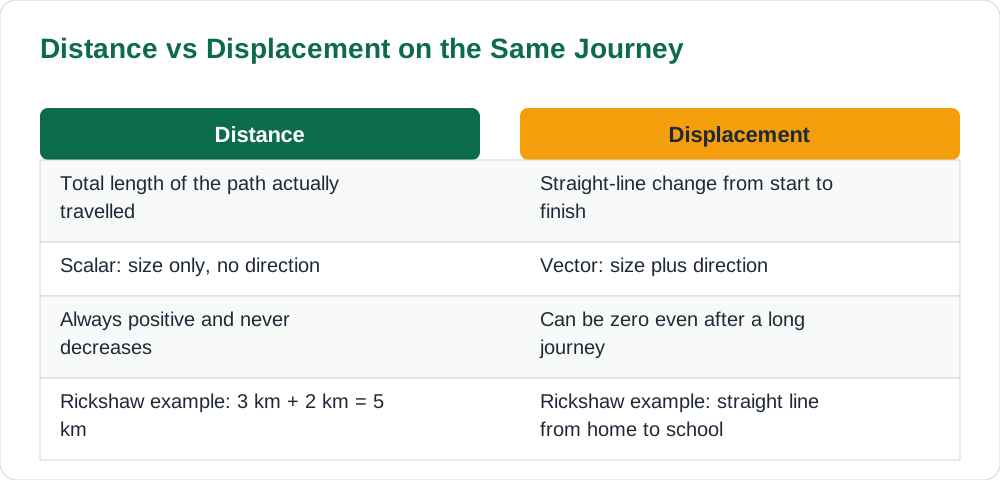
Distance is the total length of the path an object actually travels. It is a scalar quantity, which means it has size but no direction. If a rickshaw leaves home, travels 3 kilometres east to the market, then 2 kilometres north to school, the distance is 5 kilometres, because you add every part of the journey. The odometer in a vehicle measures distance: it keeps adding up every metre the wheels turn, no matter which way the vehicle turns. Distance is never negative, and it never decreases as a journey goes on.
A useful way to remember distance is to think of a piece of string laid along the exact route. Straighten the string and measure it, and you have the distance. A pupil who walks from the classroom to the canteen and back has covered twice the one-way distance, even though the pupil ends up back in the classroom. In word problems, look for phrases like total path, how far, or length of the journey. Those phrases almost always mean distance. When you calculate it, add each leg of the journey carefully, and keep the unit the same throughout, usually metres or kilometres.
Displacement: From Start to Finish in a Straight Line
Displacement is the change in position from the starting point to the finishing point, measured in a straight line, together with the direction. It is a vector quantity, which means it has both size and direction. In the rickshaw example above, the displacement is not 5 kilometres; it is the straight line from home to school, which is shorter than the travelled path, and it points in the direction from home to school. If you walk around the whole school ground and return to your starting point, your displacement is zero, because your finishing position is exactly your starting position, even though your legs are tired from walking a real distance.
This is the idea that confuses most pupils, so practise it with drawings. Draw a dot for the start and a dot for the finish, then join them with a straight arrow. That arrow is the displacement. The length of the arrow is the size, and the arrowhead shows the direction. In a race, two runners can cover the same distance but have different displacements if they finish at different places. And a runner who starts and finishes at the same line after one full lap has a displacement of zero. If a question asks how far an object is from its starting point, or asks for the change in position, it is asking about displacement. Sketching the path is the skill that turns these questions easy, and the same drawing habit helps with diagrams and labelling.
Speed: How Fast, Without Direction
Speed is the distance covered divided by the time taken. Its unit is metres per second (m/s) or kilometres per hour (km/h). If a pupil walks 100 metres in 50 seconds, the average speed is 2 m/s. Notice the word average: during the walk, the pupil may have walked faster at the start and slower at the end, but the average speed describes the whole journey in one number. The speedometer of a car shows the speed at one instant, called instantaneous speed, while dividing the total distance by the total time gives the average speed for the whole trip.
Speed problems become easy when you write the formula in words first: speed equals distance divided by time. Then write the numbers with units, and only then calculate. A common mistake is to mix units, for example dividing kilometres by seconds. Convert everything to one pair of units before you calculate: either metres and seconds, or kilometres and hours. To convert km/h to m/s, multiply by 5/18; to convert m/s to km/h, multiply by 18/5. Practise with real journeys you know: time your walk to school, estimate the distance, and find your average speed. Numbers that come from your own life are remembered far better than numbers from a page.
Velocity: Speed With a Direction
Velocity is the displacement divided by the time taken, and it includes direction. If a car travels 60 kilometres east in one hour, its velocity is 60 km/h east. If the same car turns around and travels 60 kilometres west in one hour, its speed is the same, but its velocity has changed completely, because the direction is opposite. This is why velocity is a vector and speed is a scalar. In everyday speech people say velocity when they mean speed, but in physics the direction is part of the meaning.
The most important consequence is this: an object moving at constant speed can still be changing its velocity if its direction changes. A bicycle going steadily around a circular track has a constant speed, but its velocity changes at every moment because its direction keeps changing. That changing velocity means the bicycle is accelerating, even though the speedometer reading stays the same. Examiners love this idea, so learn it as a sentence you can write from memory: constant speed in a circle means changing velocity, because velocity includes direction. The same careful reading of direction helps with physics numerical problems.
A second useful case is the return journey. If you walk 400 metres east to a shop in 5 minutes and walk back 400 metres west in 5 minutes, your total distance is 800 metres and your average speed is 80 metres per minute. But your displacement for the whole trip is zero, because you finished where you started, so your average velocity for the whole trip is zero. The two answers look strange side by side, yet both are correct, because they measure different things. Whenever a question seems to have a trick, check whether it is asking about distance or displacement.
A Five-Step Method for Motion Problems
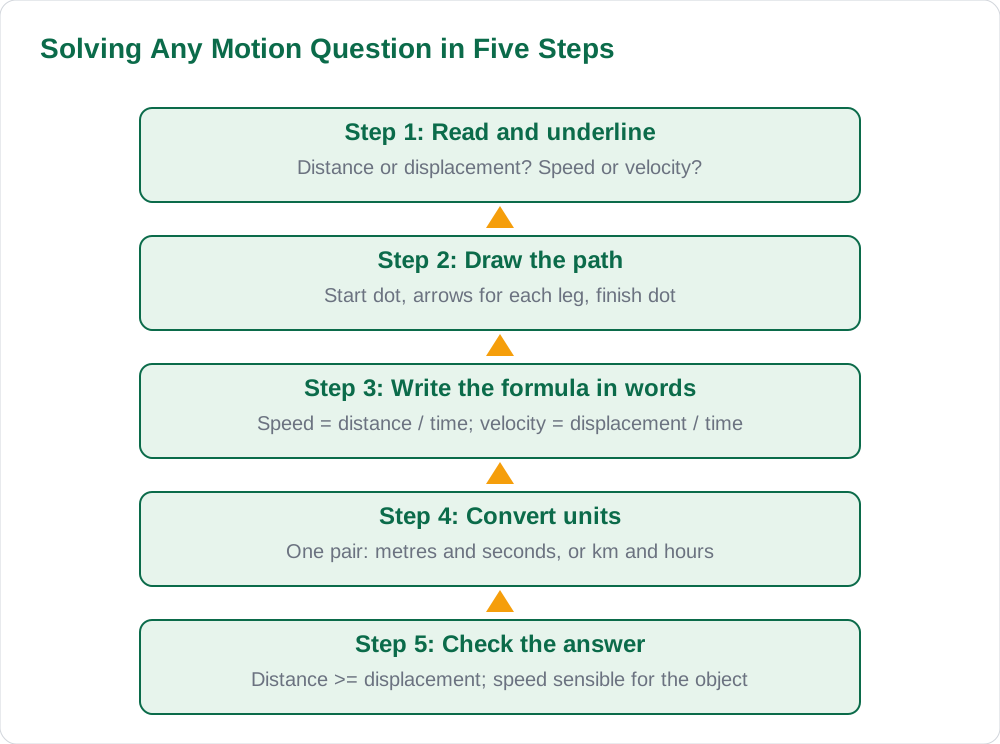
Use this method on every motion question, and your marks will rise. First, read the question twice and underline the words that tell you whether it wants distance or displacement, speed or velocity. Second, draw the path: a dot for the start, arrows for each leg, and a dot for the finish. Third, write the formula in words before you touch numbers. Fourth, convert all units to one consistent pair. Fifth, check the answer by asking whether it is sensible: is the distance at least as big as the displacement? Is the speed reasonable for a person, a bicycle, or a car? A walking speed of 200 m/s is impossible, so a result like that means a unit error.
Practise with three journeys from your own day: the walk from home to school, one lap of the school ground, and a rickshaw ride with one turn. For each journey, write down the distance, the displacement, the time, the average speed, and the average velocity with direction. Three worked examples of your own are worth more than twenty copied ones, because you know the routes and can picture every turn. If you get stuck, re-read the compare diagram in this article and ask which column your question belongs to. Solved notes and class material are listed on the solved notes page.
AI Help: Muse AI
Muse AI is Meta's personal AI assistant, and it can help with this topic by turning any journey you describe into a labelled sketch in words, so you can see distance, displacement, speed, and velocity side by side. You can ask it to explain why a full lap gives zero displacement, or to make practice questions from your own walk to school. Muse AI does not give official Sindh Textbook Board answers — always verify against your Sindh Textbook Board book and your teacher.
Join Muse with invite code LTGSWD — in the Muse app, go to Settings > Redeem token and enter the code.
Disclosure: LTGSWD is the author's Muse invite code.
5 key points you must know
- Distance is the total path length; displacement is the straight-line change from start to finish with direction.
- Speed is distance divided by time and has no direction; velocity is displacement divided by time and includes direction.
- A full lap of a track gives a large distance but zero displacement.
- Constant speed in a circle means changing velocity, because the direction keeps changing.
- Draw the path before calculating, and keep units consistent throughout.
Frequently asked questions
What is the difference between distance and displacement?
Distance is the total length of the path travelled, with no direction. Displacement is the straight-line change from the starting point to the finishing point, with direction. Distance is always at least as large as the size of the displacement, and displacement can be zero even after a long journey, for example one full lap of a track.
Can velocity be zero while speed is not zero?
Yes. On a return journey, the average velocity over the whole trip is zero because the displacement is zero, but the average speed is positive because distance was covered. Instantaneous velocity can also be zero at the turning point of a swing, even though the object was moving a moment before.
How do I convert km/h to m/s?
Multiply the km/h value by 5/18. For example, 72 km/h becomes 72 x 5/18 = 20 m/s. To convert the other way, multiply an m/s value by 18/5. Always convert units before calculating so distance and time use one consistent pair.
Why does a car going steadily around a roundabout have changing velocity?
Velocity includes direction. Around a roundabout the car's speed may stay steady, but its direction changes at every moment, so its velocity changes too. A changing velocity means the car is accelerating, even though the speedometer reading does not move.
What is the most common mistake in motion problems?
Using distance where the question asks for displacement, or speed where it asks for velocity. Underline the key words in the question, draw the path, and check whether direction matters before you calculate.
Solved notes — preview free
These guides work best with the solved exercises. Preview the solved notes free on this website — 119 solved notes for Classes 6–10 in Sindhi, Urdu, English and Arabic medium. Or browse the full solved notes catalogue for your class and medium. New solved notes are added regularly — check the catalogue for coming-soon books.