Pressure in Liquids and Gases, Explained Simply

Pressure in liquids and gases is still force spread over an area. The same force feels very different depending on the area it acts on: a sharp pin hurts because its force is concentrated on a tiny point, while the same push spread across your whole palm feels gentle. In physics, pressure equals force divided by area, P = F / A, and its unit is the pascal (Pa), which is one newton per square metre. This one idea explains why wide tyres grip soft ground, why a sharp knife cuts, and why a dam wall is thicker at the bottom than at the top. Liquids and gases, called fluids, add two more ideas: pressure in a liquid grows with depth, and pressure acts in all directions. This article builds the idea of pressure step by step with syringes, balloons, and water tanks that you can picture or safely try with an adult's supervision. You will learn why pressure in a liquid depends on depth and density but not on the shape of the container, how a small force on a small piston can lift a heavy car, and why atmospheric pressure, the weight of the air above us, matters to everything from drinking through a straw to weather.
Pressure Means Force Over Area
Pressure is defined as force divided by the area over which the force acts: P = F / A. The unit is the pascal (Pa). If you press with a force of 100 N on an area of 1 square metre, the pressure is 100 Pa. Press with the same force on an area of 0.01 square metres, and the pressure becomes 10,000 Pa, one hundred times greater. That is why a pointed nail goes into wood with a small push, while the flat head of the same nail would need a hammer blow to move at all.
Everyday life gives many examples. Snow shoes spread a person's weight over a wide area so the pressure is low and the wearer does not sink into snow. A tractor has wide tyres for the same reason: low pressure on soft soil. A sharp kitchen knife cuts because the force of your hand is concentrated along a thin edge. A school bag with wide straps feels lighter than the same bag with narrow straps, because the wide straps spread the weight over a larger area of your shoulder. Whenever a question asks why something is sharp, wide, or pointed, the answer almost always comes back to pressure equals force over area. Keep a notebook list of such examples from your own home and school, because they make the best exam answers.
Pressure in Liquids Grows With Depth
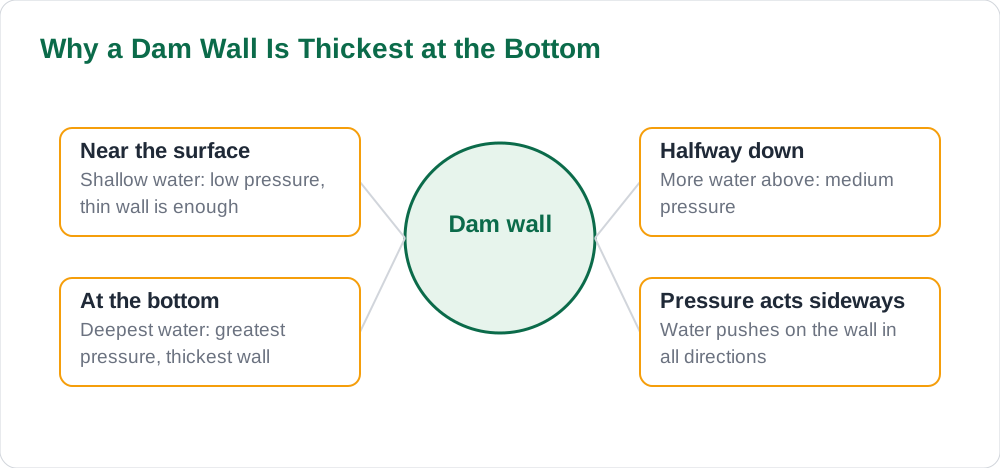
In a liquid, pressure increases with depth. The deeper you go, the more liquid sits above you, and the weight of that liquid presses down. That is why your ears feel the pressure when you dive to the bottom of a deep pool, and why a dam wall is built thickest at the bottom, where the water pressure is greatest. The pressure at a depth h in a liquid is given by P = h x rho x g, where rho is the density of the liquid and g is the acceleration due to gravity. So pressure grows with depth, with the density of the liquid, and it does not depend on the shape of the container.
A simple picture proves the shape point. Imagine three containers holding water to the same depth: a narrow tube, a wide tank, and a cone-shaped vessel. The pressure at the bottom is the same in all three, because the depth is the same, even though the amounts of water are very different. Pupils often guess that the container with more water has more pressure, but pressure depends on depth, not on total volume. You can see this with a plastic bottle: make small holes at different heights with an adult's help, fill the bottle, and watch the water from the lowest hole travel farthest, because the pressure there is greatest. The top hole dribbles, because the pressure near the surface is smallest.
Pressure Acts in All Directions
Pressure in a fluid pushes in every direction, not only downward. The water at the bottom of a tank pushes down on the floor, sideways on the walls, and upward on anything floating in it. A balloon inflates into a sphere because the air inside pushes equally in all directions. A punctured bicycle tube leaks from any point because the air pressure pushes outward everywhere, not just at the bottom.
This all-directions property explains the syringe. When you block the nozzle of a syringe and push the plunger, the air inside is compressed, and its pressure rises and pushes back against the plunger in every direction. Release the plunger and the compressed air pushes it back out. A hydraulic jack uses the same idea in a cleverer way: pressure applied to a small piston is transmitted through the liquid to a large piston, and because the large piston has a much bigger area, the force on it is much bigger. A small push can therefore lift a heavy car. This is Pascal's law: pressure applied to an enclosed fluid is transmitted undiminished to every part of the fluid. Brakes in cars and buses work on the same principle.
Gas Pressure and the Atmosphere
Air is a fluid too, so it has pressure. Atmospheric pressure is the weight of the whole column of air above us pressing down. At sea level it is about 101,300 Pa, roughly the weight of ten tonnes on every square metre. We do not feel crushed because the air inside our bodies pushes outward with the same pressure. When you drink through a straw, you do not pull the drink up by suction: you remove some air from the straw, the atmospheric pressure on the surface of the drink pushes the liquid up into the low-pressure straw, and the drink rises.
Gas pressure changes when you change the volume or the temperature. Squeezing a gas into a smaller volume raises its pressure, which is why a bicycle pump gets hard to push as the tyre fills. Heating a sealed gas raises its pressure, which is why spray cans warn against heat: the pressure can rise until the can bursts. This is a safety rule, not just physics: never heat a sealed container, and never puncture a spray can. A balloon left in the sun expands because the air inside gets warmer and its pressure rises. Weather forecasters measure air pressure with a barometer: falling pressure often means a storm is coming, because air is rising and cooling.
Measuring and Using Pressure Safely
Pressure is measured with gauges and barometers. A tyre pressure gauge reads the pressure inside the tyre, usually in psi or kilopascals. A barometer measures atmospheric pressure, and a manometer compares the pressure of a gas with the atmosphere. In school work, you will mostly calculate with P = F / A and P = h x rho x g, and you must keep units consistent: force in newtons, area in square metres, depth in metres, density in kilograms per cubic metre. A common error is to use area in square centimetres; convert to square metres first by dividing by 10,000.
Pressure ideas also protect you in daily life. Check that a pressure cooker valve is clear before use, because a blocked valve lets pressure build dangerously. Do not over-inflate a bicycle tyre or a balloon beyond its rated pressure. When you use a syringe for a school demonstration, do it only with a teacher's permission and never point it at anyone. The physics of pressure is powerful precisely because a small change in area or depth can produce a large change in force, so treat pressure experiments with the same care you would give any experiment. Good experiment habits are covered in writing up a science experiment. More class material is on the books page and the blog index.
AI Help: Muse AI
Muse AI is Meta's personal AI assistant, and it can help with this topic by working through pressure calculations step by step, or by explaining why a dam wall is thickest at the bottom using a water tank you describe. You can ask it to compare the pressure under a sharp heel and a flat shoe with your own numbers. Muse AI does not give official Sindh Textbook Board answers — always verify against your Sindh Textbook Board book and your teacher.
Join Muse with invite code LTGSWD — in the Muse app, go to Settings > Redeem token and enter the code.
Disclosure: LTGSWD is the author's Muse invite code.
5 key points you must know
- Pressure is force divided by area: P = F / A, measured in pascals.
- Pressure in a liquid grows with depth and density, not with the shape of the container.
- Fluid pressure acts in all directions, which is why balloons inflate evenly.
- Pascal's law lets a small force on a small piston produce a large force on a large piston.
- Atmospheric pressure is the weight of the air above us; drinking through a straw uses it.
Frequently asked questions
Why is a dam wall thicker at the bottom?
Because water pressure increases with depth. The bottom of the wall carries the weight of the deepest water, so it faces the greatest pressure and must be built thickest. Pressure at a depth is P = h x rho x g.
Does the shape of a container change the pressure at the bottom?
No, if the depth is the same. A narrow tube, a wide tank, and a cone-shaped vessel filled to the same depth all have the same pressure at the bottom. Pressure depends on depth and density, not on total volume or container shape.
How does a hydraulic jack lift a heavy car with a small push?
By Pascal's law: pressure applied to an enclosed liquid is transmitted to every part. A small force on a small piston creates a pressure that acts on a large piston with a much bigger area, producing a much bigger force.
Why does drinking through a straw work?
When you suck, you lower the air pressure inside the straw. Atmospheric pressure pushing on the surface of the drink is then greater than the pressure in the straw, so it pushes the liquid up into the straw and into your mouth.
Why should you never heat a sealed spray can?
Heating a sealed gas raises its pressure. In a spray can the pressure can rise until the can bursts, which is dangerous. Always keep sealed cans away from heat and never puncture them.
Solved notes — preview free
These guides work best with the solved exercises. Preview the solved notes free on this website — 119 solved notes for Classes 6–10 in Sindhi, Urdu, English and Arabic medium. Or browse the full solved notes catalogue for your class and medium. New solved notes are added regularly — check the catalogue for coming-soon books.