Writing Precautions and Sources of Error in Practicals
Precautions and sources of error are the sections where a practical write-up shows real scientific thinking, because they prove you understood what could go wrong and what you did about it. Pupils often treat these sections as an afterthought, copying the same generic lines into every experiment, but examiners can tell the difference between a copied list and a thoughtful one at a glance. A strong precautions section names specific risks for this experiment and the exact steps taken against them, while a strong errors section honestly explains why the result may differ from the ideal. This guide shows how to write both sections so they strengthen, rather than weaken, your practical.
Precautions: What They Are For
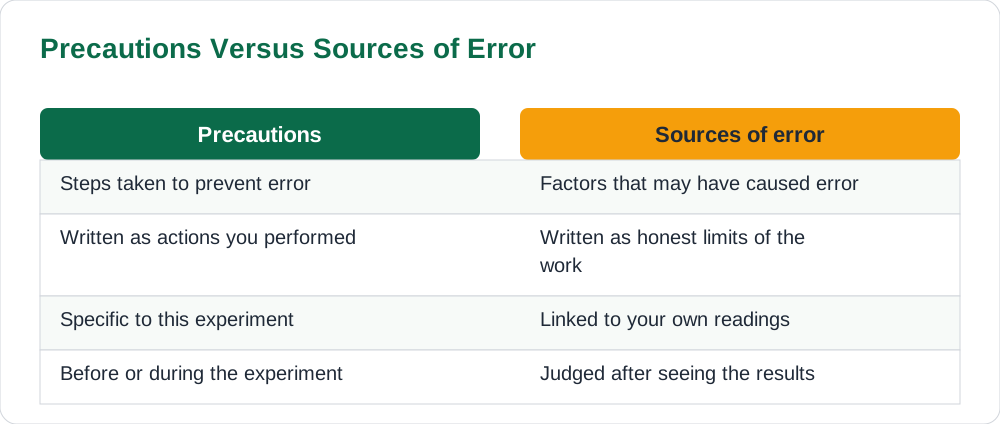
A precaution is a step taken before or during an experiment to prevent an error, protect the apparatus or the pupil, or keep the conditions fair, and it belongs in the write-up only if it was actually followed. Write each precaution as a specific action, such as reading the burette at eye level or keeping the distance constant between readings, rather than a vague instruction such as being careful. The examiner wants to see that you knew which parts of this experiment were sensitive and that you acted on that knowledge, not that you can recite a list of good intentions. Three or four specific, relevant precautions are worth far more than ten generic ones copied from another experiment.
Choose precautions by thinking through the method step by step and asking where a small change would alter the result, and write the precaution beside the risk it controls. For a measurement experiment, the risks are usually reading errors, inconsistent conditions, or apparatus faults, so precautions about eye position, repeat readings, and checking zero errors fit naturally. For a chemistry experiment, risks include contamination, incorrect volumes, and missed end points, so precautions about rinsing, careful measuring, and slow addition near the end point matter. When each precaution is tied to a real risk in your method, the section reads as understanding, not decoration.
Writing Precautions That Match Your Experiment
Match every precaution to the experiment you actually performed by naming the apparatus, quantity, or step it concerns, and avoid precautions that could not apply to your method. A precaution about avoiding parallax means little in an experiment with no scale reading, while a precaution about keeping the temperature constant is meaningless if temperature was never measured. Read your method again after drafting the precautions and check that each one could have been followed during your experiment, and delete any that fail that test. Examiners notice mismatched precautions quickly, and a single irrelevant precaution casts doubt on the rest of the section.
Phrase precautions in the past tense as actions you took, such as the readings were taken at eye level, rather than as orders to a future reader, since the write-up records work already done. Keep the language simple and direct, one precaution per line or sentence, so the examiner can count and check them easily. If your teacher gave a particular precaution for the experiment, include it and say why it mattered, rather than replacing it with a generic alternative. A precautions section that matches the method, names real risks, and describes real actions is a quiet but powerful sign of a careful experimenter. For more study material, see the solved notes and the book collection.
Sources of Error: Being Honest About Limits
Sources of error are the factors that may have made your readings or result differ from the true or ideal value, and writing them honestly shows that you understand measurement rather than merely reporting numbers. Divide them in your mind into random errors, such as small variations when reading a scale, and systematic errors, such as an instrument that reads slightly high every time, and name the ones that plausibly affected your experiment. Link each source of error to something in your data where possible, for example noting that a spread in repeat readings suggests reading variation, rather than listing faults with no connection to your results. An errors section grounded in your own data reads as genuine analysis.
Be specific about the likely size and direction of an error where you can, such as noting that a fast final addition may have overshot the end point and made a titre slightly large, rather than saying only that human error occurred. Avoid blaming everything on vague human error, faulty apparatus, or carelessness, since these phrases explain nothing and examiners discount them. If an error was noticed and corrected during the experiment, say so, and if an error could not be corrected, say how it limits confidence in the result. Honesty about limits does not lose marks; it earns them, because it shows the examiner you can judge your own work critically.
Common Weaknesses to Avoid
The most common weakness in these sections is copying the same generic list into every experiment, with phrases such as the experiment was done carefully or all precautions were taken, which tell the examiner nothing. Another weakness is listing precautions that contradict the method, such as claiming repeat readings were taken when the table shows only one reading, which undermines trust in the whole write-up. A third weakness is the opposite extreme: listing so many possible errors that the result appears worthless, including faults that could not have affected this experiment at all. All three weaknesses come from writing these sections without looking back at the method and the data, and all three are easy to avoid by checking each line against them.
Also avoid blaming other people or the equipment without evidence, since a claim that the apparatus was faulty needs a specific observation, such as a burette that leaked, to be believable. Avoid repeating the same precaution in different words to fill space, and avoid ending the section with a sweeping claim that the result was fully accurate despite the errors just listed. Read the two sections together after drafting them and ask whether they agree with each other and with the rest of the write-up: precautions claimed should match the method, and errors admitted should match the spread in the readings. When the sections agree with the evidence, they strengthen the entire practical.
Checking the Two Sections Together
Before submission, check the precautions and errors sections as a pair, since they should tell a consistent story about the experiment. A precaution that was followed should not reappear as an uncontrolled error, and an error that is admitted should not have an obvious precaution that you claim to have taken but clearly did not. If you find such a contradiction, correct the section that is wrong rather than leaving both standing, because examiners read these sections together and contradictions stand out. Also check that the sections are proportionate: a short, well-controlled experiment needs only a few lines, while a longer experiment with several sensitive steps may need more.
Finally, read the sections aloud and ask whether a stranger could understand, from them alone, what was risky about this experiment and how far the result can be trusted. If the answer is yes, the sections are doing their job, and they will lift the mark of the whole write-up. Keep a personal list of the precautions and errors that recur in your subject, such as parallax, zero error, and end-point overshoot, and learn what each one means so you can use them correctly rather than copying them blindly. Over the year, these two short sections will teach you more about experimental thinking than any other part of the notebook. More guides are on the blog and the [home page](/).
AI Help: Muse AI
Muse AI is Meta's personal AI assistant, and it can help you write better precautions by suggesting what could go wrong in a particular kind of experiment and how to reduce each risk. Try asking it for precautions for a measurement you are about to do, then keep only the ones that truly fit your method.
Join Muse with invite code LTGSWD — in the Muse app, go to Settings > Redeem token and enter the code.
Disclosure: LTGSWD is the author's Muse invite code.
Muse AI does not give official STBB answers — always verify against your Sindh Textbook Board book and your teacher.
5 key points you must know
- Write precautions as specific actions actually taken, not vague intentions.
- Match every precaution to a real risk in your method.
- Name sources of error linked to your own readings.
- Avoid generic phrases such as human error with no detail.
- Check that precautions, errors, method, and data agree with each other.
Frequently asked questions
How many precautions should I write for one experiment?
Three or four specific, relevant precautions are usually enough. Quality matters more than quantity, and a long generic list copied from another experiment weakens the section rather than strengthening it.
What is the difference between a precaution and a source of error?
A precaution is a step taken to prevent an error, such as reading a scale at eye level. A source of error is a factor that may still have affected the result, such as variation when reading the scale, judged after seeing the data.
Should I admit errors if my result looks good?
Yes, every real measurement has limits, and admitting them honestly earns marks. Name the plausible errors, link them to your readings, and say how far they limit confidence in the result.
Why should I avoid writing human error as a source of error?
Because it explains nothing: it does not say what went wrong, how it affected the readings, or how large the effect was. Name the specific fault, such as overshooting an end point or misreading a scale, instead.
Solved notes — preview free
These guides work best with the solved exercises. Preview the solved notes free on this website — 119 solved notes for Classes 6–10 in Sindhi, Urdu, English and Arabic medium. Or browse the full solved notes catalogue for your class and medium. New solved notes are added regularly — check the catalogue for coming-soon books.