Preparing for Practical Viva Questions with Confidence
A practical viva is a short spoken test in which the examiner asks you about the experiments in your notebook, the apparatus you used, and the results you obtained, and it rewards pupils who can explain their own work clearly. Many pupils know the experiments well on paper but struggle in the viva because they have never practised saying the answers out loud, so simple questions feel harder than they are. The good news is that viva questions follow predictable patterns, and a few weeks of short spoken practice can turn nervous silence into calm, confident answers. This guide shows what examiners ask, how to frame short answers, and how to rehearse so the viva feels familiar on the day.
What Examiners Ask in a Viva
Viva questions usually start from your own notebook, with the examiner opening a page and asking what the experiment was about, why you used a particular apparatus, or what your result showed. Expect questions about the aim of an experiment, the principle behind it, the steps of the method, and the meaning of a graph, table, or diagram on that page. Examiners also ask general questions about the subject, such as naming an instrument and its use, or explaining a term that appears in your write-up, to check that you understand the work rather than merely copying it. Questions are normally short and direct, and they expect short, direct answers, not long speeches.
The examiner is also checking honesty, so questions often test whether the notebook really is your work, for example by asking you to explain a step in your own words or to point to a reading in your table. If you cannot explain a page of your own notebook, the examiner will doubt the whole entry, however neat it looks. That is why viva preparation starts with reading your own notebook, not with memorising new material from a textbook. Know every experiment by its aim, method, and result, and be ready to talk about any page the examiner opens. For more study help, see the solved notes and the book collection.
Building Short, Spoken Answers
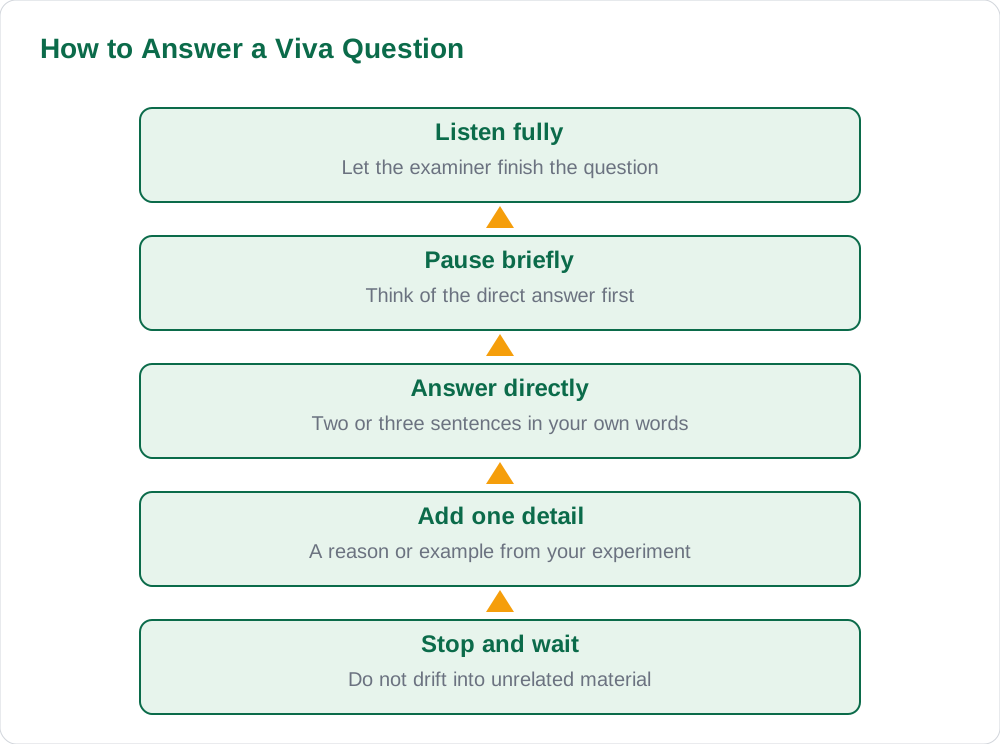
A good viva answer is short, structured, and in your own words, usually two or three sentences that answer the question directly and then stop. Start with the direct answer, then add one supporting detail, such as the reason or an example from your experiment, and avoid drifting into unrelated material to fill silence. For example, if asked why a burette is rinsed, a strong answer names the reason, that rinsing with the solution prevents dilution, and stops there, rather than describing the whole titration. Short answers are easier to remember, easier to say under pressure, and easier for the examiner to mark.
Practise turning written notes into spoken sentences, because an answer that reads well on paper can sound tangled when spoken for the first time. Read a question aloud, answer it without looking at the notebook, and then check whether you missed a key point or added something wrong. Keep a small list of the terms you tend to forget, such as instrument names or unit names, and repeat them until they come naturally. Avoid memorising long paragraphs word for word, since a forgotten word can derail a memorised answer, while an answer built from understanding can be recovered even if you pause. Understanding plus brevity is the combination examiners reward.
Practising Aloud with a Partner
Practise viva questions aloud with a classmate, family member, or teacher, because silent revision does not train your voice, timing, or confidence. Take turns as examiner and pupil: one person opens the notebook at random, asks a question about that page, and listens to the answer without interrupting, then gives one point to improve. Keep each practice round short, perhaps ten minutes, and cover different experiments each time so no page stays unfamiliar. Speaking to a real person, even a friendly one, teaches you to handle the pause before answering and the feeling of being watched, which are the parts of a viva that cause most nervousness.
After each answer, ask your partner one follow-up question, such as why you chose that method or what would happen if a step were skipped, since examiners often follow a first answer with a deeper one. If you do not know an answer, practise saying so honestly and offering what you do know, for example that you are unsure of the term but can describe the step, rather than guessing wildly or going silent. Record the questions you struggled with and revisit those experiments the same day, so practice directly repairs weak spots. A few short partner sessions across the final weeks build far more confidence than a single long cramming session the night before.
Handling Nerves and Difficult Questions
Nerves in a viva are normal, and examiners expect them, so do not let a shaky start convince you the viva is going badly. Slow down deliberately, breathe before answering, and speak at a steady pace, since rushing makes answers harder to follow and increases mistakes. If you mishear a question, it is perfectly acceptable to ask the examiner to repeat it, and if you start an answer badly, pause and restart the sentence rather than struggling on. Examiners judge the knowledge in your answers, not a perfect performance, and a pupil who recovers calmly from a stumble often scores better than one who panics silently.
For a question you truly cannot answer, honesty is the best strategy: say that you are not sure, offer the closest related fact you do know, and do not invent a confident-sounding answer that is wrong. Examiners respect an honest gap far more than a confident fabrication, and a wrong guess can lead to further questions that expose the guess. If a question is about an experiment you did not perform well, describe what you did and what you learned from it rather than pretending it went perfectly. Calm honesty, steady pace, and short answers will carry you through the hardest parts of any viva.
A Final Viva Checklist
In the last days before the viva, work through a simple checklist so nothing is left to chance on the day. Read every experiment in your notebook once, noting its aim, method, and result, and mark any page you cannot explain so you can revise it specifically. Practise naming the apparatus and instruments from your experiments, stating what each one measures and how it is read, since apparatus questions are among the most common. Prepare short answers for the most likely questions, such as the purpose of repeat readings, the meaning of a graph's slope, or the reason for a precaution you recorded, and rehearse them aloud at least once.
On the day itself, arrive early, keep your notebook tidy and in order, and greet the examiner politely before the questions begin. Listen carefully to each question, answer in your own words, and keep your hands free of notes, since reading answers from a slip is not allowed and looks dishonest. Remember that the viva is a conversation about work you already did, not a new examination of unseen material, so trust the preparation you have done. Walk in knowing your notebook, speak plainly, and let your own work speak for itself. More practical guides are on the blog and the [home page](/).
AI Help: Muse AI
Muse AI is Meta's personal AI assistant, and it can help you prepare for a viva by asking you practice questions about an experiment and giving you short model answers to compare with your own. Try asking it to quiz you on the aim and method of one of your practicals, then answer aloud before reading its reply.
Join Muse with invite code LTGSWD — in the Muse app, go to Settings > Redeem token and enter the code.
Disclosure: LTGSWD is the author's Muse invite code.
Muse AI does not give official STBB answers — always verify against your Sindh Textbook Board book and your teacher.
5 key points you must know
- Expect questions drawn from your own notebook pages.
- Give short, direct answers in your own words, then stop.
- Practise aloud with a partner in short, regular rounds.
- Ask for a question to be repeated rather than guessing wildly.
- Be honest about gaps and offer what you do know.
Frequently asked questions
What kinds of questions come up in a practical viva?
Most questions come from your own notebook: the aim of an experiment, why an apparatus was used, the steps of the method, and what a table, graph, or diagram shows. General questions about instrument names and subject terms are also common.
How long should a viva answer be?
Two or three sentences are usually enough: the direct answer plus one supporting detail, such as a reason or an example from your experiment. Long, drifting answers are harder to say under pressure and harder for the examiner to mark.
What should I do if I do not know a viva answer?
Say honestly that you are not sure, and offer the closest related fact you do know. Examiners respect an honest gap far more than a confident guess, and guessing can lead to follow-up questions that expose the guess.
Is it acceptable to ask the examiner to repeat a question?
Yes, asking for a question to be repeated is perfectly acceptable and much better than answering a question you misheard. Pause, listen again, and then give your short answer.
Solved notes — preview free
These guides work best with the solved exercises. Preview the solved notes free on this website — 119 solved notes for Classes 6–10 in Sindhi, Urdu, English and Arabic medium. Or browse the full solved notes catalogue for your class and medium. New solved notes are added regularly — check the catalogue for coming-soon books.