Building Test Confidence in Primary Classes Without Fear

Primary test confidence routine building starts with one big idea: a test is practice, not judgement. In Classes 1 to 4, many children fear tests long before they understand what a test is — they have seen older siblings cry, or they have been scolded for low marks, and they carry that fear into the classroom. The routine in this guide changes what a test means: small tests treated as practice games, warm-up questions before every test, calm breathing when nerves rise, and mistakes reviewed together as a class. Children who follow this routine stop fearing tests, and children who stop fearing tests show what they really know.
Why Small Tests Beat Big Frightening Ones
A child who faces one huge exam each term learns to fear that day. A child who faces a five-minute test every week learns that tests are ordinary. Short, frequent, low-pressure tests — a Friday quiz of five questions, a quick oral check after a lesson — build familiarity. Familiarity is the enemy of fear: the tenth small test feels like nothing, while the first big test feels like everything.
Small tests also give the teacher better information. A five-question check after Monday's lesson shows on Monday what needs re-teaching, not six weeks later when it is too late. And because the stakes are low, children answer honestly — the teacher sees real gaps instead of panicked guesses. Low stakes, high frequency, quick feedback: that is the formula for test confidence.
Tests as Practice Games
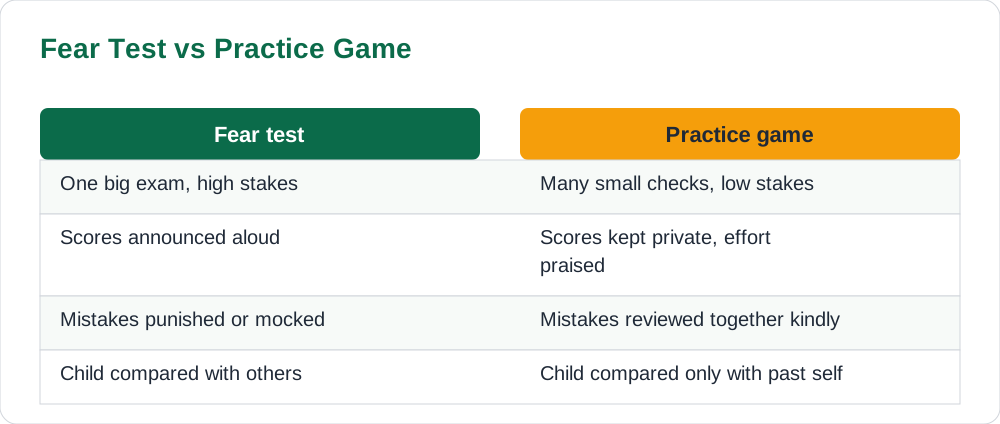
The simplest way to remove fear is to change the language. Call the test a practice game, a challenge, or a show-what-you-know round. Play it in teams sometimes, so the pressure is shared. Give points for trying, not just for correct answers. Let children use their books for the first practice game of a new topic — an open-book game teaches children how to find answers, which is a skill in itself, and it proves to them that tests are not traps.
Games need rules that protect confidence. Never announce the lowest score. Never compare one child with another. Never let a game end in shame. The moment a test becomes a public ranking, the shyest children stop trying — and the test stops measuring learning. A practice game that ends with applause for everyone teaches children that trying is safe. For more on steady study habits, see how to revise before exam night.
Warm-Up Questions Before Every Test
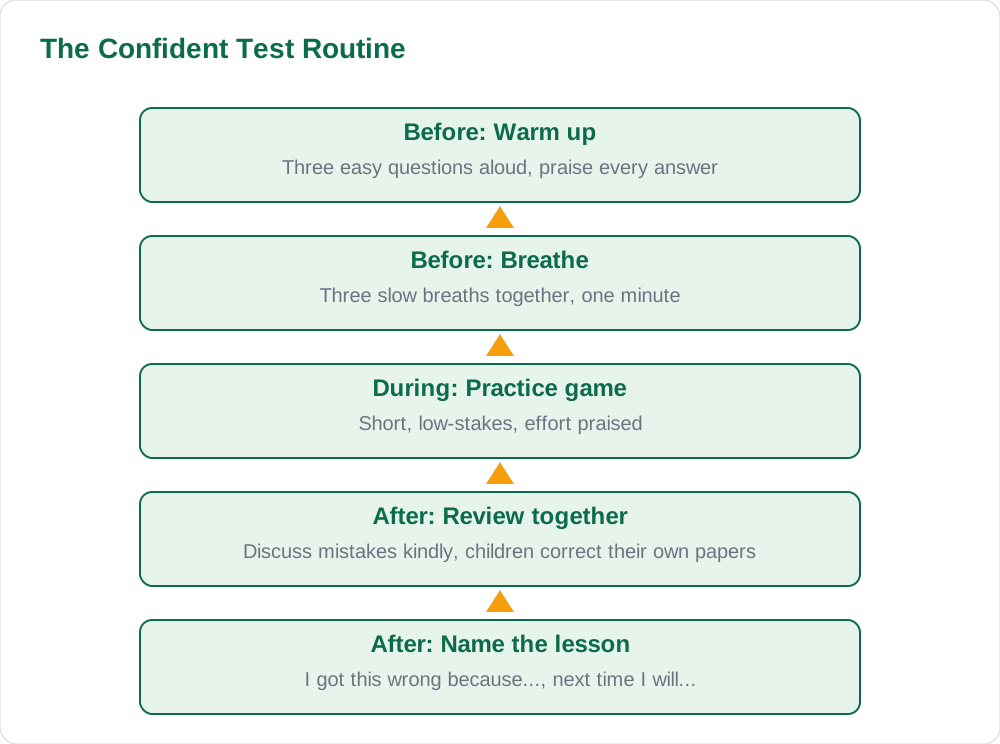
Never start a test cold. Three or four easy warm-up questions — asked aloud, answered together, with praise for every hand — wake up the child's memory and settle their nerves. The warm-ups should be questions the child can answer: the easiest facts from the topic, or a quick recap of yesterday's lesson. A child who answers two questions correctly before the test begins walks into the test already feeling like a success.
Warm-ups also remind children of what they know. Fear makes children forget; a warm-up brings the knowledge back before the test starts. Keep warm-ups short — two minutes — and keep them cheerful. If a child answers a warm-up wrongly, correct it gently and move on: the warm-up is practice, and practice is where mistakes belong.
- Ask three or four easy questions aloud before the test begins.
- Use the easiest facts from the topic so every child can answer.
- Correct warm-up mistakes gently — warm-ups are practice, not judgement.
Calm Breathing for Test Nerves
Nerves are physical: fast heartbeat, tight tummy, shaky hands. A child who feels those things thinks something is wrong. Teach children that nerves are normal, and teach them one simple tool: slow breathing. Before the test, everyone breathes in slowly for three counts, holds for one, and breathes out for three counts. Three rounds take less than a minute, and they genuinely calm the body.
Practise the breathing when children are calm, not only before tests, so the habit is ready when it is needed. Make it a class ritual — a minute of quiet breathing before every test, led by the teacher, with everyone joining in. A child who has breathed calmly with the whole class does not feel alone with their fear. Parents can use the same breathing at home before homework or a class test, and children can use it on their own once it is a habit.
Reviewing Mistakes Together
The most important part of any test happens after it: reviewing the mistakes together. Go through the questions as a class, ask children to explain the right answer in their own words, and let children correct their own papers. A mistake reviewed kindly becomes learning. A mistake returned with a red cross and no discussion becomes shame.
Teach children a simple sentence for mistakes: I got this wrong because..., and next time I will... A child who can finish that sentence has learned more from the test than any mark could show. Keep a class mistake wall — anonymous, with the tricky question and the corrected answer — so the whole class learns from one child's mistake without anyone being named. Over time, children begin to see mistakes as normal, useful, and nothing to fear. More confidence-building tips are on the blog and in the solved notes.
AI Help: Muse AI
Muse AI is Meta's personal AI assistant. It can explain concepts simply, summarise a lesson, or make practice questions for your child's level.
For test confidence, you can ask Muse AI to make a short five-question practice quiz on any primary topic, so your child can practise in a low-pressure game before the real class test.
Join Muse with invite code LTGSWD — in the Muse app, go to Settings > Redeem token and enter the code.
Disclosure: LTGSWD is the author's Muse invite code.
Muse AI does not give official Sindh Textbook Board answers — always verify against your Sindh Textbook Board book and your teacher.
5 key points you must know
- Treat tests as practice games: small, frequent, low-stakes checks.
- Start every test with three easy warm-up questions answered together.
- Teach slow breathing — in for three, hold for one, out for three — before tests.
- Review mistakes together kindly; let children correct their own papers.
- Never announce low scores or compare children with each other.
Frequently asked questions
At what age should children start taking tests?
Short, playful checks can begin in Class 1 — five questions, no marks pressure, treated as a game. The goal at this age is familiarity: tests should feel ordinary long before they feel important.
My child cries before every test. What should I do?
Tell the teacher, and practise the routine at home: warm-up questions, three slow breaths, and a short practice game with no marks. If crying continues for weeks, ask the teacher whether the test load can be reduced while confidence grows.
Should parents reward high test marks?
Reward effort and improvement, not just marks. Praise for trying hard teaches a child to keep trying; praise only for top marks teaches a child to fear anything less than the top.
How should I react to a low mark?
Stay calm. Look at the paper together, find what went wrong, and make a small plan: two questions to practise this week. A calm reaction teaches the child that a low mark is information, not a disaster.
Do practice games really help, or do children just play?
They help when the game questions match the real learning. A game that asks real questions from the topic is revision in disguise — and children revise far longer when they are playing than when they are drilled.
Solved notes — preview free
These guides work best with the solved exercises. Preview the solved notes free on this website — 119 solved notes for Classes 6–10 in Sindhi, Urdu, English and Arabic medium. Or browse the full solved notes catalogue for your class and medium. New solved notes are added regularly — check the catalogue for coming-soon books.