Community Building in Madina: Seerat Lessons
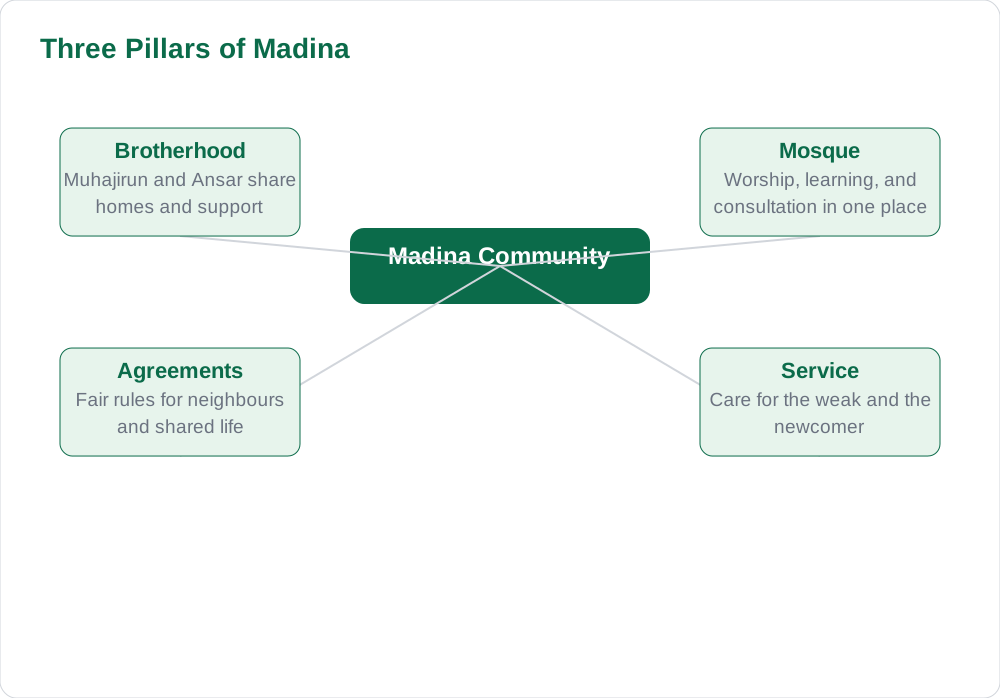
The Madina community building Seerat lessons show how a divided city became a united community built on faith, brotherhood, and justice. When the Prophet (PBUH) arrived in Madina, he did not only lead prayers. He helped organise a new society in which newcomers and long-time residents shared homes, resources, and responsibility. The mosque became a centre for worship and learning, brotherhood bound families together, and agreements set fair rules for neighbours. This guide explains how that community was built step by step, and what pupils can learn about cooperation, fairness, and service in their own schools and neighbourhoods.
A New Home in Madina
Madina offered the Muslims a new home after years of hardship in Makkah. The people of Madina welcomed the newcomers with generosity and hope. The city was not perfect, and old rivalries still existed, but there was a shared desire for peace. The Prophet (PBUH) built on that goodwill with patience and clear organisation.
Pupils should see this arrival as the start of a community project, not only a journey's end. Homes, livelihoods, worship, and neighbourly relations all had to be arranged. The lesson is that a good community is built deliberately, through fair rules and mutual care, not by chance.
- Welcome and generosity gave the newcomers a fresh start.
- Old rivalries needed patience, fairness, and steady leadership.
- Worship, work, and neighbourly life were organised together.
- A good community is built deliberately, not by chance.
Brotherhood Between Muhajirun and Ansar
Brotherhood, or Muakhat, paired the Muhajirun, who had migrated from Makkah, with the Ansar, the helpers of Madina. The Ansar shared homes, food, and livelihoods with their new brothers. This was not a formal ceremony alone. It was practical generosity that helped families survive and settle.
For pupils, this brotherhood is a lesson in sharing and empathy. It asks what we do when a new pupil joins the class, or when a neighbour faces hardship. Small acts of welcome, sharing notes, or including others in play reflect the same spirit in school life.
The Mosque as Community Centre
The mosque in Madina was far more than a place of prayer. It was a school, a meeting place, and a centre for consultation. People learned, discussed problems, and planned community work there. The mosque connected worship with daily life, so faith shaped how people treated one another.
Pupils can learn from this link between worship and service. Prayer should shape honesty, kindness, and responsibility. A school, like the mosque, works best when it is a place of learning, respect, and shared purpose. See the Hijrat lessons for how this community began.
- The mosque joined worship, learning, and consultation.
- Decisions were discussed openly with the community.
- Faith shaped daily conduct, not only ritual.
- Shared spaces build shared purpose and trust.
Agreements and Fair Rules
Fair agreements gave Madina stability. They set out rights and duties, protected life and property, and encouraged neighbours of different backgrounds to live peacefully. Everyone knew the rules, and the rules applied fairly. This helped trust grow between groups that had once been divided.
Pupils can connect this to classroom rules and school discipline. Fair rules protect everyone, not only the strong. When rules are clear, consistent, and applied with kindness, pupils feel safe, respected, and willing to cooperate.
Lessons for School and Neighbourhood
The Madina community teaches pupils that unity needs action. Welcoming newcomers, sharing resources, keeping promises, and respecting neighbours all build a stronger school and neighbourhood. Pupils do not need power to practise these values. They need willingness and consistency.
To study this lesson well, list three Madina practices and one school example for each. Discuss your list with a classmate. You can also explore related Seerat lessons and the books page to revise the lesson in your own words.
AI Help: Muse AI
Muse AI is Meta's personal AI assistant. It can help you turn Madina community building into a simple chart, list school examples for brotherhood and fairness, or make revision questions on the mosque and agreements. Muse AI does not give official STBB answers — always verify against your STBB book and your teacher. Always check your notes against your Sindh Textbook Board book and your teacher's guidance.
Join Muse with invite code LTGSWD — in the Muse app, go to Settings > Redeem token and enter the code.
Disclosure: LTGSWD is the author's Muse invite code.
5 key points you must know
- Madina became a community through brotherhood, the mosque, and fair agreements.
- The Ansar shared homes and livelihoods with the Muhajirun in practical generosity.
- The mosque joined worship, learning, consultation, and community service.
- Fair agreements protected rights and built trust between neighbours.
- Pupils build community by welcoming others, sharing, and respecting fair rules.
Frequently asked questions
Who were the Muhajirun and the Ansar?
The Muhajirun were Muslims who migrated from Makkah to Madina, leaving homes and property behind. The Ansar were the helpers of Madina who welcomed them, shared resources, and supported the new community.
Why was the mosque central in Madina?
It joined worship with learning, consultation, and community planning. People prayed, studied, discussed problems, and organised service there, so faith shaped daily life and mutual care.
What did the agreements in Madina achieve?
They set fair rights and duties, protected life and property, and encouraged peaceful coexistence. Clear, fair rules helped divided groups trust one another and live as neighbours.
How can pupils apply Madina lessons at school?
Welcome newcomers, share notes and resources, keep promises, and respect fair rules. Small, consistent acts of kindness and fairness build the same spirit of community in a classroom.
Solved notes — preview free
These guides work best with the solved exercises. Preview the solved notes free on this website — 119 solved notes for Classes 6–10 in Sindhi, Urdu, English and Arabic medium. Or browse the full solved notes catalogue for your class and medium. New solved notes are added regularly — check the catalogue for coming-soon books.