Aakhirat and Accountability: A Senior Islamiat Guide

Aakhirat is the belief in the Hereafter: that life in this world is followed by accountability, reward, and consequence. For senior pupils, this belief is not only a topic for an exam answer; it is a way of thinking about every choice, from how honestly you study to how fairly you treat others. This guide explains Aakhirat at senior depth and shows how accountability changes daily behaviour. You will learn how to study the topic with clear headings, how to connect belief to conduct, and how to write answers that show understanding rather than memorised phrases.
What Aakhirat Means at Senior Level
At senior level, Aakhirat should be explained as a complete belief, not a single word. It includes belief that this worldly life will end, that every person will be held accountable for their deeds, and that justice will be complete in the Hereafter even where it was incomplete in this world. This matters because it gives a pupil a long view of life: a good deed that nobody notices still counts, and a wrong deed that nobody catches still matters. When you write about Aakhirat, say this plainly in your own words before adding any detail, so the examiner sees the whole belief at a glance.
Senior study also connects Aakhirat with the purpose of worldly life. If life were only about immediate results, honesty would seem foolish whenever cheating paid off. Belief in accountability changes that calculation: the honest pupil is not losing out, because the real result is not limited to marks or praise. This is the reasoning senior answers need. Practise stating it in two sentences, and then support it with one everyday example, such as returning a lost item or refusing to copy work even when nobody would know.
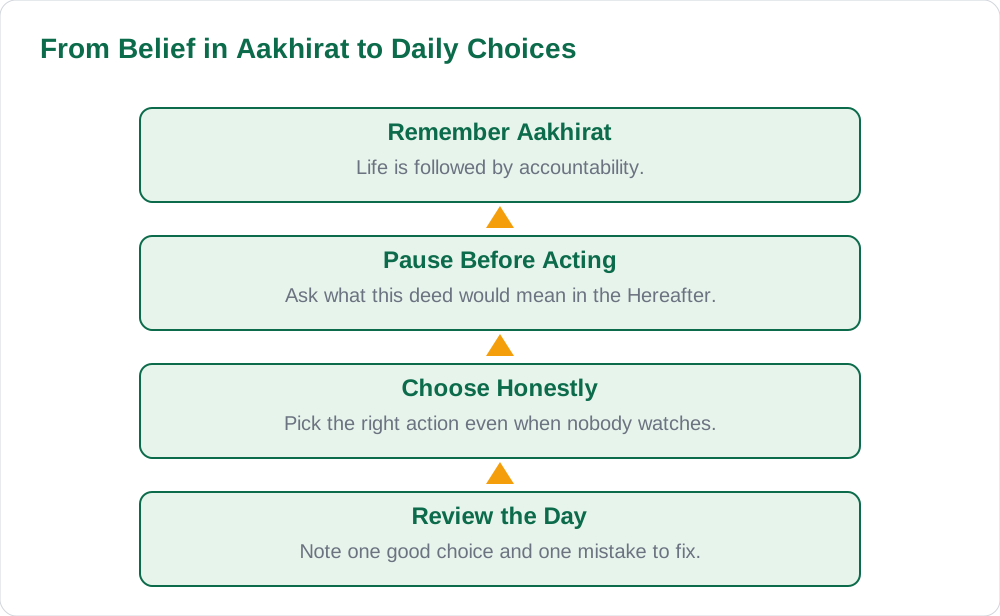
Accountability in Daily Choices
Accountability becomes real when you apply it to small, ordinary decisions. In studies, it means doing your own work instead of copying, because copied work may earn marks but teaches nothing and breaks trust. In friendships, it means speaking fairly about people who are absent, because backbiting harms others even when it feels harmless. In family life, it means keeping promises and using time well, because time and trust are both blessings for which a person is responsible. A senior pupil who can name three such examples has understood the topic far better than one who only repeats its definition.
A useful study exercise is to keep an accountability diary for one week. Each evening, write down one choice you are pleased with and one choice you would change, together with a short reason for each. Do not write long essays; two or three lines per choice are enough. Over the week, you will notice patterns, such as repeated carelessness with time or repeated kindness in a particular situation. That pattern is exactly what senior Islamiat wants you to notice: belief is proven by repeated conduct, not by a single good day.
Aakhirat, Justice, and Patience
One of the deepest senior lessons of Aakhirat is its connection with justice. In this world, the wrongdoer sometimes escapes and the good person sometimes suffers, and that can feel deeply unfair. Belief in Aakhirat teaches that justice is not cancelled by delay; it is completed in the Hereafter, where nothing is forgotten and no one is wronged. This belief does not remove the duty to seek justice in this world, but it gives patience to the person who is wronged and restraint to the person who is tempted to take revenge. Senior answers should hold both sides together: work for justice now, and trust complete justice in the Hereafter.
Patience also follows from Aakhirat in a practical way. When a pupil works hard and still fails, or when a good effort goes unrecognised, the belief that effort itself is recorded gives a reason to continue. This is not an excuse for poor planning or laziness; it is a reason to combine good planning with steady effort and to accept results with dignity. In your notes, link Aakhirat with patience under one heading, and write two examples: patience in hardship and patience in doing good without immediate reward.
Writing Strong Answers on Aakhirat
A strong answer on Aakhirat follows the same shape as other senior belief answers: definition, explanation, reasoning, and effect on life. Begin by defining Aakhirat clearly, then explain accountability in your own words, then give the reasoning that links belief to conduct, and finish with two practical examples from study, family, or community life. Avoid filling the answer with general praise of the topic; every paragraph should add a meaning, a reason, or an example. Read your draft and cross out any sentence that could fit any topic equally well, because such sentences add length without adding marks.
Terminology helps here too. Use Aakhirat, accountability, deeds, and justice precisely, and explain each term briefly when you first use it. For example, instead of writing 'accountability is important', write 'accountability means that every deed is recorded and will be judged'. That single habit turns vague writing into senior-level writing. You can practise the same precision on related belief topics through the Hadith study method and the blog listing for other senior Islamiat guides.
Common Mistakes and How to Fix Them
The most common mistake on this topic is writing only about the future and never about the present. An answer that describes the Hereafter in general terms but never explains what it changes today is only half an answer. Fix this by ending every paragraph with a short application sentence, such as 'This is why a pupil refuses to copy even when copying is easy.' The second mistake is confusing accountability with fear alone. Fear of consequences is part of the topic, but hope for reward and love for good are equally part of it, and a balanced answer mentions both.
The third mistake is using dramatic or invented details about the Hereafter that your textbook does not teach. Senior Islamiat rewards accuracy and restraint: stick to what your book teaches, state it carefully, and develop the reasoning and application instead of inventing vivid detail. Before the exam, revise from your own summary page and the books collection for your class, and test yourself by explaining Aakhirat to a classmate in two minutes without notes.
AI Help: Muse AI
Muse AI is Meta's personal AI assistant. It can help with this topic by giving you everyday examples of accountability, or by quizzing you on how Aakhirat connects to honesty, patience, and justice.
Join Muse with invite code LTGSWD — in the Muse app, go to Settings > Redeem token and enter the code.
Disclosure: LTGSWD is the author's Muse invite code.
Muse AI does not give official STBB answers — always verify against your Sindh Textbook Board book and your teacher.
5 key points you must know
- Aakhirat is belief in the Hereafter, including accountability for deeds and complete justice.
- Accountability changes small daily choices: honest study, fair speech, and keeping promises.
- Belief in Aakhirat supports patience, because effort is recorded even when results are delayed.
- Strong answers use definition, reasoning, and practical examples from real life.
- Avoid writing only about the future; every paragraph should show what belief changes today.
Frequently asked questions
What is the simplest definition of Aakhirat for a senior answer?
Aakhirat is belief that worldly life is followed by accountability in the Hereafter, where deeds are judged and justice is complete. Start your answer with this definition, then explain accountability and its effects on daily life.
How does Aakhirat relate to honesty in exams?
A pupil who believes in accountability knows that copied work may earn marks but breaks trust and teaches nothing. Honest work matters because the real result is not limited to marks, and the deed itself is recorded.
Does belief in Aakhirat mean ignoring justice in this world?
No. Senior Islamiat teaches both: work for justice and fairness now, and trust that complete justice is established in the Hereafter. Patience with delay is not an excuse for accepting wrongdoing.
How can I revise Aakhirat quickly before an exam?
Use the accountability diary for a week, then summarise it into three examples and one paragraph of reasoning. Test yourself by explaining Aakhirat to a classmate in two minutes without looking at your notes.
Solved notes — preview free
These guides work best with the solved exercises. Preview the solved notes free on this website — 119 solved notes for Classes 6–10 in Sindhi, Urdu, English and Arabic medium. Or browse the full solved notes catalogue for your class and medium. New solved notes are added regularly — check the catalogue for coming-soon books.