Amr bil Maroof and Community Life for Senior Pupils
Amr bil Maroof means enjoining good: encouraging what is right and discouraging what is wrong, as a duty of the Muslim community. Senior Islamiat asks pupils to apply this duty beyond the classroom, in school corridors, neighbourhood streets, and online spaces where young people now spend much of their time. This guide explains Amr bil Maroof at senior depth: what it means, how it should be practised wisely and kindly, and how it works in three settings that shape a pupil's daily life. The goal is a pupil who improves their surroundings without arrogance or harshness.
Amr bil Maroof: A Community Duty
Amr bil Maroof is best understood as a shared duty, not a personal hobby. When a community encourages good and discourages wrong, its members protect one another: honesty becomes normal, bullying becomes difficult, and younger children grow up seeing good conduct modelled. When nobody speaks up, wrong conduct spreads because silence looks like approval. Senior pupils should explain this community logic clearly: one person's courage in speaking kindly can change the standard for a whole class, just as one person's silence can let a bad habit settle in.
This duty has a paired side, forbidding wrong, which must be practised with the same wisdom. The aim is always reform, not victory in an argument. A pupil who corrects others to show superiority has missed the point, while a pupil who corrects privately, kindly, and with evidence has understood it. In your notes, define Amr bil Maroof with both sides, encouraging good and discouraging wrong, and add the governing principle: wisdom and good manners in both.
Amr bil Maroof in School Life
School is the first community where most senior pupils practise Amr bil Maroof. It appears in small acts: inviting an excluded classmate to join a group, refusing to join in mocking a teacher, returning a found item instead of keeping it, and telling a friend honestly that copying harms them. Each act is small, but each one sets a standard that classmates notice. Pupils who practise these acts consistently become the quiet leaders of a school, even without any title, because their conduct earns trust.
School practice also includes knowing when and how to speak. A private word usually works better than a public correction, which can embarrass and harden the other person. If a problem is serious, such as bullying or cheating that harms others, telling a teacher is not betrayal; it is the responsible form of the same duty. Senior answers should show this judgement: private advice for small faults, responsible reporting for serious harm, and kindness in both cases. For a junior-level companion, see the Amr bil Maroof guide for class 8.
Amr bil Maroof in the Neighbourhood
In the neighbourhood, Amr bil Maroof means being a good neighbour in visible ways: greeting people, keeping shared spaces clean, lowering noise that disturbs others, checking on elderly residents, and resolving disputes by talking rather than quarrelling. These acts seem ordinary, but they are exactly what community duty looks like in practice. A neighbourhood where residents greet one another and care for shared spaces feels safe, while one where nobody cares feels neglected, even if its houses are similar. Senior pupils should be able to name five such neighbourhood acts without hesitation.
Neighbourhood practice also teaches patience, because adults do not always welcome advice from young people. A senior pupil earns a hearing by first being reliable: helping without being asked, speaking respectfully to elders, and keeping promises. Advice offered after such conduct is heard differently from advice offered by someone who never helps. This is an important senior lesson: Amr bil Maroof begins with your own conduct, and only then extends to words. Write this principle at the top of your notes for the topic.
Amr bil Maroof Online
Online life is now a real community, and Amr bil Maroof applies there just as it does offline. Encouraging good online means sharing truthful content, refusing to spread rumours or mocking posts, defending someone who is being harassed in a group chat, and leaving conversations that turn cruel. Discouraging wrong online means the same restraint: not forwarding unverified claims, not joining pile-ons, and not treating a screen as an excuse for words you would never say face to face. Senior pupils should treat their online conduct as part of their character, not as a separate world.
The online setting needs extra care because words travel fast and last long. A harsh comment posted in seconds can harm for months, while a kind comment can encourage someone you have never met. Before posting, a senior pupil should pause and ask three questions: is it true, is it kind, and is it necessary? If it fails all three, it should not be posted. This three-question check is an excellent practical point for exam answers on Amr bil Maroof in modern life, because it is specific, memorable, and usable.
Writing and Practising Amr bil Maroof
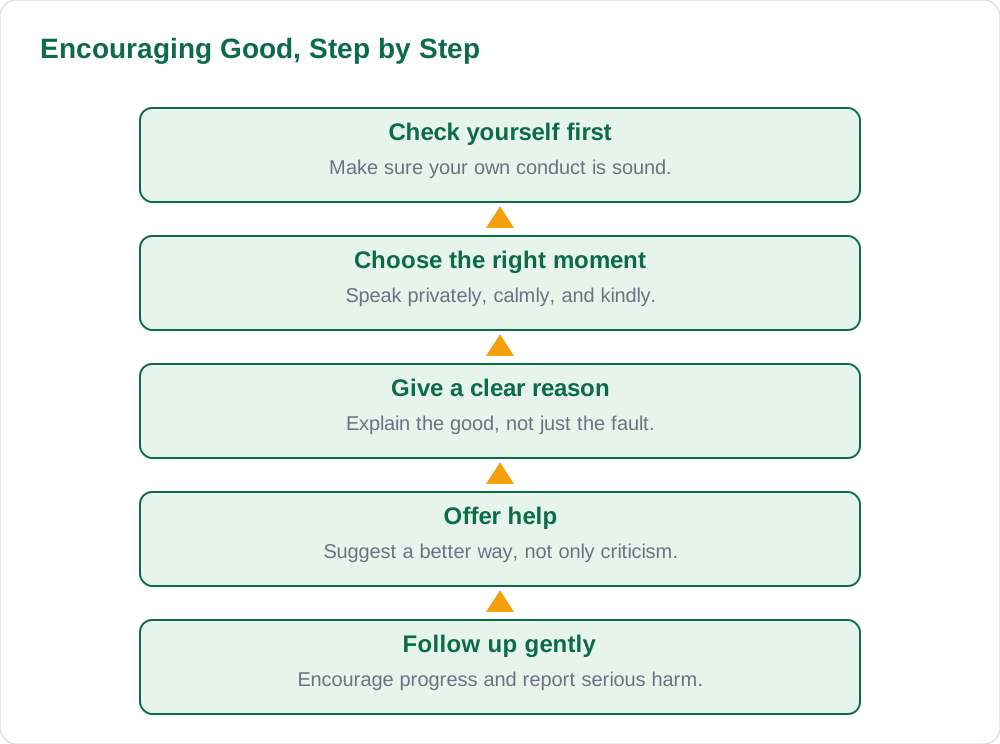
A senior answer on Amr bil Maroof should define the duty, explain why communities need it, and then develop one paragraph per setting: school, neighbourhood, and online life. Each paragraph should name specific acts, not general kindness, and the conclusion should stress wisdom and manners: speak privately, give reasons, offer help, and report serious harm responsibly. Answers that follow this shape sound mature because they show judgement, not only knowledge. Avoid the mistake of listing faults to condemn; the topic is about encouraging good, and the tone of the answer should show it.
Practice matters as much as writing. Choose one act for each setting this week: one kind word to an excluded classmate, one helpful act for a neighbour, and one refusal to forward an unverified message. Do them quietly and note what happened. These three small acts give you real examples for answers and real habits for life, which is the point of the topic. For your class book, visit the books collection and the solved notes pages to revise the matching chapter.
AI Help: Muse AI
Muse AI is Meta's personal AI assistant. It can help with this topic by helping you draft kind, private wording for encouraging a classmate, or by suggesting specific good acts for school, neighbourhood, and online life.
Join Muse with invite code LTGSWD — in the Muse app, go to Settings > Redeem token and enter the code.
Disclosure: LTGSWD is the author's Muse invite code.
Muse AI does not give official STBB answers — always verify against your Sindh Textbook Board book and your teacher.
5 key points you must know
- Amr bil Maroof is a shared community duty: encouraging good and discouraging wrong.
- Its governing principle is wisdom and good manners, aiming at reform, not victory.
- In school it means quiet leadership: inclusion, honesty, and refusing to join mockery.
- In the neighbourhood it means reliable conduct first, and advice second.
- Online it means truthfulness, kindness, and refusing to spread rumours or harassment.
Frequently asked questions
Is Amr bil Maroof only about correcting others?
No. Its main side is encouraging good: modelling honesty, including others, and praising good conduct. Correcting wrong matters too, but it should be private, kind, and aimed at reform, not at showing superiority.
Should I correct a classmate publicly if they are wrong?
Usually not. A private, calm word works better because public correction can embarrass and harden the other person. Reserve reporting to a teacher for serious harm such as bullying, which is the responsible form of the same duty.
How does Amr bil Maroof apply online?
Share truthful content, refuse to spread rumours or mocking posts, defend people being harassed in group chats, and leave cruel conversations. Before posting, ask: is it true, is it kind, and is it necessary?
What if people ignore my advice?
Advice does not always work at once, and that is normal. Keep your own conduct sound, repeat advice kindly if appropriate, and accept that you cannot force change. Your steady example often influences people over time more than one conversation.
Solved notes — preview free
These guides work best with the solved exercises. Preview the solved notes free on this website — 119 solved notes for Classes 6–10 in Sindhi, Urdu, English and Arabic medium. Or browse the full solved notes catalogue for your class and medium. New solved notes are added regularly — check the catalogue for coming-soon books.