Revisiting Sabr, Ikhlaas, and Adl at Senior Level
Sabr, Ikhlaas, and Adl are three qualities every Islamiat pupil meets early, but senior Islamiat asks for much more than their definitions. Sabr is patience and steadfastness, Ikhlaas is sincerity of intention, and Adl is justice and fairness. At senior level, you must show how these qualities work together in real situations: in study when results disappoint, in work when effort goes unnoticed, and in community life when fairness is difficult. This revision guide revisits all three with senior examples, so that your answers sound mature and your conduct benefits too.
Sabr: Patience That Keeps Working
Sabr is often misunderstood as simply waiting quietly, but senior Islamiat teaches a more active meaning: steadfastness in doing good, restraint from wrongdoing, and endurance in hardship. A pupil practises Sabr when she keeps studying after a poor result instead of giving up, when he controls anger during an argument instead of saying something hurtful, and when a family bears difficulty without abandoning honesty. In each case, Sabr is not passivity; it is continued right action under pressure. Senior answers should show this active side with examples, not only with the definition.
A useful way to study Sabr is to divide it into three everyday forms: patience in obedience, such as keeping up study routines when motivation fades; patience against wrongdoing, such as refusing to cheat when cheating seems easy; and patience in hardship, such as accepting a difficult result with dignity while working to improve. Write one example for each form from your own life, and Sabr stops being an abstract word. It becomes a description of choices you already recognise.
Ikhlaas: Sincerity Behind the Action
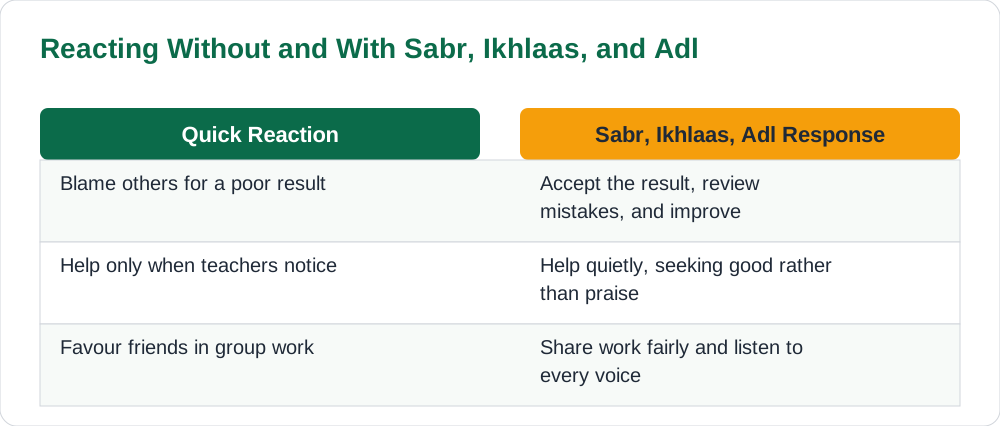
Ikhlaas means doing good sincerely for Allah, without showing off or seeking praise. It is the quality that gives actions their value: the same helpful act counts differently when done for praise than when done quietly for good. Senior pupils face this test constantly, because school life rewards visible achievement. Studying for marks alone, helping only when teachers watch, or praying only when others see it are all signs that intention needs checking. Ikhlaas does not forbid good results or appreciation; it asks that they not be the reason for the deed.
To study Ikhlaas honestly, ask one question about each good habit: would I still do this if nobody knew? If the answer is yes, the habit has sincerity. If the answer is no, the habit needs an intention reset, not abandonment. A practical exercise is to do one good deed each week completely quietly: help a classmate, tidy a shared space, or encourage someone, without telling anyone. Quiet deeds train sincerity better than any definition, and they give you genuine examples for exam answers about intention.
Adl: Justice in Small and Large Decisions
Adl means justice and fairness: giving each person their due, judging without favouritism, and standing by the truth even when it costs you. Senior Islamiat extends Adl beyond courts and governments into daily life. A group leader practises Adl by sharing work fairly instead of giving easy tasks to friends. A pupil practises Adl by admitting a mistake instead of blaming someone else. A class practises Adl when it listens to quieter voices, not only confident ones. When you write about Adl, always give a small-scale example alongside the large idea, because small-scale justice is where most pupils live.
Adl also requires honesty about bias. Everyone finds it easier to be fair to friends than to rivals, and to notice others' faults while excusing their own. Senior study of Adl should include this self-check: am I judging this situation by the same standard I would apply to myself? Pupils who practise that question in group work, games, and family discussions develop a fairness instinct that shows in their answers. For a companion guide, see the justice and fairness guide, the books collection, and the solved notes pages for your class.
How the Three Qualities Work Together
Sabr, Ikhlaas, and Adl are strongest together, and senior answers should show their connection. Consider a pupil who is unfairly blamed for a group mistake. Sabr keeps her from reacting angrily. Ikhlaas keeps her motive clean: she corrects the record to protect truth, not to win praise. Adl guides the outcome: she states facts fairly, without exaggerating others' faults. Remove any one quality and the response weakens: without Sabr it becomes a quarrel, without Ikhlaas it becomes showing off, and without Adl it becomes self-defence. This linked example is an excellent model for exam answers.
Build one linked example of your own and reuse its structure for different questions. Take a situation from study, work, or community life, and write three sentences: one showing Sabr, one showing Ikhlaas, and one showing Adl. Practise this three-sentence exercise weekly, with a new situation each time. Within a month, you will have a bank of examples that make any question on these qualities easy to answer, because you will be describing patterns you have already thought through.
Revising the Three Qualities for Exams
Revision of Sabr, Ikhlaas, and Adl should be example-led. For each quality, prepare one definition sentence, one everyday example, and one linked example showing all three together. Write these on a single page and revise from that page, not from long notes. Then test yourself with a simple question: explain one quality to a younger pupil in three sentences. If the younger pupil understands, your own understanding is solid. If you cannot simplify it, return to your notes and find the gap.
The most common exam weakness on these topics is writing three identical paragraphs that all say 'this quality is important'. Prevent it by giving each quality its own distinctive example and its own vocabulary: steadfastness and restraint for Sabr, sincerity and intention for Ikhlaas, fairness and due rights for Adl. Distinct examples and distinct words make distinct paragraphs, and distinct paragraphs earn distinct marks. Finish revision by writing one full answer that links all three qualities through a single situation.
AI Help: Muse AI
Muse AI is Meta's personal AI assistant. It can help with this topic by giving you new everyday situations to practise Sabr, Ikhlaas, and Adl on, or by helping you turn one situation into a three-part linked example.
Join Muse with invite code LTGSWD — in the Muse app, go to Settings > Redeem token and enter the code.
Disclosure: LTGSWD is the author's Muse invite code.
Muse AI does not give official STBB answers — always verify against your Sindh Textbook Board book and your teacher.
5 key points you must know
- Sabr is active steadfastness: continuing right action under pressure, not passive waiting.
- Ikhlaas is sincerity of intention: doing good for Allah, not for praise or display.
- Adl is justice and fairness in small decisions as well as large ones.
- The three qualities are strongest together, each correcting the others' weaknesses.
- Revise example-led: one definition, one everyday example, and one linked example per quality.
Frequently asked questions
How is Sabr different from simply waiting?
Waiting is passive, while Sabr is active steadfastness: continuing to study after a poor result, controlling anger in an argument, and bearing hardship without abandoning honesty. Senior answers should show Sabr as continued right action under pressure.
Does Ikhlaas mean good results and praise are bad?
No. Ikhlaas asks that praise and results not be the reason for the deed. A pupil may be pleased by good marks, but the deed should still be worth doing if nobody knew about it.
What is a small-scale example of Adl?
Sharing group work fairly instead of giving easy tasks to friends, admitting a mistake instead of blaming someone else, or listening to quieter voices in class discussion. Small-scale justice is where most pupils practise Adl daily.
How can I write one answer covering all three qualities?
Use one situation and three sentences: one showing Sabr, one showing Ikhlaas, and one showing Adl. For example, a pupil unfairly blamed for a group mistake stays calm, corrects the record for truth rather than praise, and states facts fairly.
Solved notes — preview free
These guides work best with the solved exercises. Preview the solved notes free on this website — 119 solved notes for Classes 6–10 in Sindhi, Urdu, English and Arabic medium. Or browse the full solved notes catalogue for your class and medium. New solved notes are added regularly — check the catalogue for coming-soon books.