Structuring Answers in Sindhi-Medium Exams
Many Sindhi-medium pupils know the answer but lose marks because the answer is disorganised. The examiner cannot find the main point, the explanation wanders, and the layout hides the good work. This guide teaches one reliable structure for Sindhi-medium answers across subjects: heading, point, explanation. Learn it once, use it everywhere, and your answers will look as good as they are.
The Heading-Point-Explanation Pattern
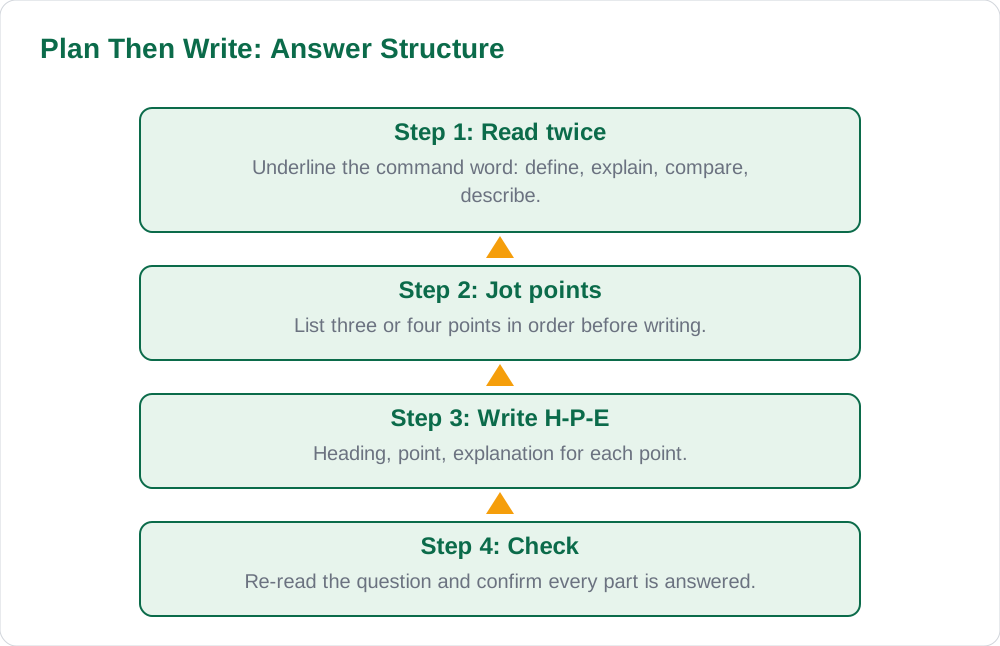
Every strong answer has three layers. The heading tells the examiner what this part is about. The point states one clear idea. The explanation develops that idea in two or three short sentences, with an example where it fits. Then you move to the next heading and the next point. This pattern keeps answers focused and makes marking easy, which is exactly what you want.
Write the heading slightly larger or underlined. Keep each point on its own line or in its own short paragraph. Avoid writing one long paragraph that mixes three ideas together. A well-structured answer of five short paragraphs earns more marks than a page of tangled writing. For the full answer method, see how to write a perfect answer.
- Heading: what this part is about.
- Point: one clear idea, stated simply.
- Explanation: two or three short sentences, plus an example.
- New point: new heading or new paragraph.
Planning Before You Write
Spend the first minute planning, not writing. Read the question twice and underline the command word: define, explain, compare, describe, or give reasons. Then jot down three or four points you will cover, in order. This tiny plan prevents the most common failure: writing everything you know in random order and missing the point the question actually asked.
If the question asks for reasons, plan three reasons. If it asks for a comparison, plan two columns: this side and that side. If it asks for a process, plan the steps in order. A plan of five words can save five marks. For time habits that protect planning time, read how to manage time during exams.
Opening and Closing Every Answer Well
Open with a direct answer, not a long introduction. If the question asks what photosynthesis is, begin with a one-sentence definition. If it asks why a result happened, begin with the main reason. Examiners reward answers that answer at once; a slow, vague opening wastes time and marks.
Close with a one-line conclusion that restates the main point. For a science answer, state the result. For an Islamiat answer, state the lesson. For a social studies answer, state the significance. A clean closing line tells the examiner the answer is complete and confident.
- Open with a direct one-sentence answer.
- Avoid long introductions that delay the point.
- Close with one line restating the main point.
- Never end mid-sentence or trail off.
Neat Layout That Earns Marks
Layout is part of the answer. Leave a margin, write on every second line if your handwriting is large, and leave a line between paragraphs. Underline headings and key terms. Number your points when the question asks for points. These habits cost no extra knowledge, yet they make your paper easier to read and easier to mark.
Handwriting matters too. You do not need beautiful writing, but you need readable writing. Write slowly enough that each word is clear, and leave space between words. For handwriting practice, see how to improve handwriting for board exams.
- Underline headings and key terms.
- Leave a line between paragraphs.
- Number points when the question asks for points.
- Write slowly enough that every word is readable.
Practising the Structure Across Subjects
Practise the same structure in every subject so it becomes automatic. In science, the heading names the concept, the point states the fact, and the explanation gives the example. In Islamiat, the heading names the topic, the point states the meaning, and the explanation gives the lesson. In social studies, the heading names the issue, the point states the fact, and the explanation gives the local example.
Write one structured answer per day from your homework, using the heading-point-explanation pattern. Ask your teacher to mark the structure, not just the content. Within a month, the pattern will feel natural, and your answers will be clearer in every paper.
- Science: concept, fact, example.
- Islamiat: topic, meaning, lesson.
- Social studies: issue, fact, local example.
- One structured answer per day builds the habit.
AI Help: Muse AI
Muse AI is Meta's personal AI assistant. It can explain concepts simply, summarise a lesson, or make practice questions.
For this topic, ask Muse AI to take one of your draft answers and show you how to reshape it into heading, point, and explanation form.
Join Muse with invite code LTGSWD — in the Muse app, go to Settings > Redeem token and enter the code.
Disclosure: LTGSWD is the author's Muse invite code.
Muse AI does not give official Sindh Textbook Board answers — always verify against your Sindh Textbook Board book and your teacher.
5 key points you must know
- Use heading, point, explanation for every answer across subjects.
- Plan for one minute: underline the command word and jot points in order.
- Open with a direct answer and close with a one-line conclusion.
- Keep layout neat: underlined headings, spaced paragraphs, numbered points.
- Practise one structured answer per day until the pattern is automatic.
Frequently asked questions
How long should an answer be?
Long enough to cover every part of the question with heading, point, and explanation. A focused half-page answer beats a rambling full page.
Should I write headings in every answer?
Yes, especially for longer answers. Headings guide the examiner, keep you on track, and make the answer look organised.
What if I forget a point during the exam?
Move on and write the points you remember. Return to the question at the end if time remains; a structured partial answer still earns marks.
Does handwriting really affect marks?
Yes, because an unreadable answer cannot be marked. Neat, readable writing with clear spacing protects the marks your knowledge deserves.
How do I handle a question with several parts?
Answer each part separately with its own heading. Check the question at the end to confirm no part was missed.
Solved notes — preview free
These guides work best with the solved exercises. Preview the solved notes free on this website — 119 solved notes for Classes 6–10 in Sindhi, Urdu, English and Arabic medium. Or browse the full solved notes catalogue for your class and medium. New solved notes are added regularly — check the catalogue for coming-soon books.