A Drafting Workflow for Solved Notes: From Rough Answer to Fair Copy
A good solved note is rarely written in one perfect attempt. Most pupils who score well follow a drafting workflow for solved notes: they write a rough answer first, check it, and only then produce a fair copy. The rough draft is where thinking happens, and the fair copy is where presentation happens. When the two jobs are mixed together, answers become messy, incomplete, or full of crossed-out lines. Separating them makes every answer clearer and every revision session faster, because the final note is worth reading again. This workflow works for every subject and every class, from short Islamiat answers to long science explanations, and it costs only a few extra minutes per exercise.
Why Rough Work Comes First
Writing straight into a fair copy puts two different pressures on a pupil at once: finding the right answer and writing it neatly. The brain cannot do both well at the same time, so one of them suffers, usually accuracy. A rough draft removes the neatness pressure entirely. In rough work, a pupil can jot down half-formed ideas, try two different openings, cross things out, and rearrange points without worrying about how the page looks. This freedom produces better answers because the pupil is thinking about content, not handwriting, and the final answer benefits from that thinking.
Rough work also catches mistakes early. When an answer is drafted loosely first, gaps in understanding show up before the answer is final. A pupil may discover that a point needs a reason, that an example is missing, or that two sentences contradict each other. Fixing these problems in rough work is quick and painless, while fixing them in a fair copy means rewriting the whole answer. Teachers who read fair copies can tell at once which pupils drafted first, because their answers read in a logical order instead of wandering from point to point.
- Rough work is for thinking: ideas, order, examples, and wording can all change freely.
- Fair work is for presenting: neat handwriting, correct spelling, and a clean layout.
- Never skip the rough stage for long answers; it is where most of the marks are earned.
- Keep rough work in a separate notebook or on the left-hand page so it never mixes with fair notes.
Step One: Read and Collect Before Writing
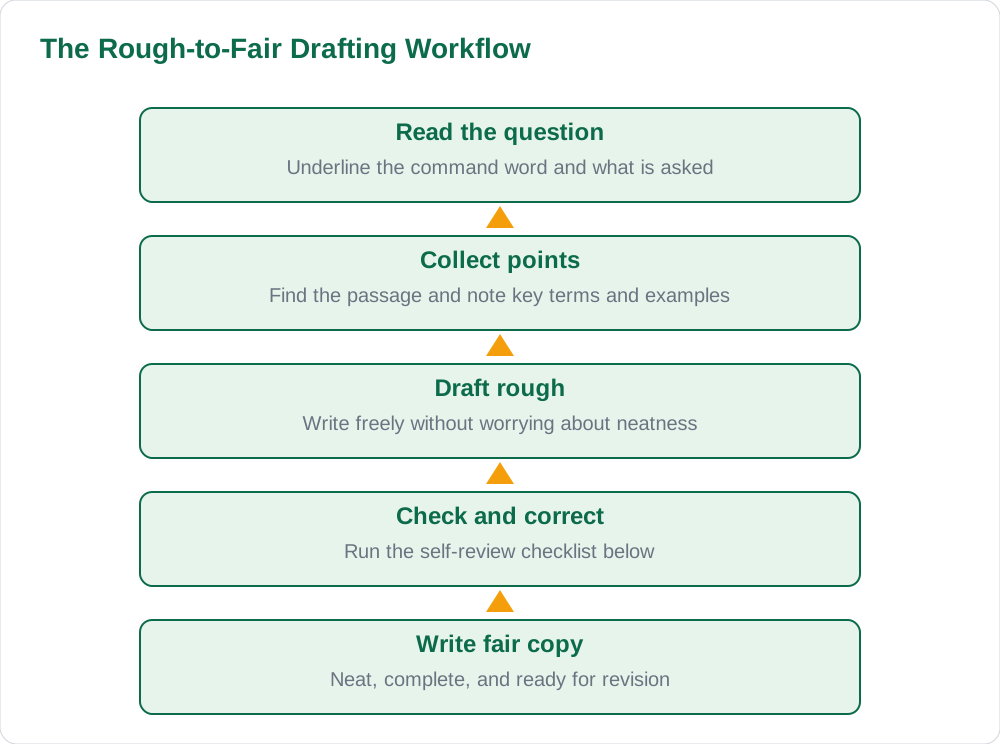
Every drafting workflow begins before a single sentence is written. The pupil reads the question twice, underlines the command word such as explain, describe, or compare, and notes exactly what is being asked. Then the pupil opens the textbook and finds the relevant passage, reading it carefully rather than relying on memory alone. Short notes are jotted down: key terms, two or three main points, and any example that fits. This collecting stage usually takes only a few minutes, but it prevents the most common error in solved notes, which is answering a different question from the one that was asked.
Collecting also means deciding the shape of the answer. A short question needs two or three sentences, while a long question needs an introduction, a body, and a closing line. The pupil should decide this shape in advance and note it in rough form, for example by writing the main points as a numbered list. With that skeleton in place, writing becomes a matter of expanding each point into a sentence or two, instead of inventing the structure while writing. Pupils who plan this way rarely run out of things to say halfway through an answer.
Step Two: Write the Rough Draft Freely
In the rough draft, speed matters more than beauty. The pupil writes the answer in full sentences but does not stop to perfect each one. If a word will not come, a gap is left and the writing continues; if a sentence sounds awkward, it is left for the checking stage. The goal is to get the whole answer onto the page in roughly the right order, with all the collected points included. A rough draft that covers everything, even clumsily, is far more useful than a beautiful half-answer, because a complete draft can be polished while an incomplete one cannot.
One useful habit is to write the rough draft slightly larger than normal, leaving space between lines. That space becomes room for corrections, added words, and arrows that move a sentence to a better place. Pupils who cram rough work into tiny lines find it hard to edit later, and their checking stage becomes guesswork. Rough work should look like a workshop, not a finished product, and there is no penalty for crossings-out, notes in the margin, or a paragraph that is rewritten twice.
Step Three: Run the Self-Review Checklist
Checking is the stage that turns a rough draft into a reliable answer, and it works best as a checklist rather than a vague re-read. The pupil reads the rough draft against the question and asks: does every part of the question have an answer, are the key terms used correctly, is there an example where one is needed, and does the answer end properly instead of stopping suddenly. Then the pupil reads again for language: spelling, punctuation, and sentences that are too long or unclear. Two short passes, one for content and one for language, catch far more errors than one general read-through.
The final check is against the textbook itself. The pupil opens the book to the relevant passage and confirms that names, terms, and facts in the draft match the book, rather than trusting memory. This is the habit that separates strong solved notes from weak ones, because memory quietly changes details over time. Any point that cannot be confirmed in the book is either corrected or removed. Only after this check is the answer ready for a fair copy, and the pupil can write it out with confidence that the content is sound. For more on this habit, see How to Check Your Answers Against the Textbook.
- Content check: every part of the question answered, in a logical order.
- Language check: spelling, punctuation, and clear sentences.
- Book check: every fact and term confirmed in the textbook passage.
- Completeness check: an example where needed and a proper closing line.
Step Four: Write the Fair Copy for Revision
The fair copy is written only after the rough draft has passed its checks. Because the content is already settled, the pupil can focus entirely on presentation: neat handwriting, even spacing, underlined headings where helpful, and a clear first line that answers the question directly. The fair copy should be written in the solved-notes folder or notebook that will be used for revision, not on a loose sheet that will be lost. A fair copy that is easy to read is easy to revise, and revision is the whole point of solved notes.
After writing the fair copy, one last quick read is worthwhile, not to re-check content but to catch copying slips: a skipped word, a repeated line, or a spelling error introduced while copying. These slips are common and easy to miss, which is why the final read matters even though the content was already verified. Once the fair copy is clean, the rough draft can be kept for a day or two and then discarded, while the fair copy becomes the permanent note. Over a term, this workflow builds a folder of notes that a pupil can trust completely, because every answer in it was drafted, checked, and fairly copied. Browse the solved notes collection to see how organised notes support revision, and explore all books to find the textbook each note belongs to.
AI Help: Muse AI
Muse AI is Meta's personal AI assistant, and it can help with this drafting workflow in a practical way. A pupil can ask Muse to explain a tricky question in simpler words before drafting, or to suggest how to organise the points of an answer, which makes the rough draft stage much easier.
Join Muse with invite code LTGSWD — in the Muse app, go to Settings > Redeem token and enter the code.
Disclosure: LTGSWD is the author's Muse invite code.
Muse AI does not give official STBB answers — always verify against your Sindh Textbook Board book and your teacher.
5 key points you must know
- Separate thinking from presentation: rough draft first, fair copy second.
- Collect points from the textbook before writing a single sentence.
- Check every draft twice: once for content, once for language.
- Confirm every fact in the book itself before writing the fair copy.
- Keep fair copies in one organised folder so revision is quick and reliable.
Frequently asked questions
How long should the rough draft stage take?
For a short answer, two to three minutes is enough; for a long answer, five to eight minutes. The rough stage should never take longer than the fair copy itself, because its job is to organise thinking, not to produce a second perfect answer.
Should rough work be kept or thrown away?
Keep it for a day or two in case a doubt comes up, then discard it once the fair copy has been checked. The fair copy is the permanent note; keeping every rough draft would clutter the folder and slow down revision.
What if I find a mistake while writing the fair copy?
Stop and check the textbook before continuing. Correct the fair copy neatly, or rewrite that answer if the correction is large. Never let a known mistake stay in a fair copy, because revision will teach the wrong version.
Does this workflow work for short one-line answers too?
For very short answers, the workflow shrinks: read the question, recall or check the point, write it neatly. The full rough-to-fair process matters most for answers of three sentences or more, where ordering and completeness affect marks.
Solved notes — preview free
These guides work best with the solved exercises. Preview the solved notes free on this website — 119 solved notes for Classes 6–10 in Sindhi, Urdu, English and Arabic medium. Or browse the full solved notes catalogue for your class and medium. New solved notes are added regularly — check the catalogue for coming-soon books.