STBB's 195-Title Benazir Bhutto Textbook Series for 2026-27 Explained
For the academic year 2026-27, the Sindh Textbook Board (STBB) has completed publication of textbooks from Early Childhood Education up to Grade 10: 195 titles in total, in Sindhi, Urdu, and English. The books belong to the Shaheed Mohtarma Benazir Bhutto Textbook Series. Education Minister Syed Sardar Ali Shah said that curriculum changes will come from the next academic year, focused on research, scientific thinking, creativity, and modern trends, along with religious tolerance, mutual respect, gender studies, and environmental protection. This article explains what 195 titles means, what is inside the series, what the coming curriculum changes could mean, and how students should use the new textbooks well.
What STBB Completed: 195 Titles From ECE to Grade 10
For academic year 2026-27, STBB completed publication of textbooks from Early Childhood Education up to Grade 10, a total of 195 titles in Sindhi, Urdu, and English. That figure is the headline, and it deserves a moment of unpacking. It does not mean 195 different subjects. It means 195 textbook titles across all classes, all subjects, and all three mediums of instruction. A single subject in a single class can appear as three titles, one in each medium, and the total counts every one of those editions. The number therefore reflects the scale of providing books in three languages across eleven levels of schooling, from early childhood to Grade 10.
For students and parents, the practical meaning is that the prescribed books for the year are published and available through the board's channels. If you are starting a new class, make sure you have the correct edition for your medium: Sindhi, Urdu, or English. A book in the wrong medium can slow you down for the whole year, because the examples, exercises, and chapter order may differ. Check the class, subject, and medium printed on the cover before you begin, and use our Books page to confirm which STBB books belong to your class.
- Academic year 2026-27: textbooks from Early Childhood Education to Grade 10
- Total: 195 titles in Sindhi, Urdu, and English
- Series: Shaheed Mohtarma Benazir Bhutto Textbook Series
- Check class, subject, and medium on the cover before you begin
What Is Inside the 195 Titles
The 195 titles cover the full range of school subjects taught from Early Childhood Education to Grade 10, in three mediums. That range includes languages, mathematics, science, social studies, Islamiat, and the other subjects in the Sindh curriculum, with each class and medium receiving its own editions. For younger children, the books focus on reading, counting, and early concepts. For middle and secondary classes, the books carry the full syllabus that board examinations are set from. Whatever your class, your textbook is the base document for your year: the chapters your teacher covers, the exercises you practise, and the content your examination will test.
Students sometimes ask whether they should study from a guidebook instead of the textbook. The honest answer is that the textbook comes first. Guidebooks, notes, and solved exercises help you practise and revise, but they are supplements, not replacements. Board papers are set from the prescribed syllabus and textbooks, so a student who knows the textbook deeply is never caught by surprise. Use Solved Notes to practise exercises and check your answers, but always return to the textbook chapter itself to understand the concept behind each question.
- Full range: languages, mathematics, science, social studies, Islamiat, and more
- Three mediums: Sindhi, Urdu, and English editions
- Textbook is the base document for the year and the examination
- Guidebooks and notes are supplements, not replacements
Curriculum Changes Coming From the Next Academic Year
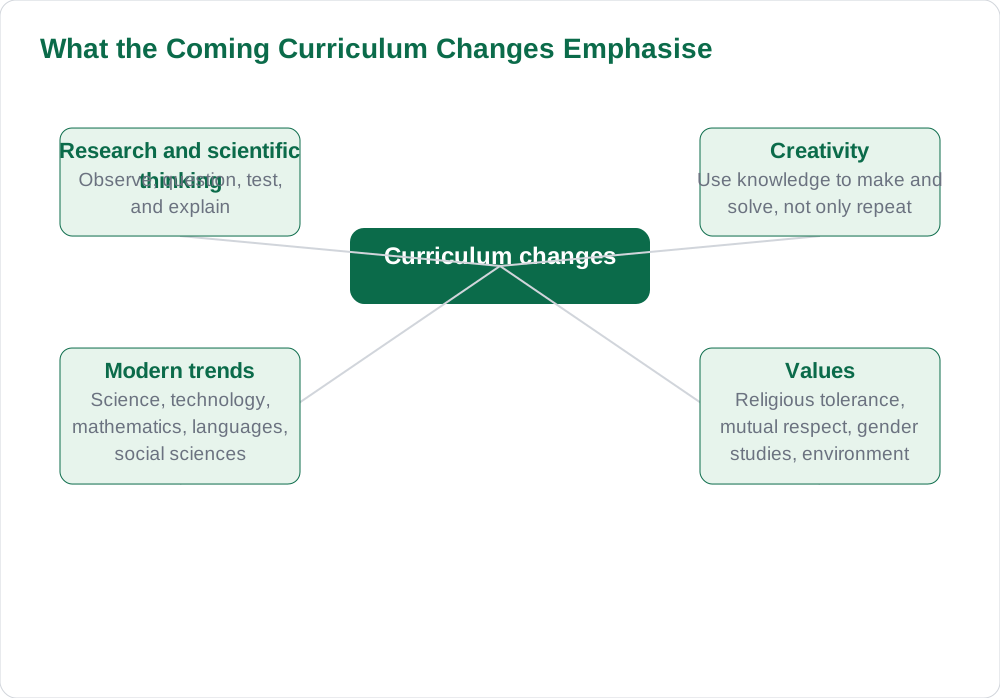
Education Minister Syed Sardar Ali Shah said that curriculum changes will come from the next academic year, focused on research, scientific thinking, creativity, and modern trends in science, technology, mathematics, languages, and social sciences. The announcement also listed religious tolerance, mutual respect, gender studies, and environmental protection among the focus areas. That is a broad agenda, and it is worth reading carefully. It signals a shift from memorisation alone towards understanding, questioning, and applying knowledge, alongside values that help students live and work together in a diverse society.
What does that mean for a student in practice? It means that the ability to explain an idea, test it, and use it will matter more than the ability to repeat it word for word. A Science student may be asked to observe, record, and explain, not only to define. A language student may be asked to write and discuss, not only to memorise. A Social Studies student may be asked to compare and judge, not only to list. These are skills that take time to build, so the best preparation is to start now: ask why, practise explaining ideas aloud, and connect each chapter to something real in your life.
- Focus: research, scientific thinking, creativity, modern trends
- Subjects named: science, technology, mathematics, languages, social sciences
- Values named: religious tolerance, mutual respect, gender studies, environmental protection
- Shift: from memorisation alone towards understanding and applying knowledge
What the Changes Mean for Students in Each Stage
For younger students in Early Childhood Education and primary classes, the changes should mean more learning through activity, stories, and questions, rather than through long passages to memorise. Parents can support this by reading with their children, asking them what they learned each day, and letting them explain ideas in their own words. A child who can explain a concept has understood it, and a child who can only repeat it may need one more explanation. That difference is the heart of the announced shift.
For middle and secondary students, the changes should mean more attention to how you study, not only to how much you study. Practise writing explanations, solving problems step by step, and discussing ideas with classmates. In Science, practise the method: observe, record, explain. In languages, practise writing short paragraphs and speaking clearly. In Social Studies, practise comparing viewpoints and giving reasons. These habits are exactly what the coming curriculum rewards, and they are also the habits that raise marks under any syllabus. See our study tips collection for methods that build them.
- Younger students: more activity, stories, and questions; explain ideas in own words
- Middle and secondary: practise explaining, solving step by step, and discussing
- Science: observe, record, explain; languages: write and speak clearly
- Social Studies: compare viewpoints and give reasons
How to Use the New Textbooks Well This Year
A new textbook series is only useful if students use it well. Start by reading each chapter before your teacher teaches it, even if you only skim the headings, diagrams, and exercises. That first skim gives you a map of the chapter, so the teacher's explanation lands on prepared ground. After the lesson, read the chapter fully, solve the exercises without looking at answers, and write a short summary in your own words. Then revise the chapter within a week, because a chapter read once is usually half-forgotten within days unless it is revised.
Keep your books in good condition, because you will return to them all year for revision and examination preparation. Mark difficult points with a pencil so you can find them quickly, and keep a notebook of formulas, definitions, and diagrams you forget. If a chapter confuses you, ask your teacher rather than skipping it, because skipped chapters become the questions you fear most. And remember that the textbook is the authority for your examination: when a guidebook and the textbook disagree, trust the textbook and ask your teacher to explain the difference.
- Skim each chapter before the lesson: headings, diagrams, exercises
- After the lesson: read fully, solve exercises, write a short summary
- Revise each chapter within a week to beat forgetting
- When a guidebook and the textbook disagree, trust the textbook
AI Help: Muse AI
Muse AI is Meta's personal AI assistant, and it can help you get more from the new STBB textbooks by explaining a difficult chapter simply, summarising a lesson, or turning a chapter into practice questions.
Join Muse with invite code LTGSWD — in the Muse app, go to Settings > Redeem token and enter the code.
Disclosure: LTGSWD is the author's Muse invite code.
Muse AI does not give official STBB answers — always verify against your Sindh Textbook Board book and your teacher.
5 key points you must know
- For 2026-27, STBB completed 195 textbook titles from Early Childhood Education to Grade 10, in Sindhi, Urdu, and English.
- The books belong to the Shaheed Mohtarma Benazir Bhutto Textbook Series.
- Curriculum changes come from the next academic year, per Education Minister Syed Sardar Ali Shah.
- Focus areas: research, scientific thinking, creativity, modern trends, plus tolerance, respect, gender studies, and environment.
- The textbook comes first; notes and guides are supplements, not replacements.
Frequently asked questions
How many STBB textbook titles were completed for 2026-27?
STBB completed 195 textbook titles from Early Childhood Education up to Grade 10, in Sindhi, Urdu, and English, in the Shaheed Mohtarma Benazir Bhutto Textbook Series.
What does 195 titles mean?
It means 195 textbook titles across all classes, subjects, and three mediums. A single subject in a single class can appear as three titles, one in each medium, and the total counts every edition.
When do the curriculum changes start?
Education Minister Syed Sardar Ali Shah said curriculum changes will come from the next academic year. Students should expect a shift towards research, scientific thinking, and creativity.
What values did the minister name in the curriculum changes?
The announcement named religious tolerance, mutual respect, gender studies, and environmental protection alongside modern trends in science, technology, mathematics, languages, and social sciences.
Should I study from the textbook or a guidebook?
The textbook comes first, because board papers are set from the prescribed syllabus and textbooks. Use Solved Notes to practise, but return to the textbook chapter to understand each concept.
Solved notes — preview free
These guides work best with the solved exercises. Preview the solved notes free on this website — 119 solved notes for Classes 6–10 in Sindhi, Urdu, English and Arabic medium. Or browse the full solved notes catalogue for your class and medium. New solved notes are added regularly — check the catalogue for coming-soon books.