Tauheed Explained for Class 6: One Allah, Simply Understood
Tauheed is the belief that Allah is One, without any partner or equal. It is the first and most important belief in Islam, and it shapes how a Muslim thinks, worships, and behaves every day. For Class 6 pupils, Tauheed is not a difficult idea to memorise. It is a clear and beautiful idea to understand: there is one Creator who made the world, who cares for all living things, and who alone deserves our worship. When pupils understand Tauheed well, the rest of Islamiat becomes easier, because every lesson about prayer, honesty, kindness, and the life of the Holy Prophet Muhammad (peace be upon him) grows from this one root.
What Tauheed Means in Simple Words
Tauheed means that Allah is One. He has no partner, no equal, and no one shares His power. He was not born, and He has no children. He alone created the heavens and the earth, the sun and the moon, the mountains and the seas, and every living thing in them. Nothing happens without His knowledge and His will. When pupils say that Allah is One, they are saying something very big in very few words: all power, all knowledge, and all mercy belong to Him alone.
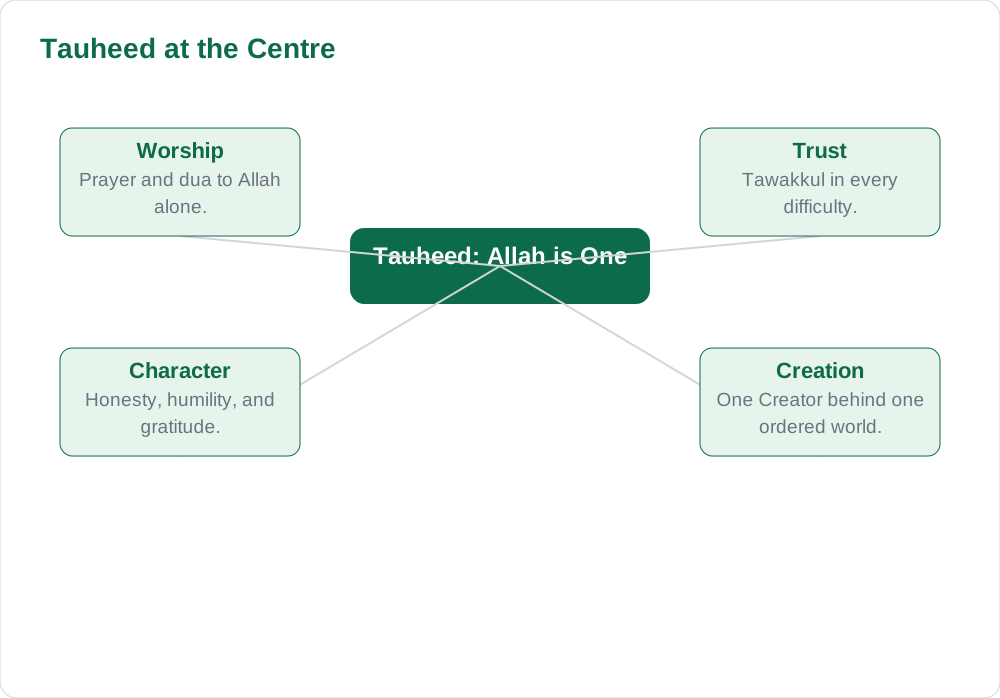
A useful way to understand Tauheed is to look at the order of the world. The sun rises every morning, the seasons change in turn, and the human body works in a wonderful balance. This order points to one Creator and one plan. If there were many gods with different wishes, the world would be full of confusion and conflict. The harmony of creation is a daily sign of the oneness of Allah. Pupils can discuss this in class: what signs of one Creator do they see in nature, in their own bodies, and in the order of day and night?
- Allah is One, with no partner and no equal.
- Allah alone created everything and cares for all creation.
- Allah alone deserves worship, prayer, and trust.
- The order of nature is a daily sign of His oneness.
Tauheed and Worship: Why We Pray to Allah Alone
Because Allah is One, Muslims worship Him alone. Namaz, dua, fasting, and charity are all offered to Allah alone, and no one else is asked for help in the way that only Allah can help. This keeps worship pure and simple. A pupil who understands Tauheed knows that prayer is a direct conversation with Allah. There is no need for any middle person, and no need to fear anyone else when asking for forgiveness, guidance, or strength. This belief gives a believer confidence and peace of heart.
Tauheed also protects a person from fear and superstition. A believer does not fear lucky charms, magic, or the anger of false powers, because all power belongs to Allah alone. At the same time, Tauheed teaches humility. A person who believes in one Allah knows that wealth, strength, and success all come from Allah, so pride has no place. Pupils can practise this lesson by beginning their work with the name of Allah, by thanking Him for small blessings, and by asking Him alone for help before a test or a difficult task.
Everyday Examples That Make Tauheed Clear
Teachers can make Tauheed clear with examples from daily life. A school has one head teacher who makes the rules for the whole school. If every class made its own opposite rules, the school would fall into confusion. In the same way, the whole universe follows one plan because it has one Creator. A second example is a book with one author. The story holds together because one mind planned it. Creation holds together because one Allah designed it. These examples are not proofs by themselves, but they help young pupils feel the sense of Tauheed before they study it in greater depth.
Another everyday example is trust. When a child is lost in a market, the child looks for one trusted person, a parent or a police officer, and holds that hand firmly. A believer holds firmly to Allah in the same way, trusting that Allah sees, hears, and knows everything. This trust is called Tawakkul. It does not mean sitting idle. A pupil still studies, still prepares, and still works hard, but the heart rests on Allah for the result. Discussion question for class: how does trusting Allah change the way we face a difficult exam or a personal worry?
- One school, one set of rules: order comes from one authority.
- One author, one story: creation follows one plan.
- One trusted hand in a crowd: Tawakkul means trusting Allah while still working hard.
- Find more solved notes and study help on the solved notes page.
How Tauheed Shapes Character and Behaviour
Tauheed is not only a belief to say with the tongue. It is a belief that changes behaviour. A person who truly believes that Allah sees everything will try to be honest even when no teacher or parent is watching. A person who believes that Allah provides for all will share food, books, and time with others instead of holding everything tightly. A person who believes that Allah is the only true judge will treat others fairly, even when it would be easier to be unfair. In this way, Tauheed becomes the root of good character, or akhlaq.
Pupils can practise Tauheed in small daily choices. Telling the truth when a lie would be easier is Tauheed in action, because the pupil acts as if Allah is watching. Refusing to copy in a test is Tauheed in action, because the pupil trusts Allah rather than cheating. Helping a classmate who is struggling is Tauheed in action, because the pupil thanks Allah for his own ability by using it for others. Teachers and parents can praise these small acts and connect them to the big belief, so that pupils see that faith and behaviour belong together.
Discussion Questions and Study Method for Class 6
Good study of Tauheed means discussion, not only reading. Pupils can work in pairs and answer questions such as: what does it mean to say Allah is One, in your own words? Why do Muslims worship Allah alone? What is one sign of Allah oneness that you noticed today? How does believing that Allah sees everything change the way you behave when you are alone? Each pair can share one answer with the class, and the teacher can correct misunderstandings gently. This method helps pupils own the idea instead of only repeating it.
For revision, pupils can make a one-page summary with three parts: a definition of Tauheed in two sentences, three everyday examples, and three ways Tauheed changes behaviour. They can then test each other with short questions and explain the answers aloud. Parents can help by asking one discussion question at home each evening. For more structured study support, families can explore the STBB books collection and the blog study guides for further reading on Islamiat topics.
- Define Tauheed in your own words, without copying a sentence.
- Give one example from nature that shows one Creator.
- Name one daily choice that shows belief in Allah oneness.
- Revise with a one-page summary and peer questioning.
AI Help: Muse AI
Muse AI is Meta's personal AI assistant, and it can help with this topic by explaining Tauheed in even simpler words, giving fresh everyday examples, or turning the lesson into short practice questions for revision.
Join Muse with invite code LTGSWD — in the Muse app, go to Settings > Redeem token and enter the code.
Disclosure: LTGSWD is the author's Muse invite code.
Muse AI does not give official STBB answers — always verify against your Sindh Textbook Board book and your teacher.
5 key points you must know
- Tauheed means Allah is One, with no partner or equal.
- Muslims worship Allah alone and trust Him in every difficulty.
- The order of nature points to one Creator and one plan.
- Tauheed shapes character: honesty, humility, gratitude, and fairness.
- Pupils learn Tauheed best through discussion, examples, and daily practice.
Frequently asked questions
What is Tauheed in one sentence?
Tauheed is the belief that Allah is One, with no partner or equal, and that He alone created everything and alone deserves worship.
Why do Muslims worship Allah alone?
Because Allah alone is the Creator and Sustainer of all things, worship belongs to Him alone. This keeps faith pure and gives the believer a direct relationship with Allah.
How does Tauheed change daily behaviour?
Belief that Allah sees everything encourages honesty, fairness, and kindness even when no one else is watching, and it removes fear of false powers.
What is Tawakkul?
Tawakkul means trusting Allah for the result while still working hard and preparing properly. It is trust joined to effort, not a replacement for effort.
How can Class 6 pupils revise Tauheed?
Make a one-page summary with a definition, three examples, and three behaviour lessons, then practise explaining it aloud and answering discussion questions with a partner.
Solved notes — preview free
These guides work best with the solved exercises. Preview the solved notes free on this website — 119 solved notes for Classes 6–10 in Sindhi, Urdu, English and Arabic medium. Or browse the full solved notes catalogue for your class and medium. New solved notes are added regularly — check the catalogue for coming-soon books.