First-Day Routines That Set Up a Calm Classroom
The first day of class sets the tone for the whole term, and a calm classroom rarely happens by accident. When pupils walk in and immediately see order, warmth, and clear expectations, they relax and settle faster. This article gives teachers a practical first day routines plan that covers learning names quickly, agreeing a small set of rules together, and teaching the everyday routines pupils will repeat all year. Instead of spending the day reading out rules or lecturing, you will build habits from the very first lesson: how to enter, how to ask for help, and how to move between activities. These small, well-taught routines prevent most later disruption, because pupils know exactly what to do and what their teacher expects. Whether you teach a small class or a crowded one, the first day is your best chance to build a calm, respectful classroom culture.
Start Before the Bell: Prepare the Room and Yourself
A calm first day begins before any pupil arrives, so prepare the room the evening before or early in the morning. Arrange seats so every pupil can see the board and you can reach every desk without squeezing past bags. Write a simple welcome message on the board with your name, the subject, and the first task pupils should do when they sit down, such as writing their name on a card. Place name cards, a seating plan, and the materials for the first activity where you can reach them without hunting through cupboards mid-lesson. When the room looks ready, pupils read the message instantly: this teacher is organised, and this lesson matters.
Prepare yourself too, because your mood on the first day is contagious. Decide in advance how you will greet pupils at the door, what you will say in the first two minutes, and how you will handle a late arrival without stopping the lesson. Keep your first instructions short and visible, and practise saying them in a calm, steady voice. Pupils test boundaries most on day one, not out of rudeness but to learn where the lines are, so a teacher who is prepared, friendly, and firm gives them the security they need. For more teaching ideas, browse the solved notes and the book collection for material you can use in your first week.
Learn Names Fast: Make Every Pupil Feel Known
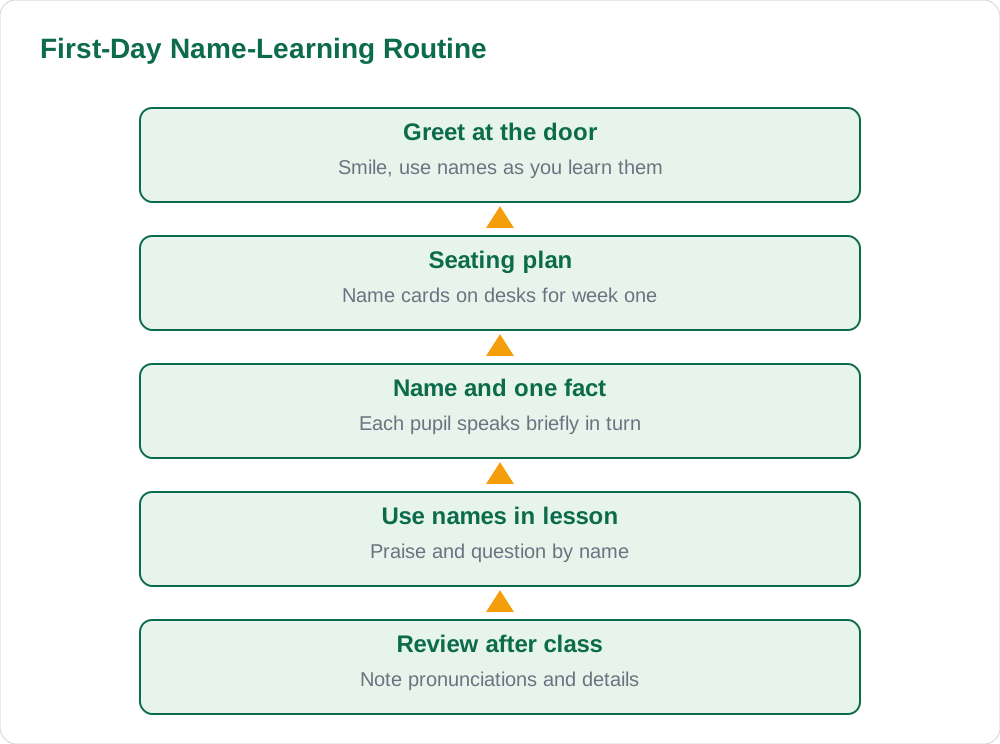
Learning names quickly is one of the most powerful first-day routines a teacher can build, because a pupil who hears their own name feels seen and is far less likely to drift off task. Use a seating plan and call the register by asking each pupil to say their name and one short fact, such as a favourite subject or hobby, while you repeat the name back. In a large class, work row by row and use name cards on desks for the first week, so you can address pupils by name even before you have memorised them all. Repeat names naturally during the lesson whenever you praise, question, or redirect a pupil, and by the end of the day you will already know many of them.
Names also help you manage behaviour without raising your voice, since a quiet word using a pupil's name carries far more weight than a general shout to the whole class. Play a short name game if time allows, such as asking pupils in a row to introduce the person beside them, which builds listening as well as memory. Keep a small notebook or class list where you jot down pronunciations and anything you learn about each pupil, and review it before the second lesson. Pupils notice when a teacher remembers them, and that recognition builds the trust that makes every later routine easier to teach. You can also explore the blog for more classroom strategies to try across the term.
Agree a Small Set of Rules Together
Rules work best on the first day when pupils help to shape them, because a rule they agreed to feels fair rather than imposed. Ask the class what kind of classroom helps everyone learn, and collect short answers such as listen when others speak, raise a hand, and keep the room tidy. Guide the discussion toward five or six positive rules written as things to do, not a long list of bans, and write them on a chart that stays on the wall. Explain each rule with a concrete example, such as what respectful listening looks like during a classmate's answer, so pupils are not left guessing what you mean.
Once the rules are agreed, practise them immediately instead of only talking about them. Run a two-minute rehearsal where pupils practise raising a hand, waiting to be called, and moving quietly to group work, and praise the exact behaviour you want to see again. Be clear about the consequence for breaking a rule, and keep it calm, consistent, and private wherever possible, so discipline never becomes a public showdown. Pupils respect a teacher who follows through every time, and a small set of well-taught rules prevents the need for constant correction later. Visit the about page to learn more about this site's mission for teachers and pupils.
Teach the Everyday Routines Pupils Will Repeat
Beyond rules, the first day should teach the practical routines that fill every lesson: entering the room, starting work, asking for help, and packing up. Show pupils exactly where to sit, where to keep bags, how to collect and return books, and what to do when they finish a task early. Demonstrate each routine once, then have the class practise it, because a routine that is only explained is forgotten by tomorrow, while a routine that is practised becomes automatic within a week. Keep the number of routines small on day one, perhaps four or five, and add more gradually as the class masters the first set.
Routines save teaching time all term, since a class that enters quietly and starts the starter task without prompting gives you back several minutes every lesson. Use the same signals every day, such as a hand raised for attention or a countdown for packing up, so pupils respond without needing a fresh explanation. When a routine slips, reteach it calmly the next day rather than scolding the whole class, and praise the pupils who follow it well. Over time these routines become the invisible structure of a calm classroom, freeing you to focus on teaching rather than crowd control. The [home page](/) offers a starting point for finding resources for every class you teach.
End Day One with Connection and a Clear Next Step
How the first day ends matters as much as how it begins, because the last five minutes are what pupils remember on the walk home. Close with something positive and personal: recap one thing the class did well, thank pupils by name where you can, and preview tomorrow's lesson with a small teaser that makes them curious. Give a short, achievable first homework task, such as bringing one question about the subject, and explain exactly where and when it is due. A calm, warm ending sends pupils home telling their families that the new teacher is kind and organised, which builds support for your classroom from the very start.
Finally, spend ten minutes after the lesson reviewing your own first day while it is fresh. Note which routines worked, which pupils need extra attention, and what you will reteach tomorrow, and adjust your seating plan if a particular pairing caused friction. Keep the notes in your class file and check them before the second lesson, so day two builds on day one instead of starting from scratch. A teacher who reflects and adjusts quickly earns a reputation for fairness and care, and that reputation does more for classroom calm than any single rule. For questions or suggestions, use the contact page to get in touch.
AI Help: Muse AI
Muse AI is Meta's personal AI assistant, and it can help teachers draft a first-day plan, phrase classroom rules in positive language, or brainstorm quick name games for a new class. Try asking it for a short first-day schedule and then adapt the ideas to your own class size and subject.
Join Muse with invite code LTGSWD — in the Muse app, go to Settings > Redeem token and enter the code.
Disclosure: LTGSWD is the author's Muse invite code.
Muse AI does not give official STBB answers — always verify against your Sindh Textbook Board book and your teacher.
5 key points you must know
- Prepare the room, seating plan, and first task before pupils arrive.
- Learn names fast with name cards, repetition, and a short name activity.
- Agree five or six positive rules together and practise them on day one.
- Teach a few everyday routines by demonstration and practice, not lecture.
- End with praise, a preview of tomorrow, and a small achievable task.
Frequently asked questions
How many rules should a teacher set on the first day?
Five or six positive rules are enough. A short list is easier to remember and enforce than a long list of bans, and you can add routines gradually as the class masters the first set.
What if I cannot learn all names on the first day?
That is normal, especially in a large class. Use a seating plan and name cards for the first week, repeat names during lessons, and review your class list after each lesson until you know everyone.
Should first-day rules be decided by the teacher or the class?
Guide the discussion, but let pupils contribute. When pupils help word the rules, they understand them better and are more willing to follow them, while you still keep the final say on safety and fairness.
What makes a good first-day homework task?
Keep it short and achievable, such as bringing one question about the subject. It should build curiosity, not stress, and it gives you something positive to discuss at the start of day two.
Solved notes — preview free
These guides work best with the solved exercises. Preview the solved notes free on this website — 119 solved notes for Classes 6–10 in Sindhi, Urdu, English and Arabic medium. Or browse the full solved notes catalogue for your class and medium. New solved notes are added regularly — check the catalogue for coming-soon books.