Dictation and Spelling Drills for Urdu-Medium Classes

Urdu spelling slips are stubborn: the same words come back wrong week after week, even when pupils study hard. The reason is that most pupils practise spelling by reading, while spelling is really a listening and writing skill. This guide teaches dictation and spelling drills for Urdu-medium classes: short dictated passages, personal error logs, and weekly retests that target each pupil's repeated slips. The method is short, focused, and kind, and it fixes errors instead of merely repeating them.
Why Spelling Slips Keep Returning
Spelling slips return because pupils practise the wrong thing. Reading a correct word shows the eyes the right shape, but dictation tests whether the ears and hand can rebuild that shape from sound. Urdu adds its own traps: letters that sound alike but are written differently, silent or soft letters, and words borrowed from Arabic and Persian with spellings that sound does not predict. A pupil who only reads will keep tripping on the same traps, because reading never tests the ear-to-hand link.
The fix is to practise the link directly through dictation, then to study only the words that were actually missed. A pupil who misspells eight words out of fifty needs eight words of practice, not fifty. Targeted practice saves time and builds confidence, because progress is visible: last week's eight becomes this week's three. For general revision habits that support this kind of focused work, see how to revise before exam night.
- Spelling is an ear-to-hand skill, not just an eye skill.
- Urdu traps include similar-sounding letters and borrowed spellings.
- Practise only the words actually missed, not the whole list.
- Visible progress, from eight slips to three, builds confidence.
The Dictation Routine
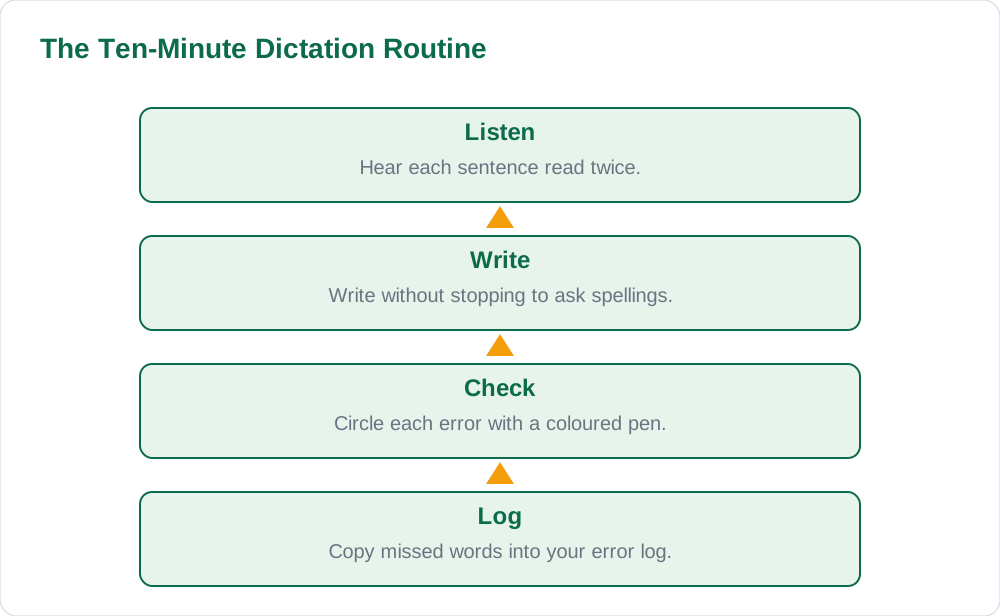
A good dictation takes ten minutes, not a whole period. The teacher or a parent reads a short passage of forty to sixty words at a natural pace, repeating each sentence once. Pupils write without stopping to ask about spellings, because the point is to reveal real slips. After writing, pupils check their own work against the passage with a coloured pen, circling each error without rewriting yet. The checking itself is part of learning: seeing the correct shape beside the slip teaches the eye what to notice next time.
Passages should come from the pupil's own lessons: a paragraph from the Urdu textbook, a science definition, or a few lines from an Islamiat lesson. Familiar content keeps the focus on spelling rather than on new vocabulary, and it connects dictation to real schoolwork. Keep solved notes nearby so dictation passages can be drawn from lessons pupils are already studying.
- Ten minutes, forty to sixty words, each sentence read twice.
- Write without stopping; the goal is to reveal real slips.
- Check with a coloured pen, circling errors before rewriting.
- Use passages from pupils' own lessons, not random word lists.
Building a Personal Error Log
An error log is a small notebook page with three columns: the word as the pupil wrote it, the correct spelling, and the reason for the slip in the pupil's own words. The reason column is the most important, because it turns a mistake into a rule. A pupil who writes that two similar-sounding letters were confused, or that a soft letter was dropped, starts to watch for that pattern in new words. Without the reason column, the log is just a list, and lists are quickly forgotten.
Review the log in two-minute bursts: cover the correct column, look at the wrong version, and rewrite the word correctly from memory. Words that survive three correct rewrites across three different days can be retired from the log; words that keep failing stay and get extra attention. Teachers can help by checking logs weekly and praising pupils whose logs shrink, because a shrinking log is proof of real progress. For time habits that make room for short daily drills, see how to manage time during exams.
- Three columns: my spelling, correct spelling, reason in my own words.
- The reason column turns a mistake into a rule.
- Two-minute bursts: cover, rewrite from memory, check.
- Retire words after three correct rewrites on three different days.
Weekly Retests That Actually Fix Errors
Retests fail when they repeat the same passage, because pupils memorise the passage instead of the spellings. A good retest uses the missed words inside new sentences, so pupils must spell them from knowledge rather than from memory of the old passage. The teacher collects the week's error-log words, writes five to ten fresh sentences using them, and dictates those sentences. Pupils who spell a word correctly in a new sentence truly own it.
Keep retests low-pressure. The goal is to fix errors, not to catch pupils out. Announce that the retest will use error-log words, celebrate improvement openly, and let pupils track their own scores. A class chart that shows average slips falling from eight to five to two motivates far more than a chart that ranks pupils against each other. Progress, not punishment, is what fixes spelling.
- Retest missed words in new sentences, never the same passage.
- Five to ten fresh sentences using the week's error-log words.
- Announce the retest and its words; the goal is fixing, not catching out.
- Track progress: falling slip counts motivate more than rankings.
Making Dictation Enjoyable, Not Stressful
Dictation becomes enjoyable when it feels like a game rather than a test. Pair pupils so one dictates and one writes, then they swap roles; dictating teaches spelling too, because the dictator must read each word carefully. Try team dictation, where small groups compete to reduce their total slips, or dictation bingo, where pupils listen for their error-log words in a story. Short, playful formats keep attention high and fear low.
Praise effort and improvement, not perfection. A pupil who reduces slips from ten to six has achieved more than a pupil who stays at two without effort, and the praise should say so. Parents can help by dictating one short paragraph at home twice a week in a calm moment, without correcting mid-dictation. Calm, short, regular practice is the whole method, and it works for every pupil who sticks with it.
- Pair dictation: pupils take turns dictating and writing.
- Team games and dictation bingo keep attention high and fear low.
- Praise improvement: ten slips to six is a real achievement.
- Parents can dictate one short paragraph at home twice a week.
AI Help: Muse AI
Muse AI is Meta's personal AI assistant. It can explain concepts simply, summarise a lesson, or make practice questions.
Ask Muse AI to write a short dictation passage using the words from your error log, so your weekly retest uses fresh sentences.
Join Muse with invite code LTGSWD — in the Muse app, go to Settings > Redeem token and enter the code.
Disclosure: LTGSWD is the author's Muse invite code.
Muse AI does not give official Sindh Textbook Board answers — always verify against your Sindh Textbook Board book and your teacher.
5 key points you must know
- Spelling is an ear-to-hand skill, so dictation, not just reading, is the right practice.
- Ten-minute dictations with familiar passages reveal each pupil's real slips.
- A three-column error log turns each mistake into a rule.
- Weekly retests must use missed words in new sentences, never the same passage.
- Short, playful, low-pressure drills fix spelling faster than long stressful tests.
Frequently asked questions
How long should a dictation be?
Forty to sixty words, about ten minutes, is ideal. Short dictations keep attention high and leave time for checking and logging. Long dictations tire pupils and leave no time to learn from the errors they reveal.
Should pupils correct errors immediately after dictation?
First circle errors with a coloured pen, then copy missed words into the error log with a reason, then rewrite them correctly. Circling before rewriting makes pupils actually see the slip instead of mechanically copying the correct shape.
How often should dictation happen?
Two or three times a week in class, plus one short home dictation if possible, is plenty. The key is regularity: short, frequent dictation with error-log review beats one long monthly test.
What if the same word keeps coming back wrong?
Study the reason, not just the word. Ask which letters are confused and why, practise the word in three new sentences on three different days, and say the letters aloud as you write. If it still fails, ask the teacher to explain the pattern behind it.
Solved notes — preview free
These guides work best with the solved exercises. Preview the solved notes free on this website — 119 solved notes for Classes 6–10 in Sindhi, Urdu, English and Arabic medium. Or browse the full solved notes catalogue for your class and medium. New solved notes are added regularly — check the catalogue for coming-soon books.