A Learner Glossary of Arabic Terms in Urdu-Medium Islamiat
Islamiat passages become much easier when the Arabic terms inside them make sense. Urdu-medium pupils often memorise translations of whole paragraphs without understanding words such as iman, taqwa, sabr, or adl, so the meaning slips away in the exam. This learner glossary explains the Arabic terms pupils meet most in Islamiat in plain Urdu, with a short explanation and a everyday example for each. The goal is not blind memorisation; it is reading Islamiat passages with real understanding.
Why Arabic Terms Block Understanding
Arabic terms carry meanings that a single Urdu word rarely captures fully. Iman, for example, is often translated as belief, but in Islamiat it also carries trust, acceptance, and commitment in the heart. When a pupil only memorises belief, the passage feels thin, and exam answers become one-word responses instead of thoughtful explanations. Understanding the fuller meaning lets pupils explain, not just repeat.
The block grows when pupils skip over unfamiliar terms instead of pausing on them. A passage with five unknown terms feels like a wall, but five terms explained one by one become five small steps. Pupils should underline each Arabic term on first reading, write a plain-Urdu meaning in the margin, and reread the passage. For general Islamiat study habits, see how to study Islamiat effectively.
- One Arabic term often carries more meaning than a single Urdu word.
- Underline unknown terms on first reading instead of skipping them.
- Write a plain-Urdu meaning in the margin and reread the passage.
- Understanding beats memorisation: explain the term, do not just repeat it.
How to Use This Glossary
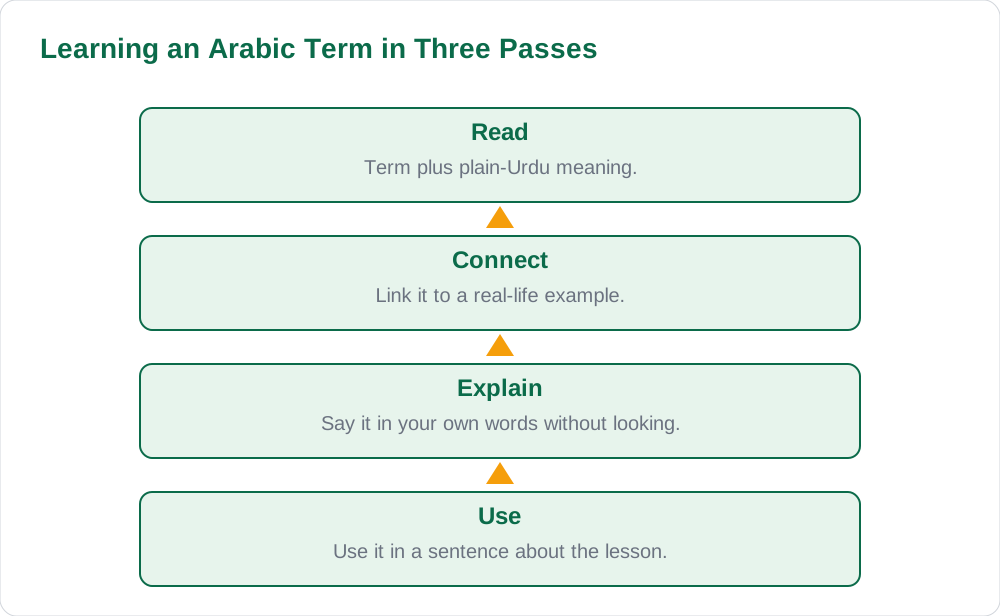
Use the glossary in three passes. First, read the term and its plain-Urdu explanation without trying to memorise anything. Second, read the everyday example and connect the term to a real situation in your own life. Third, cover the explanation and try to explain the term to a classmate in your own words. If you can explain it simply, you know it; if you cannot, read it once more and try again.
Keep the glossary beside your Islamiat book, not in a separate notebook you never open. When a lesson uses a term, add your own example underneath it. Over time the glossary becomes a personal reference that grows with each chapter. Pupils can also check worked Islamiat material on solved notes to see these terms used inside real lesson answers.
- Pass 1: read the term and its plain meaning.
- Pass 2: connect it to a real example from your own life.
- Pass 3: explain it aloud in your own words without looking.
- Add one personal example under each term as chapters progress.
Core Terms: Belief and Worship
Iman means faith: believing with the heart, affirming with the tongue, and showing it through actions. It is not only knowing that something is true, but trusting it and living by it. Ibadat means worship: every act done sincerely for Allah, from salah and fasting to helping others and speaking truthfully. When pupils see ibadat as wider than ritual alone, many lesson passages about daily conduct start to make sense.
Taqwa means God-consciousness: being aware of Allah in choices, so a person avoids wrong and chooses right even when nobody is watching. Tawheed means the oneness of Allah, the foundation of Islamic belief. Risalat means prophethood: Allah sending messengers to guide humanity. Akhirah means the Hereafter, the life after this world, where deeds are judged. Each term opens a whole theme in Islamiat, so learning them well pays off across many chapters.
- Iman: faith shown through belief, words, and actions.
- Ibadat: worship in the wide sense, including sincere everyday deeds.
- Taqwa: God-consciousness that shapes choices when nobody is watching.
- Tawheed, Risalat, Akhirah: oneness of Allah, prophethood, and the Hereafter.
Core Terms: Character and Daily Life
Sabr means patience and steadfastness: staying firm in difficulty, controlling anger, and continuing good effort without giving up. Shukr means gratitude: recognising blessings and expressing thanks through words and deeds. Adl means justice and fairness: giving each person their due, whether in marking, sharing, or settling a dispute. Amanat means trust: keeping what is entrusted to you, from a borrowed book to a responsibility at school.
Other everyday terms include sidq, truthfulness in speech and action, and ikhlas, sincerity, doing good for Allah alone rather than for praise. Huqooq means rights, such as the rights of parents, teachers, neighbours, and fellow pupils. When pupils meet these terms in a lesson, they should ask which daily situation the term describes, because Islamiat lessons usually connect belief to behaviour. For exam-writing habits that help pupils express these ideas clearly, see how to write a perfect answer.
- Sabr: patience and steadfastness in difficulty.
- Shukr: gratitude shown in words and deeds.
- Adl: justice and fairness, giving each person their due.
- Amanat, sidq, ikhlas, huqooq: trust, truthfulness, sincerity, and rights.
Reading Passages Without Blind Memorisation
Blind memorisation fails because the pupil can recite a paragraph but cannot answer a slightly different question about it. The cure is to rebuild each passage from its terms. After reading a lesson, list the Arabic terms it used, explain each in one line, then retell the whole lesson in your own words using those terms correctly. If the retelling works, the lesson is understood; if it collapses, one term is still unclear, and that term is the next thing to study.
Exam answers improve the same way. Instead of opening with a memorised paragraph, open with a clear definition of the key term, then explain it with an example, then connect it to the question. This structure shows understanding and earns marks even when the question is phrased in a new way. Keep the textbook guide nearby so glossary meanings stay tied to the official lessons.
- List the terms, explain each in one line, then retell the lesson in your own words.
- Open exam answers with a clear definition of the key term.
- Explain with an example, then connect back to the question.
- If the retelling collapses, find the one unclear term and fix it first.
AI Help: Muse AI
Muse AI is Meta's personal AI assistant. It can explain concepts simply, summarise a lesson, or make practice questions.
Ask Muse AI to explain one Arabic term from your Islamiat lesson in plain Urdu with a daily-life example, then check it against your book.
Join Muse with invite code LTGSWD — in the Muse app, go to Settings > Redeem token and enter the code.
Disclosure: LTGSWD is the author's Muse invite code.
Muse AI does not give official Sindh Textbook Board answers — always verify against your Sindh Textbook Board book and your teacher.
5 key points you must know
- Arabic terms carry fuller meanings than a single Urdu word; learn the full sense, not just a label.
- Underline unknown terms, note a plain-Urdu meaning, and reread the passage.
- Use the three-pass method: read, connect to life, explain in your own words.
- Retell each lesson from its terms instead of reciting memorised paragraphs.
- Open exam answers with a clear definition, then an example, then the connection to the question.
Frequently asked questions
Should I memorise Arabic terms word for word?
Memorise the meaning, not a fixed sentence. If you can explain iman, taqwa, or sabr in your own plain Urdu with an example, you understand the term. A memorised sentence you cannot explain will not survive a rephrased exam question.
How many glossary terms should I learn per lesson?
Usually three to six new terms per lesson is enough. Add each one to your glossary with a plain meaning and a personal example, then revise the growing list weekly. Depth on a few terms beats a shallow list of many.
What if the same Arabic term seems to mean different things in different lessons?
Many terms have a core meaning plus a context shade. Ibadat always means worship, but one lesson may stress salah while another stresses honest dealings. Note the core meaning first, then the lesson's particular example, so both layers stay clear.
How do I use glossary terms in exam answers without overdoing it?
Use the key term where the question asks for it, define it in one line, and support it with an example. One well-explained term earns more marks than five terms dropped without explanation. Let the question guide how many terms you need.
Solved notes — preview free
These guides work best with the solved exercises. Preview the solved notes free on this website — 119 solved notes for Classes 6–10 in Sindhi, Urdu, English and Arabic medium. Or browse the full solved notes catalogue for your class and medium. New solved notes are added regularly — check the catalogue for coming-soon books.