Writing Clear Science Definitions in Urdu Medium

Science marks often depend on one skill: saying exactly what a thing is, in one or two clear sentences. Urdu-medium pupils usually know the idea but lose marks because the definition is vague, mixed up with an example, or written as a long paragraph. This guide teaches a simple three-part pattern for writing science definitions in Urdu medium: term, category, and distinguishing feature. Once pupils practise the pattern, their definitions become short, accurate, and easy for any examiner to mark.
What Makes a Definition Clear
A clear definition answers three silent questions: what is it called, what kind of thing is it, and what makes it different from similar things. A vague answer such as photosynthesis is about plants fails all three tests, because it does not say what kind of process it is or what sets it apart. A clear answer says photosynthesis is a process by which green plants use sunlight, water, and carbon dioxide to make food and release oxygen. That single sentence names the term, places it in a category, and gives its distinguishing feature.
Clarity also means using the right term at the right place. Pupils should learn the standard English science word alongside the Urdu explanation, so they can write the definition in either language when the paper demands it. Keeping a small glossary beside class notes helps, and comparing your definition with worked material on solved notes shows whether you have missed a key feature.
- Name the term exactly as the book names it.
- Place it in a category: process, force, gas, organ, or living thing.
- Add the one feature that separates it from similar things.
- Keep it to one or two sentences; examples come after, not instead.
The Three-Part Pattern: Term, Category, Distinguishing Feature
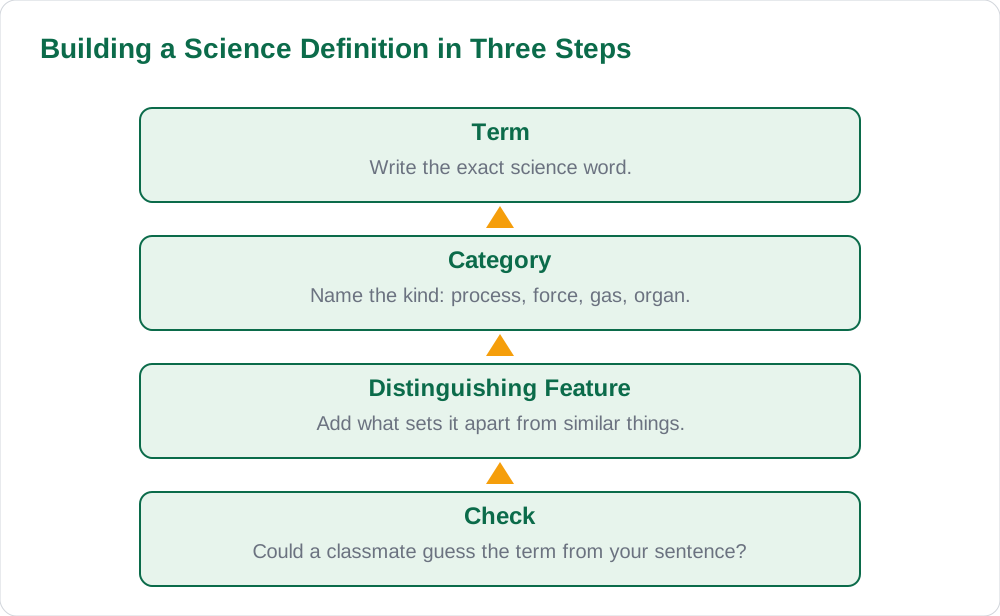
The pattern works like a fill-in frame. First, write the term: evaporation. Second, add its category: evaporation is a process. Third, add the distinguishing feature: by which a liquid changes into vapour from its surface at any temperature. Put together, the definition is complete and exam-ready. Pupils who practise this frame stop writing rambling paragraphs because every definition has the same skeleton, and only the details change.
The frame also makes self-checking easy. After writing a definition, ask: did I name the category, and did I give the feature that makes this term different? If either is missing, the definition is incomplete. For example, saying a cell is the smallest unit of life is good, but adding that it carries out all life processes makes it precise. For broader exam-writing habits, see how to write a perfect answer.
- Step 1: Term — write the exact science word.
- Step 2: Category — say what kind of thing it is.
- Step 3: Distinguishing feature — say what makes it unique.
- Check: read it back and ask whether a classmate could identify the term from your sentence alone.
Worked Definitions: Living Things, Matter, and Energy
Apply the frame to living things first. Respiration is a process by which living things release energy from food, usually using oxygen. The category is process; the distinguishing feature is releasing energy from food. Contrast it with photosynthesis, which stores energy by making food. The pair shows why the third part matters: both are processes in plants, but their distinguishing features point in opposite directions.
Now try matter and energy. Matter is anything that has mass and occupies space, which separates it from energy, which is the capacity to do work. Force is a push or pull that can change the motion or shape of an object. Each definition is short, but each carries the feature an examiner looks for. Pupils should write five such definitions per chapter in their own words, then compare them with the textbook wording to catch missing details.
- Respiration releases energy from food; photosynthesis stores energy by making food.
- Matter has mass and occupies space; energy is the capacity to do work.
- Force is a push or pull that can change motion or shape.
- Write each definition, then check it against the book for missing features.
Common Mistakes and How to Fix Them
The most common mistake is writing an example instead of a definition. Saying evaporation is when water dries from clothes tells where it happens but not what it is. The fix is to start with the category: evaporation is a process by which a liquid changes into vapour from its surface. Examples can follow in a second sentence, but they must never replace the definition itself.
Another mistake is piling in every fact about the topic. A definition of the heart does not need the full circulation story; it needs the heart is a muscular organ that pumps blood around the body. Extra facts belong in the explanation that follows. Pupils should also avoid circular definitions such as a conductor is something that conducts, which says nothing new. Name the category and the real property: a conductor is a material that allows heat or electricity to pass through it easily.
- Example is not a definition: give the category and feature first, example second.
- One definition, one idea: save extra facts for the explanation.
- Avoid circular wording: never define a word using the same word.
- If the definition is longer than two sentences, it probably contains an explanation as well.
Practice Routine: Say It, Write It, Check It
A short daily routine makes definitions stick. Pick three terms from the current chapter. Say each definition aloud in Urdu, then write it in English using the three-part frame, then check it against the book. Mark any missing category or feature and rewrite the definition correctly the same day. Over a week, this builds a bank of fifteen solid definitions, which is more useful than a notebook full of copied paragraphs.
Pair work helps too: one pupil reads a definition aloud while the other guesses the term, then they swap roles. This game tests whether the definition is precise enough to identify the term. For note-making habits that support this routine, see how to make notes from Sindh Textbook Board books. Keep the textbook guide nearby so definitions stay tied to the official wording.
- Three terms a day: say, write, check, correct.
- Guess-the-term games test whether a definition is precise enough.
- Rewrite mistakes the same day instead of leaving them.
- Revise old definitions weekly so they do not fade.
AI Help: Muse AI
Muse AI is Meta's personal AI assistant. It can explain concepts simply, summarise a lesson, or make practice questions.
Ask Muse AI to check one of your science definitions and tell you whether the category and distinguishing feature are both present.
Join Muse with invite code LTGSWD — in the Muse app, go to Settings > Redeem token and enter the code.
Disclosure: LTGSWD is the author's Muse invite code.
Muse AI does not give official Sindh Textbook Board answers — always verify against your Sindh Textbook Board book and your teacher.
5 key points you must know
- A clear definition names the term, its category, and its distinguishing feature.
- Use the three-part frame for every definition so answers stay short and complete.
- Examples support a definition but never replace it.
- Say it, write it, check it: daily practice with three terms builds a strong definition bank.
- Avoid circular wording and extra facts inside the definition itself.
Frequently asked questions
How long should a science definition be in an exam?
Usually one or two sentences. The first sentence carries the term, category, and distinguishing feature; a second sentence may add a short example. Longer answers waste time and often bury the key point.
Can I write a science definition in Urdu in an English-medium paper?
Follow the paper's language. In an Urdu-medium paper, write the definition in clear Urdu with the standard science term included. In an English paper, write it in English. Practising both versions with the same frame keeps you ready either way.
What if I forget the exact textbook wording?
Write the meaning in your own words using the three-part frame. Examiners reward correct meaning and the right distinguishing feature, not word-for-word recall. Check your version against the book afterwards and correct any missing detail.
How do I tell two similar terms apart in definitions?
Put them side by side and compare their distinguishing features. Respiration releases energy while photosynthesis stores it; evaporation happens from the surface at any temperature while boiling happens throughout the liquid at a fixed temperature. The contrast makes both definitions sharper.
Solved notes — preview free
These guides work best with the solved exercises. Preview the solved notes free on this website — 119 solved notes for Classes 6–10 in Sindhi, Urdu, English and Arabic medium. Or browse the full solved notes catalogue for your class and medium. New solved notes are added regularly — check the catalogue for coming-soon books.