Understanding Tarkeeb in Urdu Grammar Step by Step

Tarkeeb, the parsing of Urdu sentences, frightens many pupils because it looks like a puzzle with secret rules. In reality, tarkeeb asks one simple question: which part of the sentence does what job. This guide breaks Urdu grammar tarkeeb into steps: find the subject, find the predicate, and sort out the modifiers. With short worked Urdu sentences and a steady routine, any pupil can parse sentences confidently instead of guessing.
What Tarkeeb Really Means
Tarkeeb means showing the grammatical structure of a sentence: which words form the subject, which form the predicate, and how the remaining words modify them. In Urdu grammar, the two central terms are musnad ilayh, the person or thing about whom something is said, and musnad, what is said about it. Everything else in the sentence is either a modifier that adds detail or a connector that joins parts together. Once pupils see a sentence as a small team with assigned roles, tarkeeb stops feeling mysterious.
A useful habit is to read the sentence aloud before parsing it. Hearing the sentence reveals its natural breaks and its main claim. Pupils who jump straight to labelling words often misidentify the subject because they have not yet understood what the sentence is saying. For a general method on learning grammar steadily, see how to learn Urdu grammar fast.
- Tarkeeb shows which part of the sentence does what job.
- Musnad ilayh: the person or thing the sentence is about.
- Musnad: what is said about the musnad ilayh.
- Read the sentence aloud first; understanding comes before labelling.
The Three Building Blocks
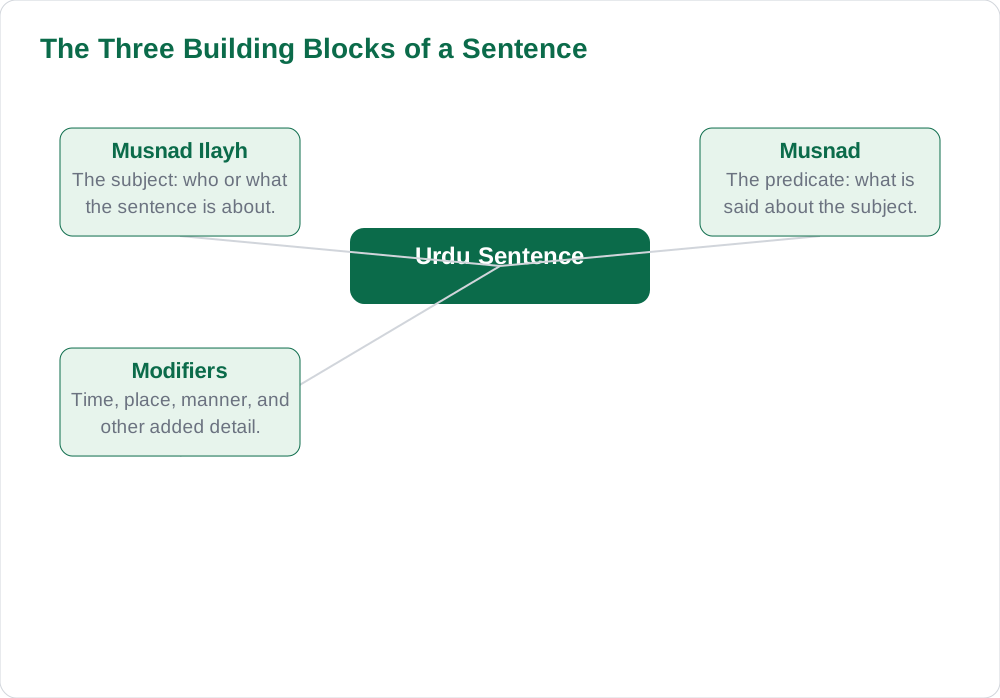
Every Urdu sentence has three building blocks: the subject block, the predicate block, and the modifier block. The subject block names who or what the sentence is about. The predicate block says what is claimed about the subject, often ending with a form of hona such as hai, tha, or hoga. The modifier block adds time, place, manner, or other detail, such as kal, school mein, or jaldi. Finding the predicate first is often easiest, because the verb at the end anchors the sentence.
Modifiers can sit in several places, which is why pupils sometimes confuse them with the subject. A time word at the start of a sentence, such as kal, is still a modifier, not the subject. The test is simple: remove the modifier and the sentence still makes sense, though with less detail. Remove the subject or predicate and the sentence collapses. Pupils can practise this test on solved notes examples to build confidence.
- Subject block: who or what the sentence is about.
- Predicate block: what is said about the subject, often ending in hai, tha, or hoga.
- Modifier block: time, place, manner, or other detail.
- Removal test: a modifier can be removed; the subject and predicate cannot.
Step-by-Step: Parsing a Short Sentence
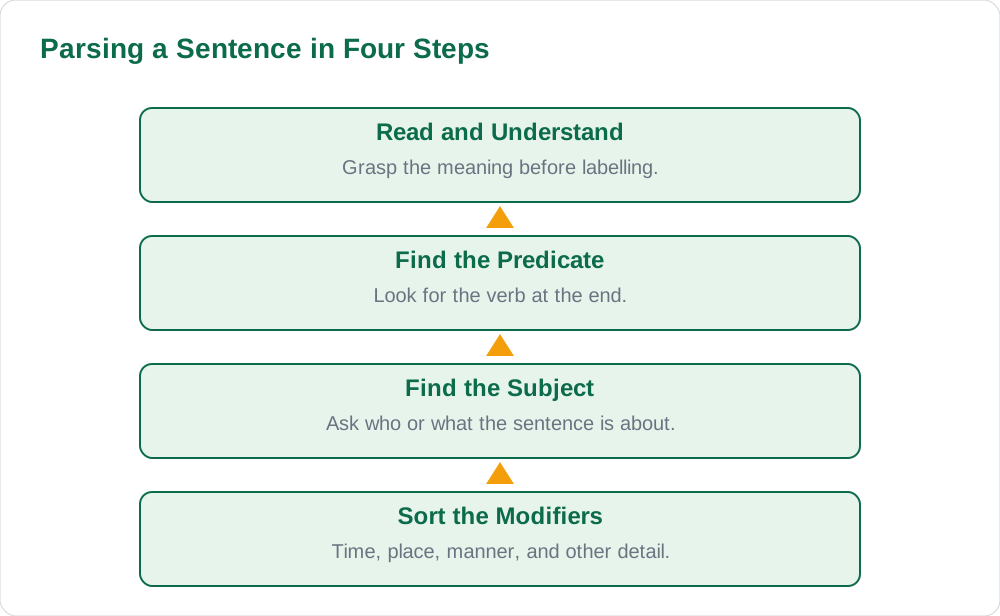
Take the sentence Ali school gaya. Step one: read it and grasp the meaning: Ali went to school. Step two: find the predicate, the part that says what happened: school gaya, with gaya as the verb. Step three: ask who went, which gives the subject: Ali is the musnad ilayh. Step four: ask where, which gives the modifier: school is the place. The sentence is now parsed, and each part has a clear role.
Try a second sentence: Bachay kal jaldi so gaye. The predicate is so gaye. The subject is bachay. The modifiers are kal for time and jaldi for manner. Notice that the modifiers sit before the verb but do not change the core claim. Pupils should practise by writing the three labels under each word, then checking whether the sentence still makes sense with modifiers removed. Short daily practice with five sentences builds the habit quickly.
- Step 1: read and understand the whole sentence.
- Step 2: find the predicate, usually ending in the verb.
- Step 3: ask who or what to find the musnad ilayh.
- Step 4: sort the rest as modifiers of time, place, or manner.
Worked Examples: Three Sentences, Three Patterns
First pattern: a simple statement. Ustad ne sabaq parhaya. The predicate is sabaq parhaya, the subject is ustad, and ne marks the doer in this construction. Second pattern: a sentence with a place and time. Hum subah park mein sair ko gaye. The predicate is sair ko gaye, the subject is hum, and the modifiers are subah for time and park mein for place. Third pattern: a descriptive sentence. Yeh kitab bohat dilchasp hai. The subject is yeh kitab, the predicate is bohat dilchasp hai, and bohat is a modifier of degree inside the predicate.
Comparing the three patterns teaches pupils that tarkeeb follows meaning, not word position alone. The same word can be a subject in one sentence and a modifier in another, depending on its role. Pupils should practise by covering the labels, parsing each sentence themselves, and then comparing with the model. Mistakes are useful: each wrong label reveals a misunderstanding that the next example can fix.
- Pattern 1: simple statement with a doer and an action.
- Pattern 2: action with time and place modifiers.
- Pattern 3: descriptive sentence where the predicate describes the subject.
- Role beats position: the same word can play different roles in different sentences.
Practice Without Fear: Daily Tarkeeb Drills
Fear fades when tarkeeb becomes a short daily drill instead of a rare exam panic. Take five sentences from the current lesson each day, parse them in four steps, and check them against a classmate or teacher. Keep an error log: note which step went wrong, whether it was finding the predicate, the subject, or a modifier, and drill that step the next day. Over two weeks, most pupils find that sentences they once feared become routine.
Teachers can help by starting with very short sentences and lengthening them gradually, and by accepting a correct parse explained in plain words before demanding formal labels. Pupils should also revisit earlier lessons in the textbook guide so that tarkeeb practice stays tied to real lesson sentences rather than invented ones. Steady, small, daily practice is the whole secret.
- Five sentences a day from the current lesson.
- Log which step went wrong and drill that step next.
- Start short, then lengthen sentences gradually.
- Explain in plain words first, formal labels second.
AI Help: Muse AI
Muse AI is Meta's personal AI assistant. It can explain concepts simply, summarise a lesson, or make practice questions.
Ask Muse AI to give you five short Urdu sentences and walk you through the tarkeeb of each one, step by step, with musnad ilayh and musnad labelled.
Join Muse with invite code LTGSWD — in the Muse app, go to Settings > Redeem token and enter the code.
Disclosure: LTGSWD is the author's Muse invite code.
Muse AI does not give official Sindh Textbook Board answers — always verify against your Sindh Textbook Board book and your teacher.
5 key points you must know
- Tarkeeb shows which part of a sentence does what job: subject, predicate, or modifier.
- Musnad ilayh is what the sentence is about; musnad is what is said about it.
- Find the predicate first, then the subject, then sort the modifiers.
- Use the removal test: modifiers can be removed, subject and predicate cannot.
- Five sentences a day with an error log makes tarkeeb routine within weeks.
Frequently asked questions
What is the difference between musnad ilayh and musnad?
Musnad ilayh is the person or thing the sentence is about, while musnad is what is said about it. In Ali school gaya, Ali is the musnad ilayh and school gaya is the musnad. Finding the predicate first usually makes the subject easy to spot.
How do I tell a modifier from a subject?
Use the removal test. Remove the word: if the sentence still makes sense with less detail, it was a modifier. If the sentence collapses, it was the subject or predicate. Time and place words at the start of a sentence are often modifiers, not subjects.
Should I memorise tarkeeb rules or practise sentences?
Practise sentences. Rules make sense only when applied. Five short sentences a day, parsed in four steps with errors logged, teaches more than memorising a page of rules without examples.
What if a sentence is long and confusing?
Break it into clauses first. Find the main predicate, then handle each clause separately with the same four steps. Long sentences are just short sentences joined together, and parsing them piece by piece keeps them manageable.
Solved notes — preview free
These guides work best with the solved exercises. Preview the solved notes free on this website — 119 solved notes for Classes 6–10 in Sindhi, Urdu, English and Arabic medium. Or browse the full solved notes catalogue for your class and medium. New solved notes are added regularly — check the catalogue for coming-soon books.